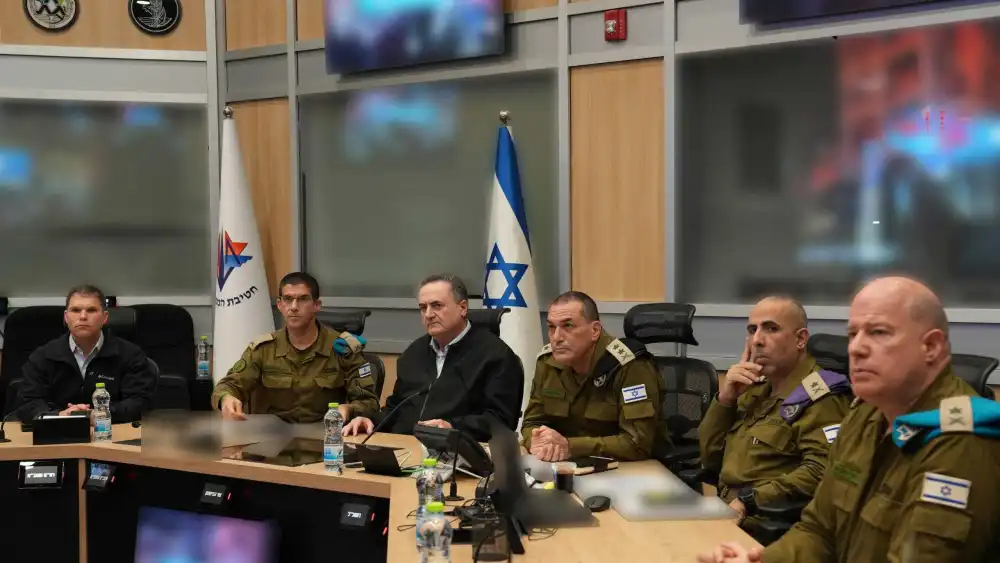

On day 27 of “Operation Roaring Lion,” the Israel Defense Forces has made major achievements toward many of the objectives it set at the start of the war, particularly in striking core Iranian regime targets, a military spokesperson told JNS on Thursday.
During a briefing with journalists, IDF International Spokesperson Lt. Col. Nadav Shoshani said, “We do feel like we’ve had great achievements with a lot of the things we prioritized as top targets. But there’s always more, and we have more.”
Shoshani confirmed that on Wednesday, the IDF struck the Iranian regime’s underwater research center in Isfahan, significantly limiting its ability to manufacture new and advanced submarines and upgrade its existing fleet.
The entire operation follows a structured strategic framework, he said, focusing on targeting military industries, weapons and missile production facilities, and surface-to-air missile systems.
The Israeli Air Force operates continuously within Iranian airspace, systematically striking thousands of regime targets, Shoshani said.
“Dozens of Israeli Air Force craft every day go back and forth acting on IDF intelligence, [amid] complete waves after waves of strikes targeting Iranian terror regime infrastructure,” he added.
Key Iranian regime command centers in Tehran have been hit in recent days, as well as Iranian intelligence organizations, Shoshani said. Targets also include weapons storage facilities and ballistic missile storage and launch sites.
Data tracked by the IDF continues to show joint operational success by Israeli and American forces in heavily suppressing the volume of Iranian ballistic missile fire, Shoshani said. “Since the third, fourth day of the operation, the numbers have been high single-digit [to] low teens with an average of approximately 10 [Iranian missiles],” Shoshani stated. “This is not something random and it is part of relentless efforts in Iranian skies by the IDF and the U.S. Armed Forces.”
US planning for Strait of Hormuz security
Also on Thursday, a military official provided further background on the elimination of senior leadership of the IRGC Navy, including its commander, Alireza Tangsiri, and the IRGC naval intelligence chief, in strikes in the port city of Bandar Abbas.
On Wednesday, during a webinar hosted by the Jewish Institute for National Security of America (JINSA), a Washington-based defense policy think tank, United States Marine Corps Gen. Frank McKenzie (ret.), the former commander of CENTCOM and a JINSA distinguished fellow, said, “This is not something that we’re drawing up on the back of the envelope day to day. These are things that have been studied for many years, were fine-tuned for many years, simulated war-gamed every way that you can. We’ve examined this problem. I have some responsibility for this plan, as does my predecessor, as does my successor. But we’ve been working on this for a long time.”
“I think we’re accomplishing the objectives that we set out. CENTCOM is executing a long, prepared campaign plan,” McKenzie said. The suppression of the ballistic threat remains paramount, he added.
Referring to the Iranian ambition of firing hundreds of missiles per volley at U.S. bases, Gulf allies and Israel, he said, “Largely we have denied them the ability to do that.”
“We’ve been able to take out Iranian air defenses to the degree that I would argue we have effectively air supremacy over most of Iran. And what that has given us the opportunity to do is go hunt for ballistic missiles.”
This air supremacy means that “now you can go north with F-15, F-16, F-18, A-10 to some degree, and of course the B-1,” McKenzie said. The United States also surged ground and maritime forces to the region. The 82nd Airborne and the Marine Expeditionary Unit give the theater commander options to execute amphibious raids against islands, shore targets and oil platforms, the former CENTCOM commander stated.
Addressing the threat to the Strait of Hormuz, McKenzie noted that the U.S. is focusing on steps to clear the strait, including removing Iranian submarines, fast attack craft and anti-ship cruise missiles.
Noting that there are actually two Iranian navies (the standard Iranian Navy and the IRGC naval branch), McKenzie said, “I think both those navies in terms of large combatants are largely gone. We struck them all. So what we’re, I think what we’re doing now is we’re focusing on preparatory steps in order to clear the Strait of Hormuz.”
This would involve neutralizing Iran’s remaining naval threats that could disrupt shipping, including submarines, fast attack craft and small swarm boats operating along the Iranian coastline, as well as coastal anti-ship missile systems positioned to target vessels transiting the Strait of Hormuz, he said.
“You go after those with slow-moving aircraft, perhaps A-10s, perhaps attack helicopters, perhaps attack them from across the gulf. A variety of weapons systems that we can employ to get after those targets. Also, short-range Iranian anti-ship cruise missiles that have been built, targeted and dug in on the north, on the northern edge of the littoral.”
The former CENTCOM commander stressed that “you don’t have to clear the whole Strait of Hormuz. You’ve got to clear a route that you’re going to bring vessels through. So you’re not clearing every bit of water up there.”
JINSA’s senior vice president for Israeli affairs, Maj. Gen. (res.) Yaacov Ayish, former head of the IDF General Staff Operations Branch, added, “When I’m watching carefully what have happened to the nuclear program of the Iranians so far, I’m talking about [‘Operation] Rising Lion’ in June and now, and I’m thinking about the achievements in that area, together with the ballistic missiles capabilities, that is the stockpiles the launchers and the production capabilities—it’s pretty amazing.”
He added, “We wanted to achieve a situation that will allow a regime change in the future in Iran. And I think we are on that track.”
Home Front Command refining alerts
Domestically, meanwhile, the IDF Home Front Command is continuously refining its alert systems to manage the ongoing incoming fire. Detection systems operated by the Israeli Air Force transfer data to the Home Front Command to trigger warnings, a military source told JNS on Thursday.
The system calculates the threat type, distance and trajectory to distribute alerts through sirens, mobile applications, cell broadcasts, radio and internet platforms. The command implemented changes to alert polygons (Israel is divided into some 1,600 of these) to increase precision. To serve populations without smartphones, the command upgraded silent wave radio frequencies to broadcast both preliminary warnings and the all-clear signals.
“Iran is, at the end of the day, a huge country. If the threat comes more from south Iran, then we’ll have more time to send the early alert. The closer the threat comes from the less time we have to transfer the early alert,” the source explained. “We give this early alert whenever we can.”