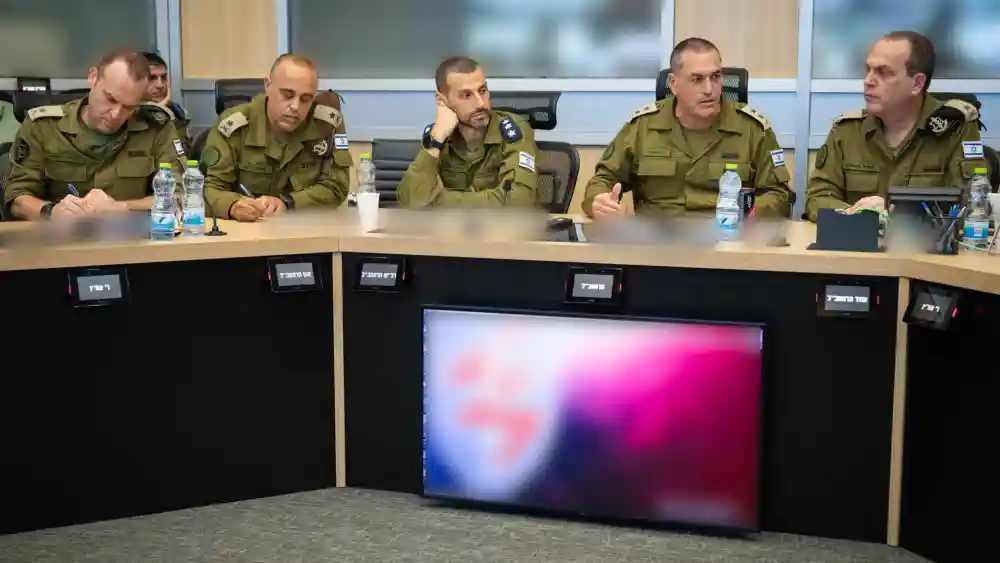

The Israel Defense Forces high command, led by Chief of Staff Lt. Gen. Eyal Zamir, held a major strategic and operational assessment in recent days, for the first time in nearly two years, launching a process to reshape the military’s core concepts and prepare for a new annual work plan.
The assessment included the presentation of a new doctrine of “defense through offense,” the designation of 2026 as a “year of readiness,” and significant structural changes, including the elevation of the IDF Depth Corps to a strategic command focused on threats in the “second circle” (countries that are located two borders away from Israel.
The high-level meeting brought together the IDF’s General Staff and the Operational Staff Forum at the Glilot base in north Tel Aviv on July 21, a major intelligence and command hub. An Israeli military official described the significance of the event.
“This situational assessment marks the launch of a process that hasn’t taken place in nearly two years. Its purpose is to streamline knowledge and perspectives in preparation for formulating the IDF’s annual work plan,” the official stated. “It is important to hold it in a broad forum to hear a variety of opinions and perspectives, especially since many of the participants have not met in such a forum in a long time.”
“Due to the ongoing fighting in Gaza, relevant commanders from the Southern Command participated in the discussion remotely,” he added.
The official summarized the new core tenets as: “Defense through offense. No ignoring of intentions or capabilities. Each arena is different—in required achievements, method and desired end-state. This also affects the duration of the campaign in each sector.”
This marks a significant departure from Israel’s traditional defense posture, which often prioritized deterrence and containment, aiming to achieve long periods of “quiet” to enable economic development and respite. Such concepts helped fuel a systematic blindness in the military before the mass murder attacks by Hamas on southern Israel on Oct. 7, 2023, which led to the threat and preparations posed by Hamas being repeatedly missed.
The new doctrine codifies a proactive strategy aimed at disrupting and neutralizing enemy capabilities on all fronts before they can pose an imminent threat to Israel, a lesson learned from the failures leading up to the Oct. 7 attacks.
The intelligence assessment presented at the meeting also highlighted the profound shifts in the regional landscape that have occurred following long months of warfare.
The official summarized the IDF’s Intelligence Directorate’s view, stating that the Middle East is a “system that has gone out of balance—actors will want to fill in the vacuum.” The assessment noted the emergence of “new enemies in every arena, both at the personal and organizational levels.” It concluded that maintaining Israel’s qualitative intelligence advantage in this new reality “requires more resources, greater creativity, and new tools.”
In his remarks at the assessment, Zamir emphasized the need for intellectual rigor and humility in this new era.
The official said Israel’s “new enemies” have appeared in all arenas. He relayed the chief of staff’s directive that “commanders must remain humble and skeptical regarding our assessments, and that every factor that is discussed should be taken into account when making decisions.”
To help implement this new strategy, Zamir announced two significant structural transformations within the IDF. First, the IDF Depth Corps, which was responsible for operations far from Israel’s borders, will be transformed into a “General Staff-level strategic command, focusing on the second circle—with the mission of management, strategy, and command over operations and strategic missions.”
The Depth Corps was originally established in 2011, in the wake of the Second Lebanon War, to coordinate the IDF’s long-range operations against enemies not sharing a direct border with Israel, primarily Iran.
Elevating it to a strategic command gives it greater authority, resources, and a direct line to the General Staff, streamlining the command of complex, long-range campaigns like the recent Operation “Rising Lion.”
The second change is the establishment of a new training department under the IDF’s military colleges. This new body will be responsible for “advancing lessons learned from the war and for the overall development of military learning processes.”
This move is designed to ensure that the tactical and strategic lessons from the current multi-front war are systematically studied and integrated into the training of the next generation of commanders, preventing a repeat of past failures to adapt.
Looking ahead, the IDF has designated 2026 as a pivotal year for implementing its new approach. The official said the year “will be designated as a year of readiness, shaping, maximizing achievements, returning to full competence and foundational skills, and seizing operational opportunities.”
This appears to indicate a plan to move from the current phase of high-intensity warfare to a period of institutional learning, rebuilding, and preparing for future campaigns based on the new doctrines. The official stated that this was the first in a series of planned assessments, with future meetings set to focus on manpower, force build-up, and military norms and values.
The chief of staff’s call for commanders to remain “humble and skeptical” is a significant organizational cultural message for the IDF. It reflects a deep concern at the highest levels of the military about the potential for institutional arrogance or “groupthink.”
This emphasis on skepticism is a direct lesson from the intelligence failures that preceded the Oct. 7 attacks, where a prevailing conception of Hamas being deterred proved catastrophic. By forcing senior officers to challenge their own assessments and consider all factors, Zamir is attempting to build a more intellectually rigorous and adaptable command structure in Israel’s military.