
How would you translate Joe Shmo into Yiddish? Yossel the Shlemiel? Not sure? Well, to be perfectly honest, neither am I.
At any rate, your average Joe (or “average Yossel”) usually has a somewhat limited perspective on matters of faith, theology and spirituality. I mean, he’s not exactly a philosopher, right?
So what does our average Yossel think about the rather substantial number of commandments Judaism expects us to fulfil?
Frankly, not much.
“Rabbi, why on earth did God give us so many obligations? Why do we need so many commandments? Non-Jews have a grand total of seven, and we Jews need 613?! Gimme a break!”
I suppose that is a fair and reasonable question. I just don’t like Joe’s tone, which could use some respect and humility. Still, I get it.
From dear Joe’s perspective, a mitzvah is just a commandment, an obligation, a duty and an unwanted burden. So, who needs so many obligations? It’s a yoke around his neck. But what if there were a different perspective entirely? Then I believe that even he might look at things very differently.
What if a mitzvah were not a burden but an opportunity? What if I told you that every mitzvah is nothing less than a bridge-building exercise that can transport mere mortals to a heavenly space? That while God seems so far away, distant and unreachable, a mitzvah actually closes the gap and is a bonding agent, bringing us closer to God.
I wonder if all the Joes out there knew that the word mitzvah doesn’t only mean “commandment” but also “connection.” They might well have a totally different approach to all these so-called burdensome and tedious “obligations.”
A mitzvah is not only a commandment or just another responsibility. It’s not a load or a liability, God forbid. Etymologically, the word mitzvah—from the Hebrew tzavta—means“connection” or “bonding.”A mitzvahis a means of connecting and bonding the Jew to God. It binds the commanded to the commander.
All thinking human beings who ever reflect or ponder on the purpose of life, in particular, and the purpose of the Jewish way of life, would surely be inspired to learn that a mitzvah is not just another job on God’s “to do” list. Instead, it is the chance to connect to God.
If we think about it, how can a mere mortal of flesh and blood possibly connect to the immortal and infinite One Above? The gap is so vast and seemingly unbridgeable. It would seem impossible.
And so, God gave us mitzvahs.
And every one of them has a specific purpose to refine our character in one way or another. Kashrut trains us to be disciplined. Shabbat gives us precious family time, when we can become humanized again after a week of pressures from everyone and everything (technology included). The mourning laws bring us comfort and a level of bereavement therapy. And so on and so forth.
But every mitzvah also has a common denominator: It is a bonding agent. Yes, a mitzvah is an opportunity to reach the infinite! How? Because, as far as we may be from each other, by performing a good deed asked of us by our Creator, a connection between us has now been established.
Rabbi Yosef Yitzchak Schneersohn (1880-1950) once gave an illustration to demonstrate this point. Please forgive me for taking some editorial license here.
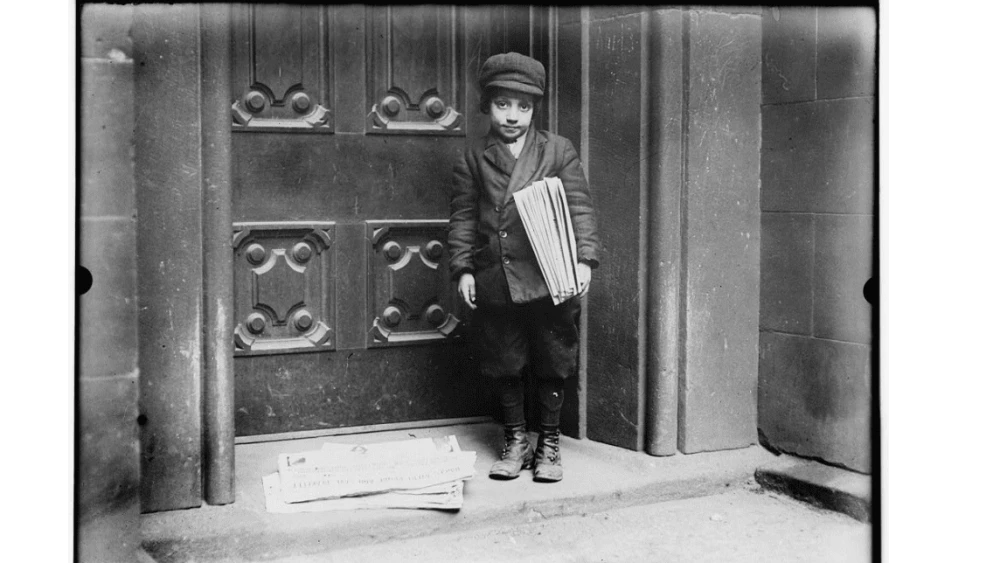
What relationship is there between the smartest person on earth and the simplest? Let’s use, for example, a great professor, perhaps Albert Einstein, and the newspaper delivery boy on the streetcorner. They appear to have nothing in common. What connection or relationship can they possibly have? Could they engage in a conversation? What would they discuss?
Yet Einstein wants to buy a newspaper, and this simple boy has one. Suddenly, a relationship is born. This lad, who has never even heard of the Theory of Relativity, can meet a need of this brilliant individual. And a connection has been made.
How much more so is the gap between a finite human being (even an Einstein) and the Infinite Supreme Being! It is infinitely wider than the gap between the professor and the newspaper boy.
But just as Einstein’s desire for a newspaper established a relationship between them, likewise, a mitzvah God asks us to perform establishes a connection between us, too. We are fulfilling not only His command but His desire, His wishes for us. The gap between mortal and immortal, finite and infinite, is suddenly bridged. We are actually bonding with God!
So Yossele, please don’t look at a mitzvah as just another job or burden. This is a golden opportunity to bond with God as no other on earth. You don’t have to escape to the mountain tops of the Himalayas to find spirituality; stay home and do a mitzvah. And you will become spiritual and more Godly.
This week’s Torah portion gets its title from the opening line, V’atah Tetzaveh, “And you, (Moses) shall command the Children of Israel to bring you pure olive oil to kindle the Menorah” in the sanctuary.
Moses, as the great spiritual leader of the Israelites, is not only commanding them but connecting them. Moses was the Divinely appointed agent to help link Jews with God. How? Via the mitzvahs that he taught them, including this one.
Our saintly leaders down the generations have always followed in Moses’s footsteps and guided the people of Israel. May we heed their calls, do the mitzvahs and get connected.