A groundbreaking Israeli-based initiative is opening an unprecedented window into one of Judaism’s greatest manuscript treasures: the Cairo Genizah. For the first time, researchers and the public can access automatic transcriptions of nearly 400,000 fragments—some 160 million words across Hebrew, Arabic, Judeo-Arabic and additional languages—making the entire collection searchable in seconds.
Housed for centuries in the Ben Ezra Synagogue in Fustat, Old Cairo, the Cairo Genizah contains more than 300,000 handwritten pieces preserved between the 9th and 19th centuries. Jewish law forbids discarding sacred texts that contain God’s name, leading communities to store worn-out manuscripts, prayer books, legal documents, business ledgers, marriage contracts, medical prescriptions and everyday writings in a genizah (repository).
What emerged was an unparalleled time capsule of Jewish life—and its interactions with Muslim and Christian neighbors—stretching across a millennium. But despite decades of digitization through the Friedberg Genizah Project, fewer than 10% of the fragments had readable transcriptions. Until now, the lack of searchable text posed one of the greatest barriers to Genizah research. That barrier has now collapsed.
A breakthrough in manuscript technology
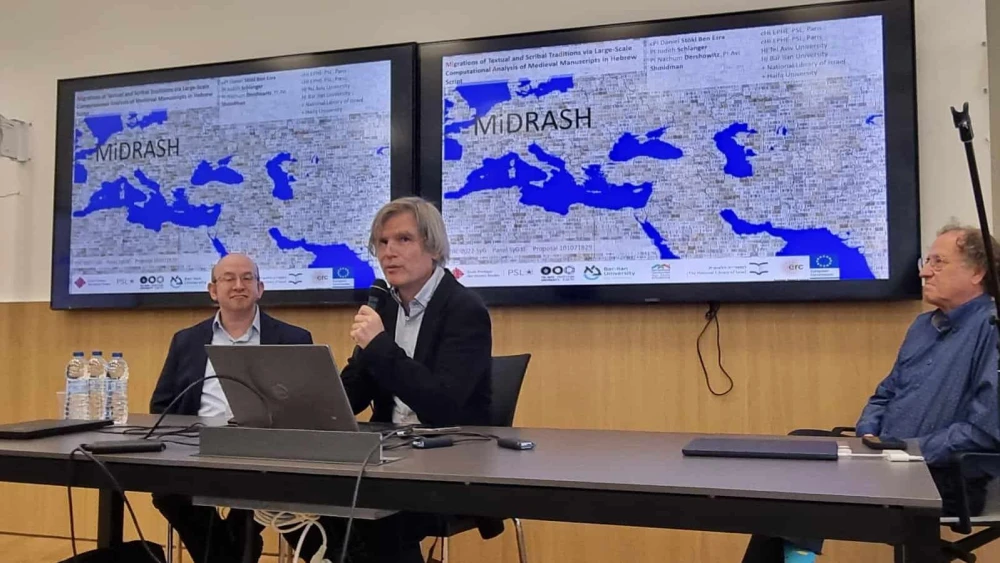
The transformation comes from MiDRASH, a major interdisciplinary initiative funded by a €10 million European Research Council Synergy Grant, the first such ERC grant ever awarded in Jewish studies for computational manuscript research.
Working in partnership with KTIV, the National Library of Israel’s digital manuscript database, MiDRASH has generated the first machine-readable transcriptions for the full Cairo Geniza corpus.
At a launch event on Monday at the National Library of Israel (NLI) in Jerusalem, project leaders presented their results to scholars, students and volunteers participating in a four-day “Transcribe-a-thon.”
“The Genizah is not just a Jewish treasure, it is a treasure for the entire world,” said Prof. Daniel Stökl Ben Ezra, one of the project’s principal investigators.
Calling MiDRASH “the largest humanities initiative the EU currently finances,” he emphasized that automatic transcription across so many languages and scripts “was once considered impossible.”
With the new system, he added, “You can now run a query and have the entire known Geniza immediately in front of you.”
MiDRASH’s transcription pipeline is powered by eScriptorium, an open-source platform for handwriting recognition. Over two years, the team developed advanced models capable of detecting page layout; deciphering semi-cursive and cursive Hebrew hands; reading Judeo-Arabic; and producing text accurate enough for full corpus search.
The principal investigators include Prof. Daniel Stökl Ben Ezra (École Pratique des Hautes Études; Dr. Avi Shmidman (Bar-Ilan University/ DICTA); Prof. Nachum Dershowitz (Tel Aviv University) and Prof. Judith Olszowy-Schlanger (Oxford University). Partners include the Elijah Lab at the University of Haifa and the Princeton Geniza Project.
During the launch, Shmidman demonstrated how a single liturgical phrase can now be traced across hundreds of fragments. “Suddenly, you can ask: Where else does this occur? When? In what context?” he told JNS. “For the first time, we can track phenomena across centuries and build much stronger cases. This completely changes the scholarship.”
Dr. Tsafra Siew, manager of Research Oriented Projects at the NLI, called the development “a game-changer for anyone working with medieval Hebrew manuscripts,” noting that automatic transcription will help scholars identify scribes, map textual transmission and uncover patterns previously impossible to detect.
Asked which material posed the greatest challenge, Dershowitz didn’t hesitate: “Cursive.”

Crowdsourcing the next stage
The launch opened four days of Transcribe-a-thon activity, running Nov. 24–27 online and in person. Volunteers review and correct machine-generated transcriptions, feeding improvements back into the system to strengthen future accuracy.
Once finalized, the corrected texts will be integrated into KTIV, providing global access to the Geniza’s breathtaking historical breadth—from the mundane to the mystical.
For scholars, students and anyone fascinated by the Jewish past, the medieval Genizah has never been more alive—or more searchable.