As athletes competed in the Winter Olympic Games, filmmakers gathered in a frosty Berlin for the 76th Berlin International Film Festival (Berlinale) from Feb. 12 to Feb. 22. As with nearly any global cultural gathering involving the Jewish state since the Hamas-led terrorist attacks in southern Israel on Oct. 7, 2023, the Israel-Gaza war quickly warmed the atmosphere.
Around the glitzy Potsdamer Platz cinemas, keffiyehs appeared as fashionable accessories while Hebrew-speaking Israeli film students moved between screenings.
Last year, the Berlinale faced accusations of tolerating antisemitic speech after filmmakers used acceptance speeches to defame Israel. The controversy prompted organizers to publish an FAQ page addressing antisemitism.
The page affirmed commitment to free expression while acknowledging Germany’s ban on the slogan “From the river to the sea, Palestine will be free,” considered a call for Israel’s destruction.
“Some language may have additional cultural significance in Germany because of the Holocaust and the country’s culture of remembrance and reconciliation,” it noted.
At the opening press conference on Feb. 12, German activist-journalist Tilo Jung raised the issue directly.
“The Berlinale as an institution has famously shown solidarity with people in Iran and Ukraine, but never with Palestine, even today,” he said, rebuking the festival for accepting public funds “in light of the German government’s support of the genocide in Gaza.”
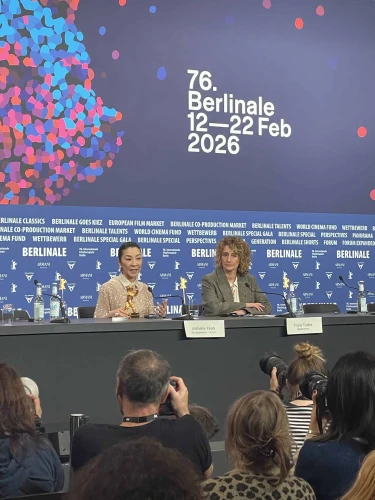
Some jury members appeared visibly irritated.
Producer Ewa Puszczynska, whose credits include the 2023 historical Holocaust drama “The Zone of Interest,” which won an Oscar for Best International Feature Film, said filmmakers should “talk to every single viewer” and encourage thought, not instruct audiences to support either Israel or Palestinians.
She added it was unfair to single out this particular conflict when asking artists to endorse political positions.
Jury president Wim Wenders echoed the sentiment: “We have to stay out of politics because if we make movies that are dedicatedly political, we enter the field of politics; but we are the counterweight to politics.”
Attacks on the festival for not taking a position on Gaza reflect a broader narrative war taking place on the streets of Berlin, where graffiti reading “Free Palestine,” “F**k Zionists” and “Stop the genocide” often appear on train stations, doors and sidewalks. Authorities restricted some pro-Palestinian demonstrations in which antisemitic speech or public disturbances were anticipated.
Israeli self-critique as festival fare
At the festival itself, some of the harshest accusations against Israel came from Israeli filmmakers.
“Bibi and Hamas are a perfect match,” said director Anat Even in narration for “Effondrement” (meaning “collapse” in English), a 2026 French-supported documentary criticizing Israel’s war in the Gaza Strip.
The film opens at Kibbutz Nir Oz, focusing on the Siman Tov family murdered by Hamas, then shifts quickly to scenes of Gaza’s destruction, accompanied by ominous sound design. Central to the film is Even’s dialogue with Paris-based producer Ariel Cypel, who urges her to depict Israel’s campaign as “extermination.”
In the film, Cypel argues that Israeli society is complicit in genocide and should face a trial similar to the Germans and Serbs after past wars.
Such productions have become emblematic of the type of cinema targeted by Israeli Culture Minister Miki Zohar’s proposed funding reforms aimed at “liberating cinema from politics.”
Even, who has long documented what she calls the nakba (an Arabic word meaning “catastrophe” or “disaster,” used by Palestinians to describe the establishment of the State of Israel), said she had not sought Israeli public funding for “Effondrement.”
“I know I would not take this money,” she told JNS after a screening.
The only Israeli-funded entry this year—“Where To?”—portrays an unlikely friendship between an Israeli party-goer and a Palestinian ride-share driver in Berlin searching for love, attempting to humanize both sides.
By contrast, Palestinian feature “Chronicles of the Siege” depicts Gaza under bombardment without reference to the Oct. 7 massacre or hostage-taking that triggered the war. Its closing credits reference “genocide” without naming Israel.
Where commerce meets conflict
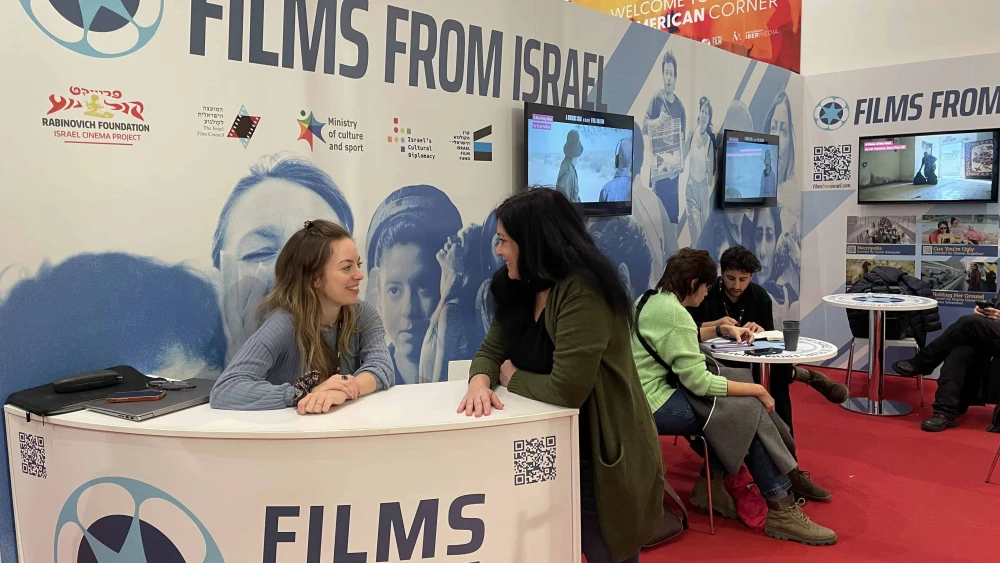
From a business standpoint, festival leadership has reason to emphasize neutrality. The Berlinale also hosts the European Film Market (EFM), where countries and studios compete commercially. Morocco, Saudi Arabia, Italy and Spain dominated the exhibition hall, while Israel maintained a presence through the “Films From Israel” booth sponsored by the Israel Cinema Project.
One country was noticeably less present: the United States. Major studios have increasingly bypassed festivals in favor of social media promotion.
Many films selected were less entertainment-driven and more aligned with Wenders’s description of cinema as prompting reflection on “the humanity behind political decisions.” The opening film, “No Good Men,” for example, is a love story set in pre-Taliban Afghanistan.
The program broadly explored themes of climate, gender and identity amid conflict—topics often associated with the cultural politics now being debated across Western democracies.
Even actress Michelle Yeoh, honored with the festival’s Golden Bear award, declined political commentary when asked about the United States.
“I’m not in a position to talk about the political situation in the United States. I want to concentrate on what’s important to us, which is cinema,” she said.
This article is the third in a series exploring the Israeli entertainment industry after Oct. 7.
Part 1: The battle for Israel’s red carpet, post-Oct. 7
Part 2: How Oct. 7 changed Israeli television and cinema
Part 4: In a taxi, the Berlinale’s ‘Where To?’ offers a roadmap for peace