OFAKIM, Israel—Hidden among the bushes in a southern Israel grove, a young Bedouin busboy and a resident from Kibbutz Be’eri lay quietly for seven hours, afraid to speak as they hid for their lives.
They had fled the Hamas-led massacre at the hard-hit kibbutz, less than three miles from Gaza, on Oct. 7, 2023, and were sheltering from terrorists in the thicket as rockets, bullets and explosions whizzed above their heads.
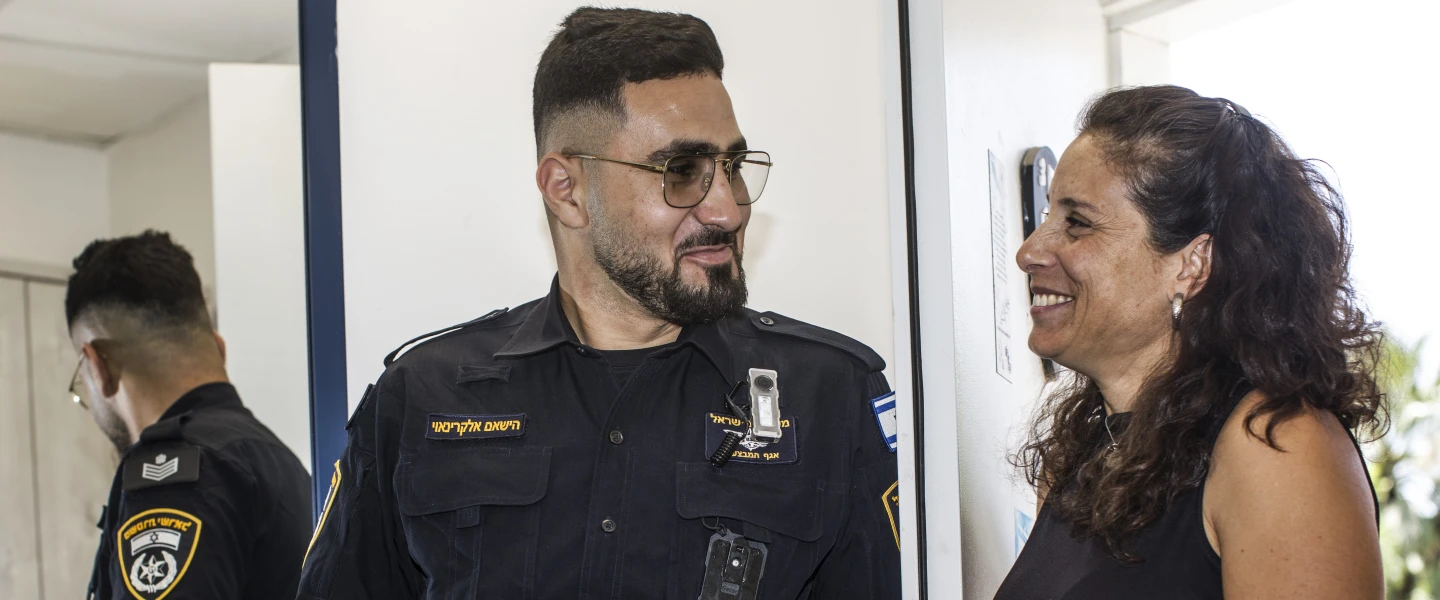
Two years later, Hisham Alkarnawi—the Muslim worker from the once-nomadic Bedouin minority who helped save the woman he had never met before—has become an Israel Police officer.
“I felt that I had to contribute more,” Sgt. 1st Class Alkarnawi, 23, said in a June 15 interview with JNS. “I liked the feeling of being able to save another human being.”
Escape from carnage
On that Black Shabbat, Alkarnawi, his brother and a cousin were running out of the communal farm after encountering several Hamas terrorists who had stormed the border and opened fire on kibbutz residents by the dining hall. The young men came across Aya Meydan, trying to head back home.
The 42-year-old mother of three—a triathlete—had set out early that fateful holiday weekend for her regular Saturday morning bike ride. She was rushing home to her family at the kibbutz after hearing the massive rocket barrage overheard, having canceled the ride with her biking partner, who would be killed on his own way home.
“All of a sudden, I see three figures running toward me shouting as rockets were in the sky,” Meydan recounted. She had just left her bicycle near the entrance to the kibbutz and had vaguely recognized the three as workers in the dining hall, but was uncertain what to do next.
Her first thought was that a rocket had hit the kibbutz. The men, however, told her that Hamas terrorists had infiltrated the community and were killing men, women and children.
“I thought to myself, my God, what children can they be killing at 7 in the morning?” she said.
The group fled on foot and split up at the nearby intersection, with Meydan and Alkarnawi sticking together.
In a moment of stress, Alkarnawi, who had seen the Hamas terrorists dressed in makeshift Israeli military fatigues at the kibbutz, told her: “Don’t trust anybody.”
“I didn’t understand why he told me this, and for a moment, I thought maybe he was a terrorist who would kill me,” Meydan said.
Still, intuitively, she stayed with the young Bedouin.

Racing for safety, the two passed two large peanut containers in the fields. Concerned that it could be a deathtrap, Alkarnawi decided to hide in the bushes.
The youth then asked the woman for her cell phone so he could call his father, explaining that his own phone and car were stolen by the terrorists. After she gave it to him, he began speaking—and then texting—in Arabic.
“That was all I needed to hear,” said Meydan, as text messages from her own brother brought news of the massive Arab terrorist invasion outside their homes. “But I soon understood that if he hadn’t killed me yet, he was my method of escape.”
Fearful himself, Alkarnawi taped their interaction together on his watch in case something would happen to her, out of concern that he would be blamed for her death.
‘Don’t shoot, don’t shoot!’
Seven hours later, curled in the bushes, the two suddenly heard a chopper in the air and got word from Alkarnawi’s father that their long-awaited rescue was finally arriving.
Sure enough, four of his father’s cousins soon pulled up in a car, using a picture of the nearby peanut containers he had sent to identify their location.
No sooner had they scrambled into the vehicle and begun to drive away than a group of Israeli paratroopers arrived, their guns drawn, and ordered everybody out of the car.
“Don’t shoot, don’t shoot! We are Israeli citizens,” they pleaded.
“I left the vehicle, I fell on the ground next to the car, and I screamed, ‘Don’t shoot!’” recounted Meydan.
The troops took her aside, certain that she had been kidnapped by the Muslim men and was being held hostage, but she assured them she was not and had, in fact, been saved by them.
After verifying their story by cross-examination, the soldiers released them at the nearby Ofakim police station.
Sitting at his desk at the same station two-and-a-half years later, the now gregarious Alkarnawi recounts with a grin how his family from the Bedouin Negev city of Rahat insisted on escorting Meydan to safety, even following by private vehicle the chartered bus she was on as it drove away from the border area and then personally seeing her reunited with a relative.
Following his harrowing experience, Alkarnawi stunned his father by telling him that he wanted to enlist in the Israel Police.
His father was initially concerned for his safety, but with perseverance and Meydan’s constant encouragement (“I couldn’t be more proud of him,” she beams), he eventually relented. After a stint as a volunteer in his hometown police station, Alkarnawi felt right at home and officially became an officer last October, right around the second anniversary of the attack.
“I felt that this was my place to be, and it has changed my whole life,” he said. “It is a common destiny that we share.”