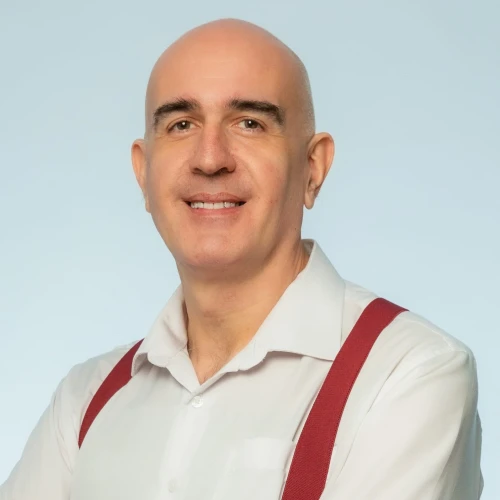
For over a decade, Hen Mazzig has fought against the delegitimization of Israel, the false narratives surrounding it, and the rising antisemitism that follows in their wake, whether through viral social media posts or in combative debates on every major international television channel, including the BBC.
Mazzig, who has expanded his advocacy work into a full-fledged organization and founded the Tel Aviv Institute to combat
antisemitism, stated recently that “Israel’s global image is in the worst state it has been since its creation.”
As part of the “The 11th Million” project announced by Israel Hayom in October 2025—a Zionist call for one million Jews from the Diaspora to immigrate to Israel over the coming decade—Mazzig, who now lives in London, highlighted the unprecedented impact on Diaspora Jews of the Oct. 7, 2023, Hamas attack and the outbreak of the “Iron Swords” war. This is an impact unlike anything seen before in the context of the Israeli-Palestinian conflict, he said.
“Jews are being attacked in New York, in L.A., in D.C. and in London. This assault was not just on Israel; it was an assault on the entire Jewish people. And Jews around the world are paying the price for it.
“I’m afraid that the Israeli government and the official bodies don’t realize how bad it is,” Mazzig said. “They think that they can do some small things or cater to a specific audience, and maybe that would change. Even the U.K. Conservative Party, which used to be so pro-Israel and understanding why we have a right for self-determination, even there, you see voices that are becoming more hostile,” he said.
A mental illness
London is considered one of the world’s most hostile cities toward Israel, with a long history of pro-Palestinian protests and surging
antisemitism. In the wake of “Operation Roaring Lion,” the city has seen demonstrations in support of the Iranian regime, mourning the elimination of Supreme Leader Ali Khamenei.
“Since Oct. 7, all my husband’s friends and colleagues stopped talking to him. I kept on apologizing to him. I said, ‘I’m so sorry you lost so many friends.’ And he said, ‘It’s not about you. It’s not about something you did. It’s just about who you are.’”
The loudest amplifiers of anti-Israel messaging are members of Generation Z, who consume content on the subject through social media.
There, they encounter millions of shares of false narratives, or the output of figures such as Candace Owens and Tucker Carlson, known for their hostility toward Israel and their promotion of conspiracy theories.
“There are millions of people who have been brainwashed and are thinking these things,” Mazzig said.
Pointing to the case of Swiss singer Nemo, the winner of Eurovision 2024, who sent back the trophy in protest at Israel’s participation in the 2026 song contest, Mazzig said, “I think it’s a mental illness to get to the point that you hate a country and the people so much that you do something like this. What are you trying to prove by that?”
It is not about whether they’ll leave London, but when
He described how the sense of boycott surrounding the Jewish state, and anyone identified with it, combined with an unprecedented spike in antisemitism and a leadership that has offered no meaningful response, has pushed London’s Jewish community to weigh aliyah.
“It’s been a nightmare for so many Jews and Israelis in London. At this point, so many of my friends are not asking if they’re going to leave London for Israel. They’re just saying when? ‘When are we going to make aliyah?”’
That sentiment was reflected in a surprising milestone. The past year saw record levels of British aliyah, even as “Operation Rising Lion” (Israel’s 12-day operation against Iran in June) brought ballistic missile threats and real destruction to Israel. For Mazzig, the timing makes perfect sense.
“You see footage coming out of Israel of people running for their lives, scared and hiding in bomb shelters. Then, in the heart of London, people are chanting, ‘Keep bombing them,’ and [you see] people celebrating Iran. These people are not condemning the regime in Iran while it’s brutally massacring tens of thousands of innocent civilians who have done nothing but protest.
“Communities in the U.K. that have been very outspoken against war and for human rights can’t even peep one word to say this is wrong? They think we deserve it. If a rocket or a missile were to hit my home tomorrow, or my family’s home, and they would die, people around the world would celebrate it.”
This realization has led to a shift in thinking among many in the Jewish community, Mazzig said.
“That is something that is very hard to live with. When this sort of footage and violence is not triggering even a fraction of the reaction that a similar footage from Gaza would trigger? Because this picture from Gaza would immediately open headlines.”
Q: Why do you think British Jews are still reluctant to come here?
A: I think some British Jews, even though in their heart they support Israel, are pretending that if they were very critical of Israel and say they’re not Zionists, they would get a ‘free pass,’ be protected, which obviously they won’t be. There’s no such thing as a good Jew for an antisemite.
The majority of British Jews today are just still holding on to the hope that maybe things will change.
-----
According to Mazzig, the current Israeli government, and whichever government is elected in this year’s election, bears a great responsibility to strengthen the bond between Diaspora Jews and the State of Israel, to encourage aliyah.
“The next leader of this country would have to answer a lot of questions. How are we going to help Diaspora Jews feel safer? How are we going to work hard to ensure that Israel is safe?
“What Oct. 7 has done for Jews around the world and for Israelis is take away the feeling of safety and security. I think whoever is going to lead this country has to work so hard to bring it back through security measures, of course, but also through thinking of ways to tell our story better.
“Israel has made mistakes just like every other country around the world. Things don’t have to be perfect to be beautiful, and Israel is beautiful enough for so many of us to risk our lives fighting for it, and I think that’s what we need to continue doing. It’s the promise of ‘Never again.’”
Originally published by Israel Hayom.