When Israeli academics and students gathered in Jerusalem on Jan. 13 to examine the explosion of misinformation following the Hamas-led attacks of Oct. 7, 2023, the focus was not only on media bias but on how distortions of the Israeli-Palestinian conflict have migrated and multiplied on university campuses far beyond Israel’s borders.
The conference, titled “Post-October 7 Lies and Misinformation Abroad on College Campuses,” was hosted by the Committee for Accuracy in Middle East Reporting and Analysis (CAMERA) together with the Politics and Communication Department at Jerusalem Multidisciplinary College (JMC).
The forum drew a packed auditorium of faculty and students concerned that campuses—once arenas for rigorous debate—are increasingly becoming echo chambers for empty slogans, selective history and outright falsehoods.
Opening the event, JMC President Prof. Ariela Gordon-Shaag stressed that academic institutions bear a special responsibility in moments of crisis. “Universities should be places of intellectual honesty,” she said, “especially when emotions are high and information is contested.”
Dr. Maoz Rosenthal, who heads JMC’s Politics and Communication Department, framed the post–Oct. 7 media and campus crisis as a case of what he called a “fundamental surprise.”
For years, he said, Israel’s public diplomacy focused on debates over the 1967 lines, only to discover after Oct. 7—particularly on Western campuses—that the argument had shifted far deeper, questioning the legitimacy of Israel’s existence altogether.
“That means the assumptions we were working with are no longer relevant, and everything has to be rethought,” he said.
Rosenthal cited incidents at elite U.S. universities, including Cornell, Columbia and UCLA, alongside polling data showing sharply declining support for Israel among young adults in the United States and Europe. These trends, he warned, are not merely reputational but strategic, since today’s students will become tomorrow’s policymakers.
He argued that Israel’s response must go beyond messaging and social media tactics to long-term governance and policy planning. The aim of the conference, he said, was not only academic analysis but the development of practical tools and recommendations for decision-makers confronting what he described as “a generational challenge” to Israel and the West.
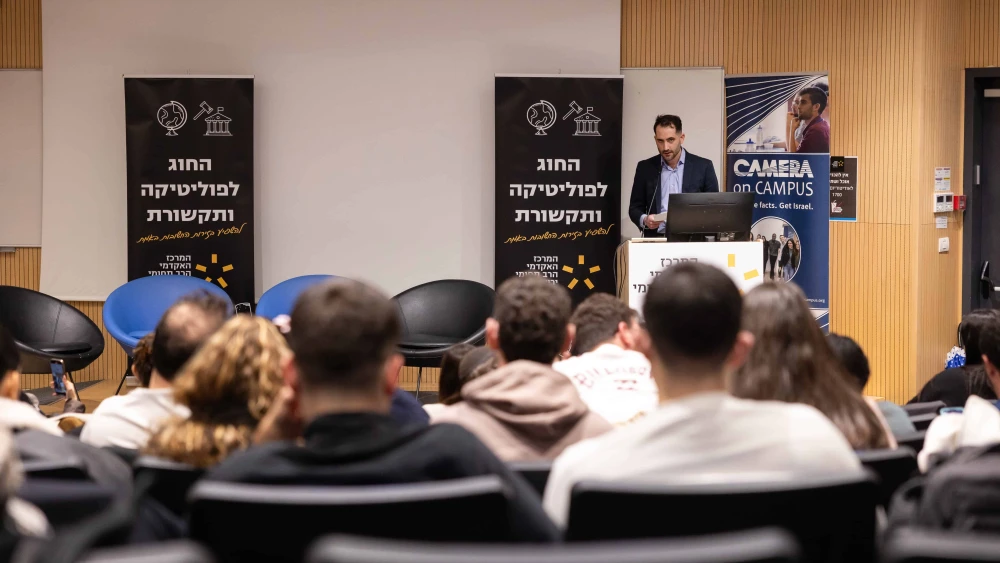
That theme was picked up by Tom Yohay, manager of CAMERA on Campus Israel, who described what he called “Israel’s eighth front”—the international battle over consciousness.
“Since Oct. 7, the world has been flooded with headlines accusing Israel of ‘genocide’ and ‘deliberate starvation,’ often while erasing the massacre, rape and kidnappings committed by Hamas,” Yohay said.
CAMERA, he said, works not to “beautify Israel,” but to insist on facts, context and fair language. “When respectable media outlets become mouthpieces for propaganda, the damage reaches far beyond journalism—it shapes how students think.”
Yohay detailed CAMERA’s extensive behind-the-scenes efforts: identifying errors, pressing editors for corrections, and in some cases forcing changes to headlines or images.
“This is not a drop in the ocean,” he said. “It’s about setting standards.”
Patterns of distortion
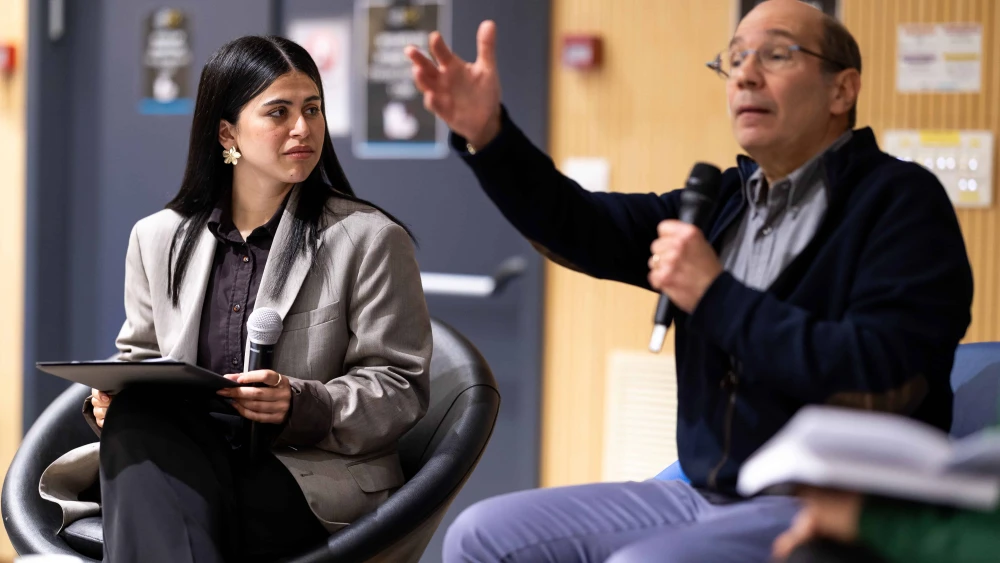
A panel discussion at the center of the conference was moderated by Shilat Machlufs, a CAMERA student fellow at JMC and a student in the college’s Politics and Communication Department. Machlufs guided the panel with a focus on how misinformation translates into daily campus realities—from hostile protests to the silencing of Jewish voices.
Machlufs said the conference itself, which she helped to organize, was part of the response.
“Before you can treat a disease, you have to diagnose it,” she said. “Our goal is to give students language, confidence and tools—not slogans.”
Panelist Dan Diker, president of the Jerusalem Center for Public Affairs, argued that what is unfolding on campuses is neither spontaneous nor new.
“There is no real distinction between hatred of individual Jews and hatred of the Jewish collective,” Diker said, invoking Natan Sharansky’s well-known “three Ds”—delegitimization, demonization and double standards. “BDS doesn’t seek reform or coexistence. It seeks to erase Israel’s right to exist, everywhere—from Tel Aviv to Jerusalem.”
Diker warned that groups such as Students for Justice in Palestine operate as disciplined national networks on hundreds of campuses. “They don’t need vast resources to do enormous damage,” he said. “They’ve spent years preparing the ground.”
Historian Gil Troy placed the phenomenon in a broader intellectual context. He traced a line from the politicization of academia and the rise of identity politics to what he called “a new nihilism” that frames the world exclusively through oppressor-oppressed binaries.
“When you label Israel as the ultimate oppressor, everything becomes permissible,” Troy said. “This isn’t just an assault on Zionism. It’s an assault on liberalism, on academia itself.”
Shilat Cohen, a leader of the European Students’ Union and the International Union of Jewish Students, said the atmosphere on campuses has shifted markedly since Oct. 7, becoming both more hostile and more informed.
While anti-Israel activism existed before the war, she said, many student groups previously lacked a basic understanding of what they were protesting.
“Today, the opposition is deeper, more researched and far more aggressive,” Cohen noted, adding that she has witnessed a sharp escalation in both rhetoric and hostility toward Jewish and Israeli students. “The hatred is stronger, and the battles are no longer superficial.”
Her work, she said, focuses on equipping Jewish and Israeli students with practical tools—ranging from advocacy skills to institutional engagement—while also intervening directly with university administrations when discrimination occurs.
“This is not only about policy,” Cohen said. “It’s about giving students the confidence, language and support to stand their ground.”
Tools for students
Beyond diagnosis of the problem, the conference addressed practical responses. CAMERA’s campus programs, Yohay explained, operate on two tracks: direct support for student groups and a fellowship program that trains students to write op-eds, organize events and challenge false narratives publicly.
“Students tell us they don’t just gain knowledge—they gain courage,” he told JNS.
Troy urged a dual strategy of “big and small.” “One professor at a time, one student at a time,” he said. “But also thinking big—asking whether you really want to be on the side of Hamas or Iran, and what that says about your moral compass.”
Several speakers highlighted a particularly potent factor on Western campuses: the export of anti-Zionist Israeli academics whose voices carry disproportionate weight abroad.
Yohay cited examples of Israeli professors who have publicly accused Israel of genocide or denied Hamas atrocities, and who are then welcomed at elite universities overseas. “Because they are Israeli, they’re treated as unimpeachable witnesses,” he said. “That credibility is then weaponized.”
Despite the grim assessment, speakers repeatedly rejected despair. Troy appealed to students to reclaim the moral high ground and to stop apologizing.
“This is not a moment for paralysis,” he said. “It’s a moment to stand tall, tell your story and stop apologizing for existing. They’re trying to rob us of our joy and our pride. Don’t let them.”
Diker echoed Troy’s call. “This is a struggle for truth,” he said, “and truth still matters—especially on campuses that claim to defend it.”
The view from Britain
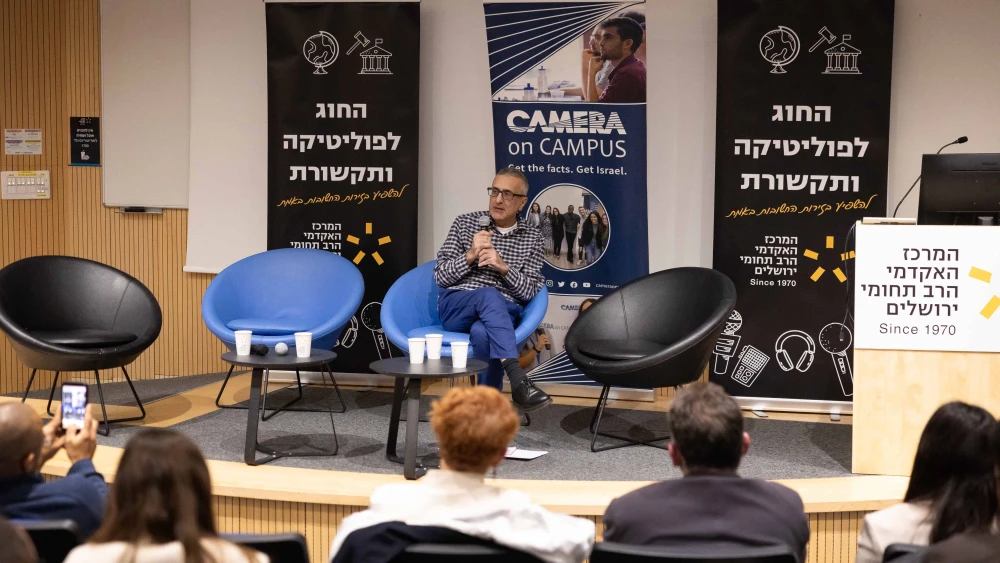
In a speech in English following the panel discussion in Hebrew, British writer Daniel Ben-Ami argued that mainstream media coverage reinforces the problem by presenting the conflict as a one-sided story. “If Israel is shown simply ‘killing Palestinians for no reason,’” he said, “then genocide becomes the obvious—if false—conclusion.”
Ben-Ami said that elite universities mirror this media environment. “Students are not rebelling against their professors,” he said. “They’re doing exactly what they’ve been taught.”
He said that the core problem in Western media coverage of Israel is not simply hostility, but the systematic framing of the conflict as something other than a war. Major outlets, he said, routinely present Israel as acting “for no reason,” erasing Hamas’s role and the reality of a two-sided conflict.
When coverage depicts Israel as an unprovoked aggressor—destroying schools, hospitals and civilians—the public is led almost inevitably to conclude that Israel is committing genocide.
“If that’s your media source,” he said, “that is the conclusion you would naturally draw.”
Ben-Ami said that this distortion is reinforced by a striking asymmetry in journalistic scrutiny. Israeli officials and pro-Israel voices are subjected to hostile questioning, while anti-Israel commentators—especially anti-Israel Jews and Israelis—are often treated with deference and little pushback, even when making extreme claims.
He traced this shift to the rise of identity politics in elite Western institutions, which recasts global conflicts through a rigid hierarchy of oppressor and oppressed. In this framework, Jews are recategorized as “hyper-privileged,” Israel is cast as a white colonial power, and traditional antisemitic tropes are repackaged in the modern language of “genocide,” “apartheid” and “white supremacy.”
On university campuses, Ben-Ami said, student protests are not rebelling against academic culture but faithfully reflecting what they are being taught—particularly in the humanities and social sciences—where activism, not inquiry, has become the dominant ethic.
‘A perfect storm’ on campus
In an interview with JNS following the conference, Troy said the hostility toward Israel and Jews on Western campuses did not emerge overnight, but is the product of decades-long ideological shifts.
In his recent work (The Essential Guide to Zionism, Anti-Zionism, Antisemitism and Jew-Hatred), Troy said he traced what he called “about 15 steps” from the bipartisan moral clarity of the 1970s—when figures such as U.S. Sen. Daniel Patrick Moynihan warned that anti-Zionism was a new form of antisemitism—to the toxic atmosphere that followed Oct. 7.
“What changed,” Troy said, “was the politicization of academia, the rise of identity politics that weaponized the old Marxist oppressor–oppressed framework and a growing self-hatred among Western elites.” Together, he argued, those forces created “a perfect storm.”
The result, he said, is not merely a campaign against Israel, but something far broader. “This is an assault on Judaism and Zionism,” Troy said. “But it’s also an assault on Americanism, on liberalism and on academia itself.”
Troy pointed to what he called a striking media double standard—one that campuses have absorbed wholesale. While protests and vigils erupt almost instantly in response to Israeli military actions, mass killings elsewhere are often met with silence.
“The Iranian protests didn’t reach the front page of The New York Times for the first week,” Troy said, noting the lack of campus demonstrations for Iranian dissidents or moments of silence for thousands killed by the regime. “The silence speaks for itself.”
He described this phenomenon as a form of “churnalism”—journalism that endlessly recycles a single narrative without context or comparison. “I’m more shocked that intelligent people don’t see the double standard than that it exists,” he said, adding that it has been “building up for decades.”
At the same time, Troy noted, Iran and Qatar have poured vast resources into what he called the “eighth front” of Israel’s war: delegitimization. “They’ve spent millions, if not billions, shaping this narrative,” he said.
From paralysis to pride
Despite the bleak diagnosis, Troy stressed that students are far from powerless. “This is not a moment for paralysis,” he insisted. “It’s not a moment for powerlessness.”
Drawing a direct line from Oct. 7 to the current campus climate, Troy said the same spirit that drove Israelis to act that day must now animate Jewish and pro-Israel students abroad. “This is a time to save not just the Jewish people,” he said, “but the soul of the West.”
He urged students to harness their fluency in social media and digital platforms, turning scholarship and history into “short, punchy videos” and clear messages that can compete in the modern information battlefield.
Troy stressed the importance of identity and confidence over constant defensiveness. “I don’t want anguished Zionists,” he said. “I want proud Zionists. I want happy Zionists.”
Hope, he concluded, must be the strategy. “They’re trying to rob us of our joy, our story, our pride,” Troy said. “Holding onto those things isn’t just resilience—it’s victory.”