


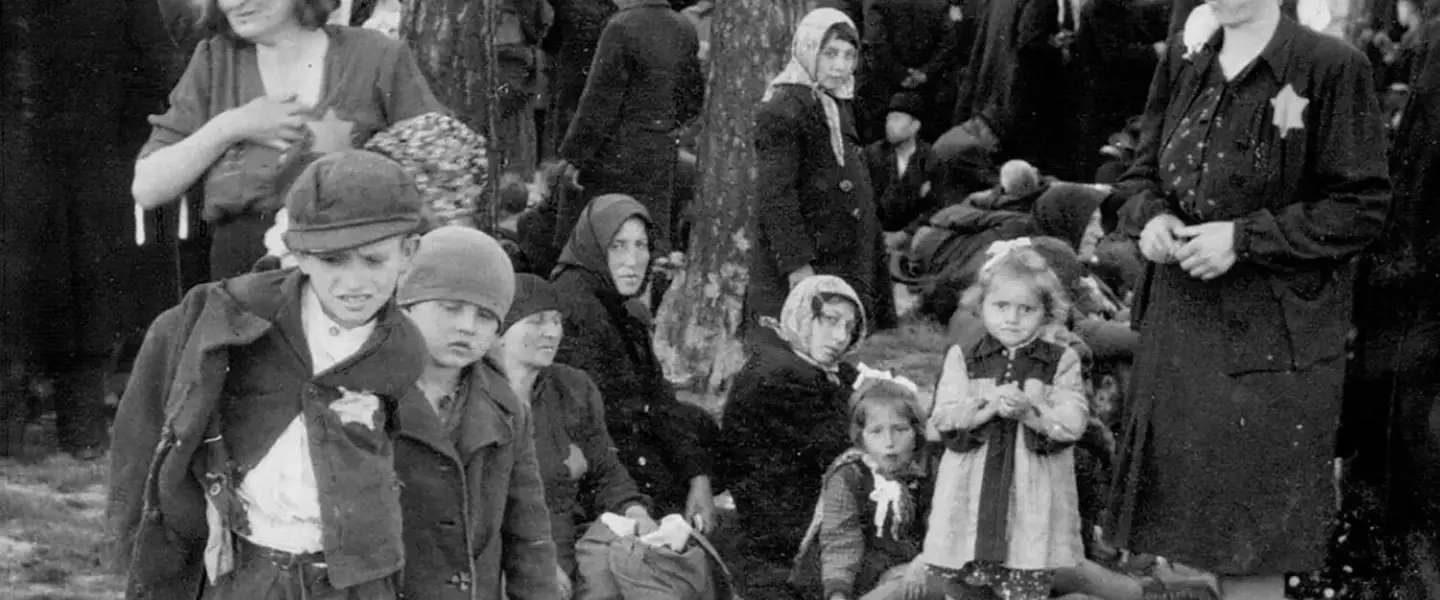
In Hungary today, the word “Kasztner” is more than a last name. It has also become a slur—shorthand for a cynical traitor.
The term refers to Rezső (Rudolf) Kasztner, a Jewish-Hungarian community leader during the Holocaust in Budapest. After he settled in Israel, his critics accused him of concealing the nature of the Nazi death machine from would-be victims while rescuing a select few, and later also aiding a Nazi war criminal evade justice.
Kasztner was assassinated in Israel in 1957 following a polarizing trial. While three of five Israeli Supreme Court justices ultimately ruled that allegations of Nazi collaboration against him were defamatory, his legacy remains fiercely contested in Hungary, Israel, and beyond.
Now, new research published by the Yad Vashem Holocaust museum in Jerusalem adds long-overlooked context to the Kasztner affair, placing his actions alongside those of contemporaries facing similar circumstances.
This comparative examination, which Yad Vashem published in an English-language book recently, casts fresh light on the role that the Nazis intended for Jews to have in the systemic murder of their own people -- an issue that continues to haunt the Jewish psyche 80 years after the Holocaust. I also remains a relevant theme of modern-day antisemitic discourse.

Kasztner’s conduct
The study, by historian László Bernát Veszprémy, examines the specific dynamics of the Holocaust in Hungary, where the genocide was delayed and then carried out with devastating speed. Veszprémy argues that Kasztner’s conduct neither diverged significantly from that of others in comparable roles nor reflected the choices of a free and unconstrained actor.
Béla Schwartz, the president of the Jewish Council of Kisújszállás near Budapest, “selected the Jews from his ghetto in the sugar factory in Szolnok on the orders of the local Jewish Council president,” Veszprémy showed in his study, titled “Bereft of Council -- The Jewish Leadership in Hungary and the Holocaust.” Many of those not selected by Schwartz were murdered.
Sándor Szűcs, the president of the Füzesgyarmat Jewish Council, also selected his fellow Jews in the internment camp. In 1946, a communist kangaroo court convicted another Jewish community leader, Rabbi Béla Berend, a member of the Jewish Council of Budapest, of aiding the Nazis.
Communist kangaroo courts
The 16-page sentence against Berend, who was likely tortured during his investigation and gave several confessions, “condemned Zionism and compared Jewish nationalism to Nazism, even though the verdict stated that the defendant’s activities were ‘generally beneficial’ to Hungarian Jews,” Veszprémy wrote.
Whereas Kasztner’s case became famous in Israel and the rest of the Jewish World, it was relatively obscure in Hungary compared to the trials put on by Hungarian authorities against other community leaders accused of collaborating with the Germans, Veszprémy said.
These cases and others “help set the context, which is one of the benefits of my research,” Veszprémy added.
The fact that Kasztner was not a unique or even unusual in his actions, Veszprémy said, helps expose the dynamics at work on virtually all the Jews whom the Nazis and their collaborators appointed as overseers.
“Virtually all these Jewish Council figures were trying to negotiate with the Germans or the Hungarians, trying to save as many people as possible through negotiations, through bribes, playing for time. This was a strategy generally employed by hundreds of Hungarian Jewish leaders at the time,” said Veszprémy.
The case for obedience
Especially in Budapest, Hungarian Jews had more reasons than others to hope that playing for time and sacrificing some could help save others, and even their communities as a whole, Veszprémy suggested.

That’s because the final solution began in Hungary only in March 1944, about two years after the Germans and their collaborators began murdering Jews systematically at Auschwitz-Birkenau. Even among Hungarian Jews with intimate knowledge of the German death machine, “The idea that this is not going to reach us, that this cannot happen here, this was very widespread among Hungarian Jews,” Veszprémy said.
Mass murders of Jews and one deportation predated the German occupation of the country in 1944, but it escalated dramatically then.
Even after the deportations began in Hungary’s countryside, Budapest’s Jews were not included, giving them fresh hopes for survival despite mass killings and atrocities perpetrated against them inside Budapest by the local Arrow Cross fascists. The absence of transport gave Budapest’s Jews incentives to cooperate with the Germans and local fascists.
In Hungary, these circumstances were not lost on Jews who sought to scrutinize the Jewish Councils’ word immediately after the Holocaust. Local Zionist activists put on a mock trial for the Jewish Council, where the mock tribunal eventually cleared the leadership of all charges, the study showed.
‘Ideal targets’
But communist authorities “soon realized that the Jewish Councils were ideal targets for highly publicized show trials to distract the masses from the daily misery and terror,” Veszprémy wrote. This led to the kangaroo courts that tried Berend and several other Jewish Council members.
Ultimately, “The Nazis did not have a chance in the end to send the Jews of Budapest off to Auschwitz, and because of this, around 200,000 Hungarian Jews survived,” Veszprémy noted in an interview with JNS. Some 565,000 Hungarian Jews were murdered in the Holocaust out of more than 800,000 Jews who were living in the early 1940s in greater Hungary, which included land that is now part of Slovakia and Romania, according to Yad Vashem.
The survival of many Budapest Jews, who tended to be less observant and insular than in the extinct countryside communities, has largely determined the modern-day character of Hungarian Jewry. It has about 47,000 members, as per a 2020 demographic study.
The ‘Jewish collaboration’ claim
The issue of alleged Jewish collaboration with the Nazis is a common theme in antisemitic discourse in Eastern and Central Europe, where some scholars and politicians use it to defend against allegations of collaboration by their own people.
In 2018, then Polish Prime Minister Mateusz Morawiecki did this in defending a law that prohibited accusing Poles of Nazi crimes. He said that “there were Polish perpetrators, as there were Jewish perpetrators, as there were Ukrainian; not only German perpetrators,” sparking furious reactions.
In Hungary, the attempt to cast Jews as collaborationists in their people’s murder has largely failed, Veszprémy said, also because of the communists had tried to make it stick in show trials like Berand’s.
Amid an increase of antisemitic sentiment across Europe in recent years and especially after Oct. 7, 2023, Hungary under Prime Minister Viktor Orban has stood out as a haven where Jews’ sense of personal safety has hardly changed, leaders of the community have said.
This is partly due to government policies and the absence of large communities of immigrants from Muslim countries, Veszprémy said. But, he added, “Hungarians also have a higher resistance to antisemitic conspiracy theories, including on alleged Jewish collaboration, because we’ve seen the communists trying to popularize them.”



