Noam, 25, and Na’ama, 26, Ozeri were living happily in the Samaria community of Peduel but felt they could make an even greater contribution to the State of Israel and the Jewish people.
Last Thursday, the pioneering couple fulfilled that dream, joining 11 other families as founding residents of the newly established community of Ebal. The Ozeris now live in caravans atop Mount Ebal, north of Shechem (Nablus), helping lay the foundations for the fledgling community.
Before Ebal was established, the nearest Jewish communities were Har Bracha, on the adjacent Mount Gerizim, and Shavei Shomron, about 17 kilometers (10.5 miles) away.
Speaking to JNS from his new home on Sunday, Noam said he and Na’ama decided to move to Ebal because they believe redeeming the Land of Israel is part of a process that brings redemption step by step.
“We (the Jewish people) waited and prayed for this moment for 2,000 years, throughout the generations,” he said.
Noam said he envisions Ebal growing not merely into another village but into a city in northern Samaria capable of accommodating 600 families, in accordance with the Samaria Regional Council’s plan.
In addition to the 12 founding families, Ebal is also home to a new 15-student agricultural yeshivah, a branch of the Alon Moreh hesder yeshivah.
Noam acknowledged that the first few days have been challenging. The homes do not yet have gas hookups or running water, which is delivered by truck, and they lack air conditioning to provide relief from the summer heat.
He also noted that the roads are not yet fully paved, saying he has already had to replace several flat tires.
At the same time, the community’s electricity currently comes from a solar-powered system.
Nevertheless, during their first Shabbat in the community, the Ozeris hosted overnight guests, using an electric hot plate to cook and warm food.
He added that many visitors from across the country have already come to see the new community and what its residents have accomplished in such a short time.
“It’s great that so many people are interested,” he said. “We will build up this place and make it inclusive for everyone.”
Noam said one of Ebal’s unique features is its location directly north of Shechem (Nablus), home to Joseph’s Tomb, as well as the orientation of its synagogue.
“We are the only synagogue that I know of anywhere whose worshippers directly face and are aligned with both Joseph’s Tomb and the Temple Mount in Jerusalem at the same time,” he said.
He said he was grateful for the support of his parents and in-laws throughout the move, even though his parents initially told him he was “crazy” to make the decision.
At the same time, he said, local Arabs were surprised by Israel’s ability to establish the community.
“This is proof that the redemption is on its way,” he said.

A strategic foothold
The first homes on Mount Ebal were erected in March, about 10 months after Israel’s Cabinet approved establishing a new community at the site.
At the time, Samaria Regional Council head Yossi Dagan said the community’s establishment near the site identified with Joshua’s Altar came in response to attempts by the Palestinian Authority to damage and destroy the Jewish heritage site.
The Samaria Regional Council said this week that Ebal is one of 19 new communities being advanced as part of a plan to strengthen security in the region and reverse what it describes as the injustice of the 2005 disengagement from northern Samaria.
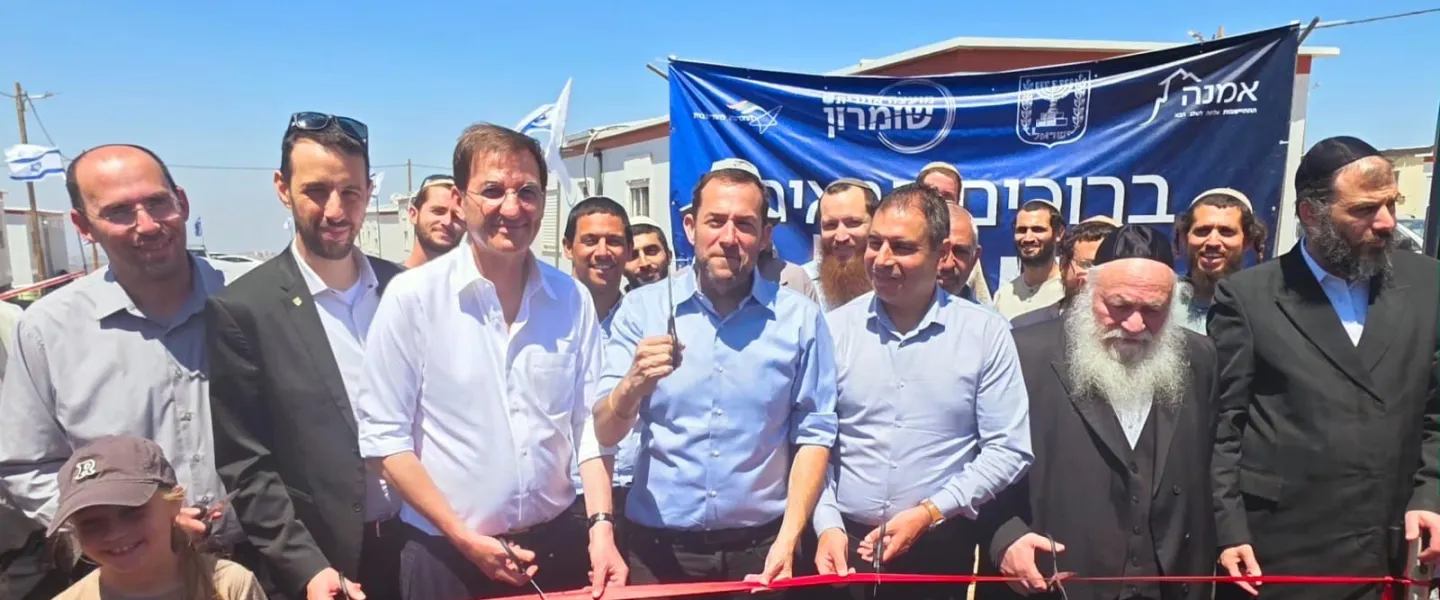
Last Thursday, Dagan hosted a ribbon-cutting ceremony attended by at least five Knesset members, regional and local leaders, and other public figures, several hours after the first families moved into their new homes.
“This is a great moment for every Zionist who loves this land—to see a new community being born in the State of Israel,” Dagan said. “The establishment of Ebal is an appropriate Zionist response and an answer of building, development and action in Samaria. We are privileged to write a new and magnificent chapter in the history of settlement. This land waited empty for thousands of years—600 families will live here.”
Likud MK Osher Shkalim, who attended the ceremony, said what moved him most was seeing children running through the hills of Samaria at a time when many young people of the “screen generation” have become addicted to material things.
“It is moving to see the education of children who come here. This is our next generation, to redeem the Land of Israel and think about the interests of the Jewish people,” he said.

‘Settlement brings security’
American Friends of Judea and Samaria co-founder and CEO Yigal Dilmoni told JNS that he brought a group of American VIPs to visit the site last month, and they were deeply impressed.
He said the establishment of Ebal is significant from a security perspective because, for the past 26 years, access to Mount Ebal had been largely prohibited due to security concerns, making it too dangerous for Israelis to visit, including Joshua’s Altar.
“The new community on Mount Ebal now enables full Israeli control over the mountain and allows for permitted visits to the altar. Settlement brings security,” Dilmoni said.
He added that, from a biblical perspective, Mount Ebal had stood desolate for thousands of years, waiting for the return of the Jewish people.
“On Mount Ebal, we were commanded to rejoice: ‘And you shall eat there and rejoice before the Lord your God’ (Deuteronomy 27:7). And now, during these days [the Three Weeks], when we commemorate the destruction [of the Temples], we are also privileged to witness the building of the land and the return to the mountain of joy,” he said.