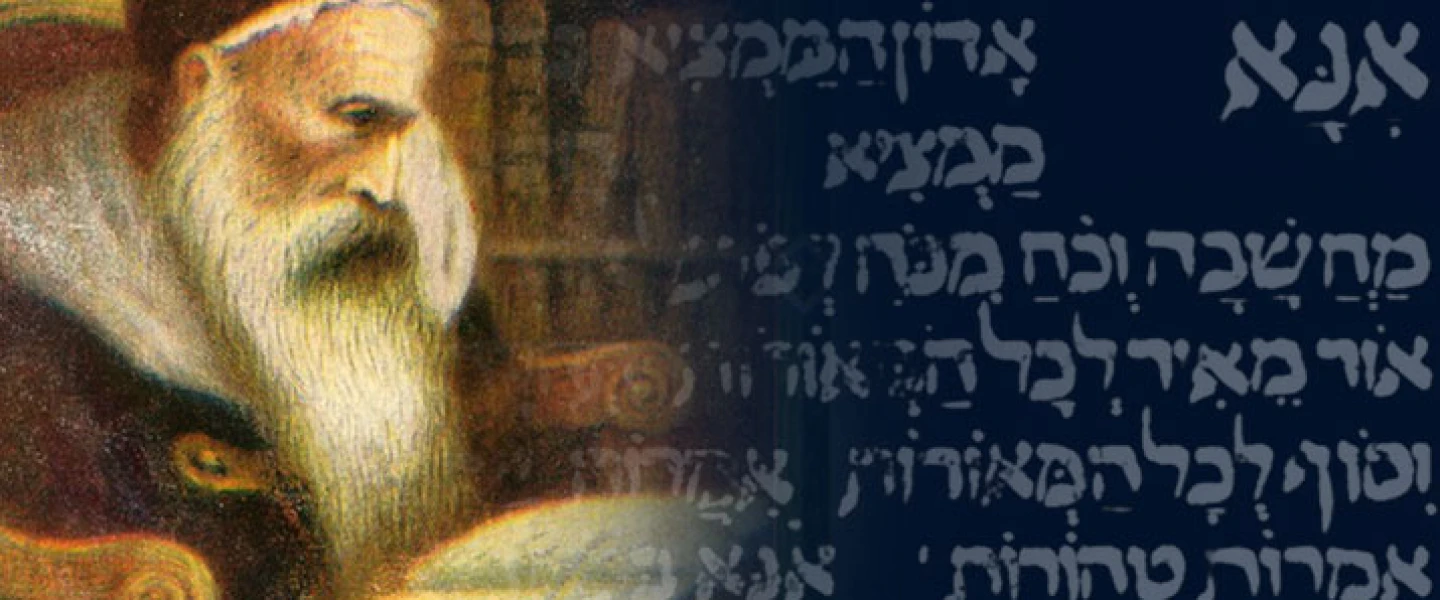
In time for the High Holidays, a recently unearthed poetic prayer attributed to the famous 13th-century rabbi known as the Ramban (Nachmanides) has been translated into English for the first time, and is now available on the website of the National Library of Israel.
Rabbi Moshe son of Nachman (born in 1194 in Catalonia; died 1270 in Akko), more commonly known as the Ramban or Nachmanides, is one of the intellectual giants of Jewish history, the author of commentaries on the Bible, the Talmud and countless other texts, as well as an array of original works widely studied and cited to this day. He was also a leading Kabbalist and a persecuted defender of his faith.
Forced to leave Catalonia following a religious disputation when he was around 70 years old, the Ramban traveled across the world to the Land of Israel, where he helped rebuild Jewish communities and scholarship decimated by the Crusades, the Mongols and the passage of time. His arrival in Jerusalem marked the beginning of hundreds of years of uninterrupted Jewish settlement in the city and the synagogue he established still stands.
Just last year, a prayer attributed to the Ramban appeared in Idan Perez’s Sidur Catalunya. The work presents the first-ever printed prayer book of the Catalonian liturgy and ritual used by the Ramban and the once-thriving Jewish communities of Catalonia, Valencia and Majorca, which were ultimately extinguished by the Spanish Inquisition and Expulsion more than 500 years ago.
Perez completed the monumental project by piecing together manuscripts and other source materials from institutions across the globe.
The prayer attributed to the Ramban was found in a manuscript written just after the Expulsion, which was likely used by Catalonian exiles living in Provence. It is now held in Rome’s Casanatense Library and is available online as part of Ktiv, the National Library of Israel-led initiative to open digital access to all of the world’s Hebrew manuscripts.
According to Perez, these types of prayers—referred to as bakashot or “supplications”—were quite common among Iberian Jews of the period. Catalonian communities apparently recited them after the regular daily prayers, while other communities across the peninsula would say their bakashot before prayers.
“The text’s content and style, along with the fact that the manuscript’s author prefaced it with the words ‘A Bakasha of Rabbi Moshe ben Nachman,’ all seem to indicate that this bakasha was, in fact, written by the Ramban himself,” says Perez, who heads the Rare Books Department at the National Library of Israel.

To the Modern Hebrew speaker, the Ramban’s poetic prayer, written some eight centuries ago, is surprisingly clear. The English translation appears below, with a few notes and sources added in parentheses for clarification purposes:
Please, O Lord who creates without having a creator
And who conceived a thought and power from potential to action, brought forth light which illuminates all of the lights from the beginning until the end, for all of the illuminations.
The words of God are pure words (Psalms 12:7).
Please, with your unseen, refined and pure power, establish my thoughts in your service, in awe, in trembling and in reverence
You have brought to light every mystery
Make me wise to know your commandments, and as a hawk soars over its prey (Job 29:36), allow me to understand and guide me in the path of your commandments
And in the ways of repentance (teshuva) instruct me
Because you are a God who desires the repentance of the wicked
And the spirit of grace flows forth onto those who know and those who do not know, and in the attribute of your beloved ones from ancient times, bless me with sublime favor, as my absolute light
And this is your favor that you shall do for me
And may I not tremble in fear of you (Job 13:21)
And raise me up on the balance of grace
And guide me in your truth and fulfill me from its delights
And from their great light, enlighten me
And like the mountain of your inheritance (Jerusalem), bring me and plant me
And between two cherubs, may your word come and console me
And desire me and receive me
And may the foundation of your world establish my soul and may it be bound up in the bundle of life, the pure soul you have placed within me, and in the great all-encompassing crown, may it be included
Include me in your exalted attribute of goodness, with every blessing and splendor∙
Please, with these crowns, which are 10 in number
And in them lay the secret to everything
May my supplication come before you
And may your ear be inclined to my joy
And may my prayer come before the sanctuary of your holiness
And from the good oil of the two olives and the wellspring, pour upon the seven candles of the entirely gold menorah (Zechariah 4:3)
And shower upon he who longs for your kindness and sees your goodness through spiritual channels from higher wellsprings and lower wellsprings (Joshua 15:19)
And you are the one who knows that I do not unburden my plea before you due to my righteousness, but rather by the merit of my forefathers I have based it, and by the greatness of your mercy and your humility and the memory of your 13 attributes.
[Translation by Zack Rothbart]