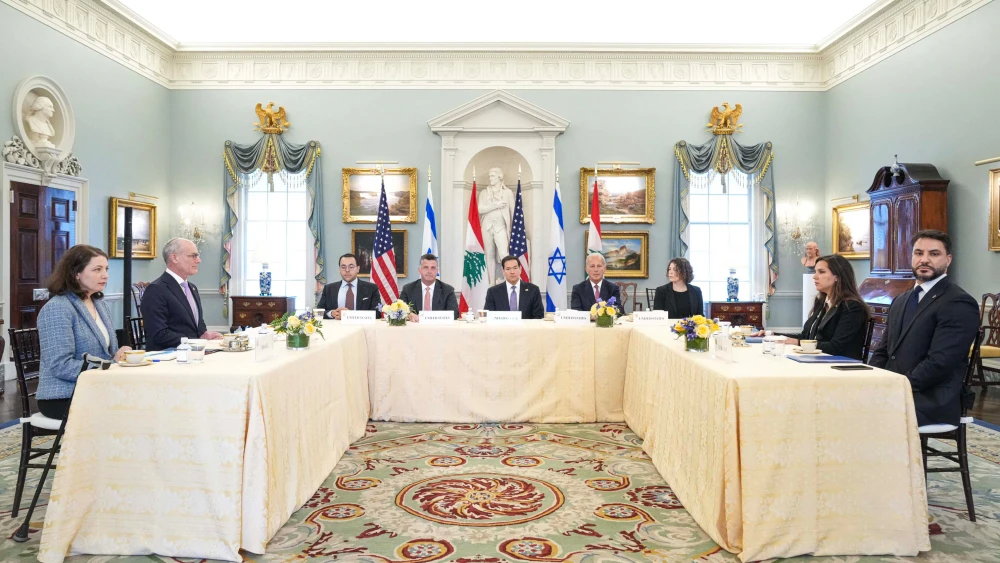

During an Independence Day reception in Jerusalem on April 23, Israeli Foreign Minister Gideon Sa’ar addressed the subject of the trilateral talks in Washington surrounding a potential deal between Jerusalem and Beirut.
“We made a historic decision to negotiate directly with Lebanon after more than 40 years,” Sa’ar said, pointing to the “unfortunate” reality that “Lebanon is a failed state … that is de facto under Iranian occupation through Hezbollah.”
However, he went on, “[T]his also leads to a conclusion: Hezbollah is a common enemy of Israel and Lebanon. Just as it threatens Israel’s security, it harms Lebanon’s sovereignty and threatens its future.”
He then stressed, “We don’t have any serious disagreements with Lebanon; there are a few minor border disputes that can be solved. The obstacle to peace and normalization between the countries is one: Hezbollah.”
He proceeded to “call on the government of Lebanon [to] work together against the terrorist state that Hezbollah built in your territory. This cooperation is needed by you even more than by us. It requires moral clarity and the courage to take risks. But there is no real alternative for ensuring a future of peace for you and for us. And for you, for Lebanon, a future of sovereignty, independence and freedom from the Iranian occupation.”
Finally, he insisted, “The people of Israel want and have always wanted peace. A real peace. A peace that is not based on illusions and on the abandonment of our future and security. A peace rooted in security. It requires patience and wisdom. It requires the abilities to confront the enemies of peace—to prevent them from establishing their strength, because they will always use it in the next phase.”
All well and good. We’ve heard this sentiment expressed by Israeli leaders for decades.
What makes the current circumstances notable is that Israeli and Lebanese representatives are meeting—directly—for the second time this month, albeit under American auspices. The first mini-summit took place on April 14. Two days later, U.S. President Donald Trump announced a 10-day ceasefire between Israel and Hezbollah.
That the terrorist organization/Iranian proxy running the Land of the Cedars isn’t having anything to do with the “negotiations” doesn’t seem to matter to the involved parties. Nor does the fact that it’s violated the ceasefire on several occasions. But at least Israel Defense Forces troops are still ensconced in Southern Lebanon, killing terrorists and locating weapons, most recently in a hidden Hezbollah operations center 25 meters (82 feet) underground—beneath a clothing store, no less.
Nothing like using civilian infrastructure for military purposes, after all. It’s the human-shield practice that Iran and its proxies have employed so successfully, since it guarantees that when Israel attacks such facilities, it will be accused of committing war crimes by targeting innocent people.
Be that as it may, the possibility of an alliance between Beirut and Jerusalem to remove Hezbollah as a deadly threat to both should be cause for optimism. Or should it?
Judging by the behavior of Lebanese President Joseph Aoun, the answer is no. In the first place, he totally rejected reports by officials, including Trump himself, of an imminent phone call between him and Israeli Prime Minister Benjamin Netanyahu.
Yes, the poor guy was incensed at the very notion of a conversation with Netanyahu, as it would hand Israel what he deemed a “moral victory.” So much for shared interests.
Nevertheless, the rebuffing of Netanyahu was excused by peace fantasists and other apologists as Aoun’s fear of assassination at the hands of Hezbollah. And though he’s certainly right to worry about that, it hasn’t really softened his stance toward the Jewish state along his border.
He made this obvious while delivering a speech to the nation on April 17. Calling the ceasefire that had gone into effect the previous day the “fruit of those who stood firm in their homes and villages, on the front lines, affirming to the world that we are here to stay, whatever happens,” he lauded everyone except for Israel.
“I express my gratitude to all those who contributed to stopping the hostilities,” he stated, “from the American president, our friend Donald Trump, to all our Arab brothers, foremost among them the Kingdom of Saudi Arabia.”
The rest of his rant about the suffering and steadfastness of the Lebanese people made it sound as though Hezbollah had nothing to do with their plight. In fact, he didn’t mention the terrorist group at all, yet asserted for its consumption that “these negotiations are neither a weakness, nor a retreat, nor a concession.” As though Hezbollah would buy it for a second.
Never mind. What he subsequently declared was directly out of Hezbollah’s playbook.
“There will never be any agreement that infringes on our national rights, diminishes the dignity of our resisting people or abandons a single piece of the land of our nation,” he said. “Our objective is clear and declared: to stop Israeli aggression against our land and our people, to obtain Israeli withdrawal, to extend state authority over all its land by its own forces, to ensure the return of prisoners and to enable our families to return to their homes and villages, in safety, freedom and dignity.”
There you have it in a nutshell. Aoun isn’t a potential partner as long as Hezbollah is setting his agenda, which means the officials convening in D.C. are wasting their breath and a lot of frequent-flyer miles.