


“The goal that unites us is saving lives,” said Sgt. Maj. Inbal Geva, an explosives ordnance disposal officer in the Israel Police, in an interview with JNS last week.
Geva began her law enforcement career in 2010, after completing her military service. Searching for purpose and continuity, she joined a field dominated by men.
“When I understood there weren’t any women on the team, I felt even more determined to succeed,” she recalled. “Women need to be everywhere. Over time, I became even more passionate about the profession and the people. It felt like home. Fifteen years later, I’m still here.”

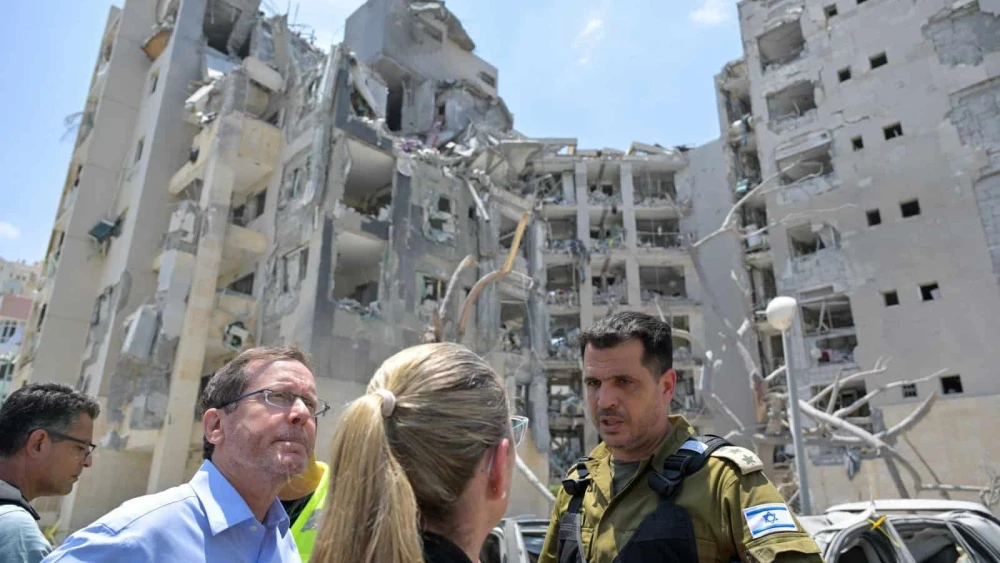
During Israel’s 12-day war last month with Iran, Geva and her team responded to missile strikes, securing impact sites and neutralizing potential secondary hazards.
“We ensure there are no unexploded ordnances or hazardous materials—some of which could even be carcinogenic—that could endanger rescue teams or civilians,” she said.
Part of Geva’s role involves identifying the type of missile used in each strike to determine whether it represents a known threat or a new kind of weapon. That process takes place amid chaos and coordination with emergency responders from the army, police and volunteer outfits like United Hatzalah.
“The destruction is hard to fathom,” Geva said. “You see people in their underwear, standing in the street because their home was just destroyed. Pets are wandering, the injured are being evacuated, and some people are trapped in air pockets beneath buildings.”

One of the missiles hit in Ramat Gan, not far from Geva’s home.
“All the buildings within 50 to 100 meters were wrecked. When you arrive, you have to breathe, stay focused and make quick, life-saving decisions,” she said. “It’s especially hard when it’s close to home. We all have emotions, but sometimes, those emotions make you faster and more effective.”
Geva said years of training have helped her channel fear into purpose.
“I’m 100% focused during the event. Sometimes I allow myself to break down after it’s over, but during the mission, there’s no room for doubt.”
Rescue under fire
First Sgt. Lielle Dahan, a patrol officer in the Israel Police for the past six years, was among those who rushed to rescue civilians in Beersheva following an Iranian missile strike.
At 5:30 a.m. on June 24, air-raid sirens sounded as Iranian missiles targeted the city. Dahan and her team responded to reports of a direct hit on a residential building.
“We found the impact site amid widespread destruction,” she told JNS. “I jumped over a fence to get inside. We started going floor by floor, entering every open door to evacuate residents.”
In one apartment, Dahan encountered a woman trapped behind a heavy closet in a safe room with her young daughter.
“I couldn’t reach the mother, but I took the child and promised her I would guide rescuers back to get her out,” she said. The woman was rescued 10 minutes later.
“Rescuing people is something the police do daily,” Dahan said. “But the level of destruction in this event—missiles hitting homes, people murdered—it was something I hadn’t seen before.”
She credited her training for helping her stay composed under pressure.
“When you see that kind of devastation, you’re shocked. But you quickly realize: This isn’t the time to be shocked. If you don’t act, no one will.”
Targeting Israel from within
While the direct confrontation with Iran lasted less than two weeks, the broader threat continues. Superintendent Sarit Peretz, head of the security department in Lahav 433, the Israel Police’s elite crime and intelligence unit, leads efforts to uncover Iranian espionage networks operating inside Israel.
Peretz has nearly 30 years of experience in the police. Her current focus is detecting and neutralizing Iranian attempts to recruit Israeli civilians via social media.
“Before Oct. 7, espionage looked like what we imagine from the movies—secret meetings, long-term relationships,” she said. “Now, Iran casts a wide net, contacting Israelis anonymously through platforms like Telegram and Facebook, offering quick money for small tasks.”
At first, the assignments seem innocent—taking photos of supermarket shelves or museum prices. Later, operatives are asked to photograph military bases or strategic infrastructure. Some are even lured into smuggling weapons or gathering intel on Israeli public figures.
“In one case, someone rented a home near the Haifa port to monitor incoming and outgoing vessels. The idea was to prepare for a possible infiltration by sea,” Peretz said.
Peretz emphasized that even if an Israeli realizes they are speaking with a foreign agent, continuing the interaction constitutes a criminal offense.
“We’ve already processed more than 40 detainees in over 27 incidents,” she said, noting the efforts are coordinated with the Shin Bet and Military Police when soldiers are involved.
While there is no standard profile for those approached by Iranian agents, financial hardship is a common thread.
“It usually starts with curiosity and easy money—but it escalates quickly.”
Women in security
Peretz began her career as a detective in Jerusalem and went on to lead Israel’s national unit against human trafficking. Today, she oversees investigations involving criminal organizations and national security threats.
She says women bring unique strengths to the field.
“Women are sharp. They think fast and have strong intuition, which is critical in interrogations and investigations,” she said. “The police force gives space and opportunity for women to advance, even if the work is demanding.”
As a mother, Peretz acknowledges the challenges.
“I come home at 6, sometimes 9 or 10 p.m., even 1 a.m. It’s hard, but it’s possible. I think I manage to keep everything under control.”



