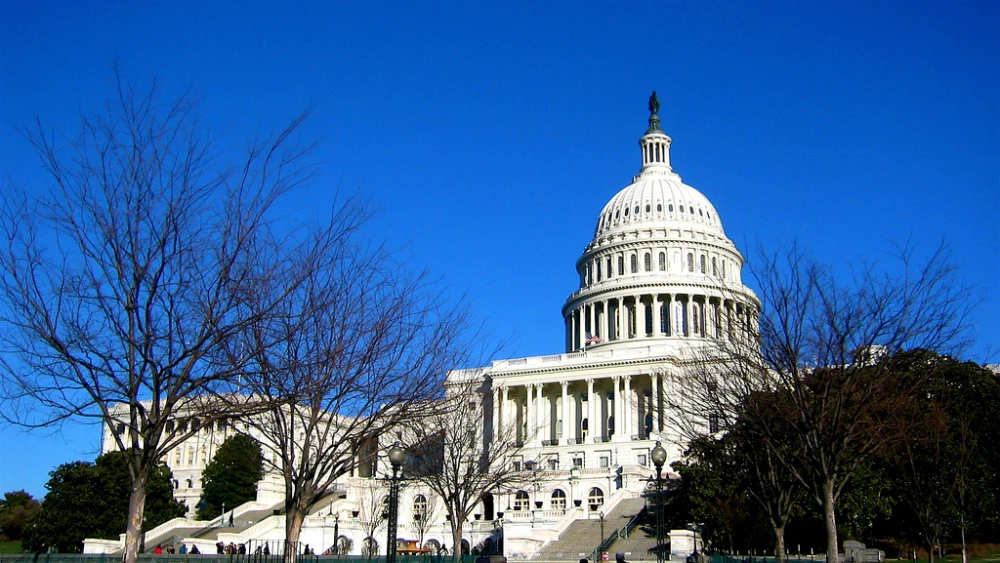
The House Appropriations Committee on Thursday advanced a bill that provides security aid to Israel without putting in place any preconditions, despite calls from a number of left-wing Democrats in recent months to condition security assistance to Israel.
The $62.24 billion fiscal year “2022 State, Foreign Operations and Related Programs Appropriations” bill fully funds the $3.3 billion in security assistance to Israel agreed upon in a 2016 Memorandum of Understanding (MoU), and was approved by the Appropriations Committee in a 32-25 vote.
The American Israel Public Affairs Committee (AIPAC) was quick to note the lack of conditions in numerous tweets it sent out expressing support for the bill’s provisions and listing parts that it deemed beneficial to Israel’s well-being and security.
“The committee’s appropriation, with no added political conditions, reflects the strong bipartisan commitment to Israel’s security in Congress and the Biden administration,” tweeted AIPAC. “A strong Israel makes America more secure. This critical aid helps ensure our ally has the resources needed to defend itself by itself in the world’s most dangerous region.”
Other items in the bill that are beneficial to Israel included:
- $50 million for the Nita M. Lowey Middle East Partnership for Peace Act, which helps build partnerships between Israelis and Palestinians to help fuel economic cooperation and support people-to-people, peace-building programs.
- $2 million to promote U.S.-Israel international development cooperation to address challenges in the developing world such as water scarcity, agriculture and energy storage.
- $6 million—a 20 percent increase from the previous fiscal year—for the Middle East Regional Cooperation program to facilitate collaborative research between Israeli and Arab scientists that promotes regional development, as part of the Israeli-Arab normalization movement.
The bill also includes what AIPAC called “strong language” condemning anti-Israel bias in the United Nations and among the world body’s agencies, as well as a provision requiring new reports to identify and eliminate anti-Semitic content in Palestinian textbooks.
Israel was not the only country receiving assistance in the bill. Others included Jordan, whose MoU was fulfilled at $1.52 billion, and Egypt, which received $1.3 billion for security assistance. But Egypt’s aid included additional governance and human-rights reporting requirements such as more stringent conditions on political prisoners and providing American citizens injured in Egypt with commensurate compensation, according to a summary of the bill.
The bill also increases economic assistance to the Palestinian people which, the summary states, is a sign that the United States is “reaffirming its strong support for achieving a negotiated two-state solution to the Israeli-Palestinian conflict.” The bill provides not less than $225 million under the Economic Support Fund for humanitarian aid and development needs in the West Bank and the Gaza Strip—a $150 million increase above for the fiscal year 2021 and $40 million above U.S. President Joe Biden’s budget request.