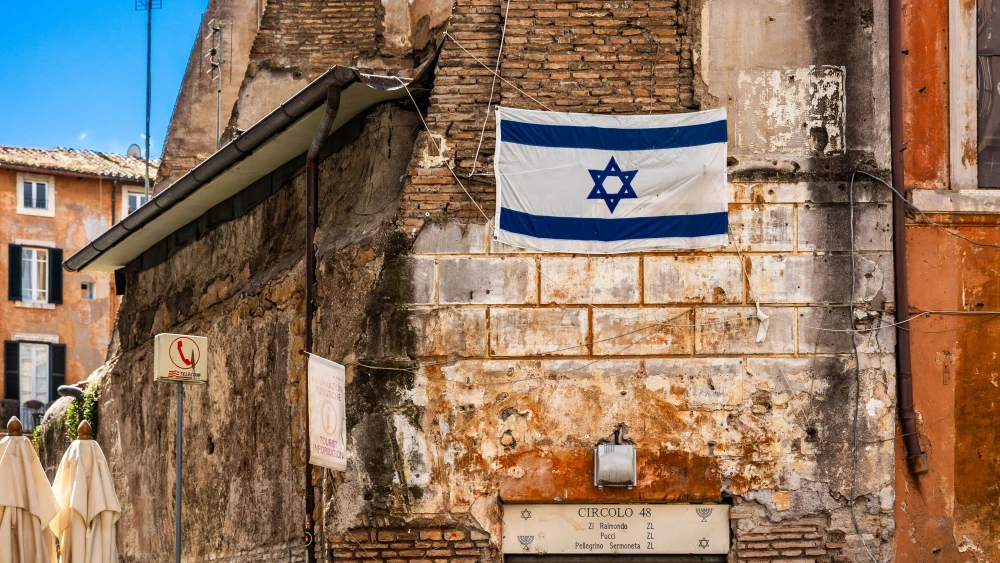

In 1547, during Rome’s Carnival, crowds gathered for a ritual designed to remind Jews of their place. Then it began: the sharp slap of bare feet against ancient cobblestones. Jewish boys—stripped completely naked, terrified, exposed—were forced to sprint through the streets as mobs spat, laughed and jeered.
This was the Corsa degli Ebrei, the “Race of the Jews,” a ritual of humiliation and abuse that took place along the Corso, or main street, of Rome. It was sanctioned by the pope, funded by the state and applauded by the public.
The purpose was not entertainment. It was humiliation elevated to public policy.
Jewish dignity existed only by permission. Jewish safety existed only until revoked.
We comfort ourselves by imagining such cruelty belongs to another age. It does not. The race never really ended. Only the route changed.
Today, the setting has changed, and now the mobs gather on college campuses, across social media and in public life. The methods evolve; the purpose does not. The goal is still to shame—isolate, silence and strip Jews of equal standing and civil protection.
We saw this in December 2023, during congressional testimony in which the presidents of several major U.S. universities were asked whether calls for the genocide of Jews violated their codes of conduct. Their answers—conditional, legalistic, evasive—revealed a truth too many still refuse to confront: When it comes to Jewish safety, institutions suddenly lose their moral vocabulary.
As Jews, we still show up. We vote. We build. We give. We lead. We participate in civic life not out of fear, but out of conviction—because responsibility, justice and democracy are deeply rooted in Jewish tradition.
Yet synagogues are attacked. Jewish students are harassed. Neighborhoods are defaced. And the problem is not isolated; it is becoming normalized.
In 2025, the Anti-Defamation League recorded 6,274 antisemitic incidents in the United States—an average of 17 anti-Jewish incidents every single day. Physical assaults reached historically elevated levels, and deadly antisemitic attacks in recent years underscored the continuing danger. Jews comprise barely 2.4% of the population in America, yet remain the overwhelming target of religious hate crimes.
This is not a spike. It is a cultural shift.
The pattern is not confined to the United States. Across Europe, Canada and Australia, antisemitic intimidation, vandalism and violence have surged since the Hamas-led terrorist attacks in southern Israel on Oct. 7, 2023. Jewish schools now require armed security. Synagogues increasingly resemble fortified buildings. Jewish families debate whether wearing a Star of David, displaying a mezuzah or speaking Hebrew in public is worth the risk.
These are not signs of a healthy society. They are unmistakable warning signs.
And when these acts occur, the leaders who rely on Jewish support often retreat. They grow cautious, then vague, then silent. They fall back on the safest sentence in modern politics: “We condemn all forms of hate.” A phrase broad enough to offend no one and protect no one.
Without consequences, condemnation is theater. It costs nothing. It changes nothing.
Worse, some political leaders continue to seek Jewish support even as they align themselves with coalitions and activist movements that tolerate or encourage antisemitism.
For too long, Jews have accepted a political arrangement in which our dependable support is taken for granted and our acquiescence assumed. We have allowed our security to be treated as conditional rather than guaranteed.
This is the old lesson repeating itself: Jews are welcomed when useful and abandoned when the partisan cost rises. Yet too many within our own community still cling to the illusion that quiet compliance will save us, blind to the reality that we are already standing starkly exposed.
In Rome, the Corsa degli Ebrei was a public spectacle meant to broadcast vulnerability. Today, the spectacle is less literal but no less deliberate. It unfolds in classrooms, corporate boardrooms, protest encampments, online mobs and political debates.
The message to Jews remains unchanged: You may participate, but your protection may vanish when it becomes costly. You may contribute, but loyalty to you may yield to political convenience. And your vulnerability will remain on display for all to see.
This is what connects the Jewish boys forced to run naked through the streets of 16th-century Rome to Jewish students hiding Stars of David on American campuses today. To Jewish parents afraid to send their children to Jewish schools. To Jews who lower their voices in public, remove Hebrew from social-media profiles or quietly question whether visible identity is still safe.
The “Race of the Jews” continues every time institutions decide that defending Jews is optional. But this cycle is not inevitable.
It ends when humiliation, literal or metaphorical, is no longer tolerated as the price of Jewish participation in public life.
It ends when institutions are forced to uphold the values they so confidently advertise.
It ends when people of good faith—students, parents, alumni, voters, donors and citizens—insist that antisemitism carries consequences.
It ends when leaders understand that antisemitism is not made acceptable by sophistication, activism, ideology or silence.
It ends when Jewish security and dignity are treated as absolute, not conditional.
It ends when Jews are treated with the same dignity, protection and civic acceptance afforded to all other communities.
It ends when Jews and their allies insist, consistently and publicly, that antisemitism is a moral failure that must be confronted wherever it appears.
There must be no more such races. Not again. Not here or anywhere. Not ever.