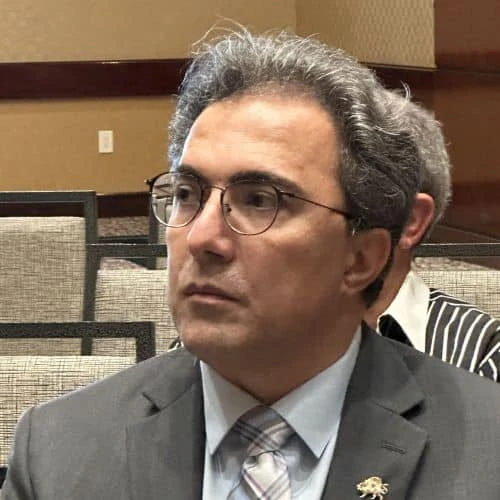
Iran plans to resume its nuclear program despite the war with Israel, the head of the Islamic Republic’s Atomic Energy Organization was quoted as saying on Tuesday.
“We planned to avoid any interruption in the nuclear industry process,” Mohammad Eslami told the state-run Mehr news agency in an interview. The article did not distinguish between military and civilian nuclear activity.
“Preparations for the revival [of the nuclear program] were foreseen in advance, and our plan is to not allow any interruption in the production and service process,” he added.
Israel attacked Iran earlier this month in what Prime Minister Benjamin Netanyahu described as a pre-emptive campaign with the goal of eliminating the nuclear and ballistic missile threat to Israel by the Iranian regime.
Prior to the strike, the United States and Iran had been engaged in nuclear talks, however, U.S. President Donald Trump had set a 60-day deadline for the negotiations. The Israeli military campaign began on day 61, after Tehran announced it would not give up uranium enrichment and increase the scope of its nuclear program.
The director general of the International Atomic Energy Agency (IAEA), Rafael Mariano Grossi, welcomed the announcement of a ceasefire between Israel and Iran on Tuesday, and urged Iran to resume negotiations and cooperation with the nuclear watchdog.
“I welcome announcements on Iran situation. Resuming cooperation with the IAEA is key to a successful agreement,” Grossi wrote on X, adding that he had written to Iranian Foreign Minister Abbas Araghchi “stressing this step can lead to a diplomatic solution to the long-standing controversy over Iran’s nuclear program.” Grossi “proposed to meet soon,” he added.
On Tuesday, hours after Trump announced the ceasefire, an Iranian rocket killed four people in Beershva. Additional projectiles were intercepted in northern Israel shortly after the Beersheva strike. Israeli Defense Minister Israel Katz said he’d ordered strikes in Tehran following the incidents Tuesday, which Katz said were an “utter violation” of the ceasefire.