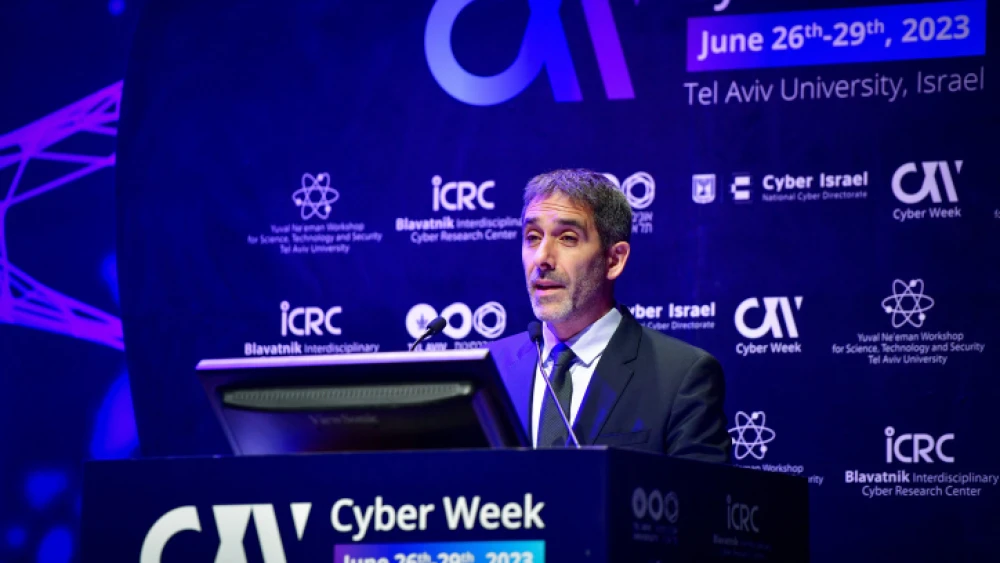
“Anyone who carries out cyberattacks against Israeli citizens must take into account the price he will pay,” said Gaby Portnoy, director general of the Israel National Cyber Directorate, on Tuesday.
Speaking at Tel Aviv University’s annual Cyber Week, Portnoy said: “In the past year, we have been working hard to develop our resilience and expand our capabilities to detect cyberattacks, raising our shields and expose malicious activities, specifically Iranian,” said Portnoy, noting the vast majority of attacks are thwarted.
Portnoy mentioned specifically a cyberattack against the Technion-Israel Institute of Technology carried out by two groups associated with the Iranian Intelligence Ministry. The February incident took the form of a ransomware attack. The hackers demanded 80 bitcoins ($1.6 million) to call it off.
Portnoy added that Iran was also preying on civilian targets in “many countries like Turkey, Saudi Arabia, Egypt, Morocco, India, Oman, Bahrain, Kuwait and more.”
The Israeli security community “knows the Iranian cyber activities inside out and is working to disrupt them in different ways,” he said.
He called for tighter international cooperation against Iranian cyber activities and commended the United States “for imposing sanctions against two active cyber players in the [Iranian] Ministry of Intelligence and Security: Mojtaba Mostafavi and Farzin Karimi, who co-founded the Ravin Academy that trains hackers for malicious activities of the ministry.”
Portnoy described some of the projects the Cyber Directorate has pursued over the past year, including partnering with the United Arab Emirates to build a “a multinational cyber collaboration platform.”
He also noted the expansion of Israel’s “Cyber Dome” project. Cyber Dome is a big-data, AI approach to cyber defense that Portnoy announced last year.
In January, Portnoy revealed that Israel’s cyber defense authorities had repelled more than 1,000 attempted attacks that collectively had the potential to cripple the country’s economy.
“As in the worlds of counterterrorism and spy games, the general public is mostly unaware of the attacks that have been stopped. Our job is to prevent those attacks that, if successful, would result in millions in damage to the economy and the country,” he said.