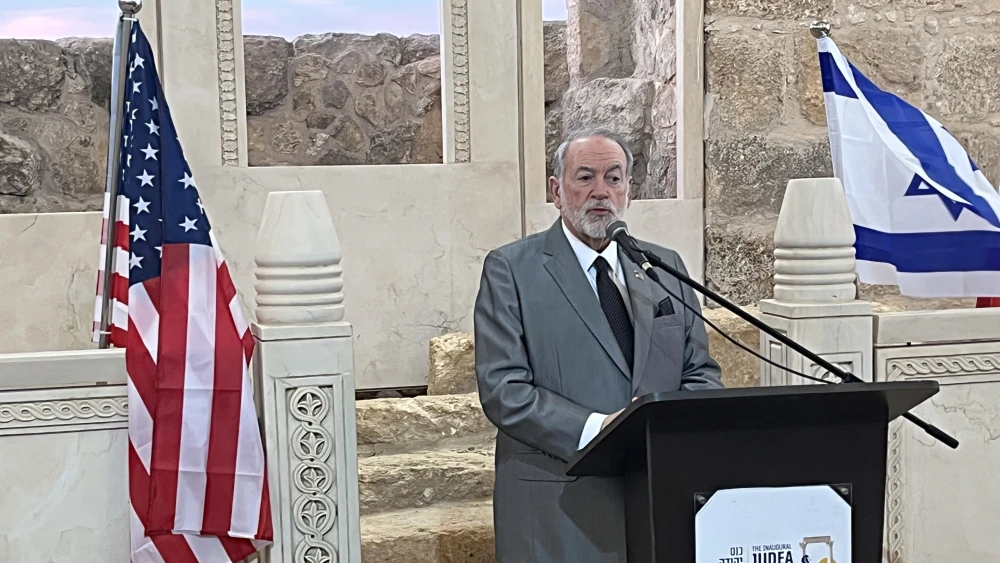
U.S. Ambassador to Israel Mike Huckabee visited Israel’s ancient Susya archeological site on Sunday in what local leaders described as a historic occasion, saying it marked the first time a sitting U.S. ambassador had visited the location.
Huckabee was in Susya to deliver the keynote address at the inaugural Judea Conference, hosted by the Hebron Hills Regional Council and its head, Eliram Azulay. The event drew government ministers, Knesset members and several hundred Israeli activists.
During his remarks the ambassador described his participation as “a great, great privilege.”
Huckabee emphasized the region’s central place in biblical history, calling Judea and Samaria “the heartland of Israel.”
“Eighty percent of the Bible took place” in Judea and Samaria, he said, adding that “it is impossible to even connect to the Scripture without connecting to Judea and Samaria.”
Huckabee added that he was particularly moved by Susya’s archaeological discoveries and biblical heritage, pointing to the ancient synagogue and a new visitor center expected to welcome thousands of guests from around the world. The site, he said, demonstrates that the region’s history stretches back some 1,500 years, with archaeological discoveries continually validating its biblical heritage.
“I love the history of it, but I love the fact that it is connected to the Bible, because I believe the Bible is the book that gives us our bearings. It points us true north,” Huckabee said, adding that the site gives Israelis reason to be grateful for their connection to the land.
During the conference, Israeli Diaspora Affairs and Combating Antisemitism Minister Amichai Chikli praised the organizers, telling JNS that Jewish residents of Judea had missed opportunities for many years to tell their story.
“So instead of our story going out, you had Masafer Yatta and all the BDS activists speaking,” he said.
He pointed to Israeli filmmaker Yuval Abraham, director of NAZA, which critics have characterized as anti-Israel propaganda, and co-director of the anti-Israel film No Other Land, noting that Abraham began his activities in the area.
Chikli described the region as a focal point for boycott activists, accusing some of orchestrating violent incidents targeting Jewish communities, particularly on weekends and during Shabbat.
The conference offered an opportunity to strengthen the public’s connection to Jewish communities across Judea by highlighting their biblical roots and introducing visitors to the communities themselves, he said. He noted that while many people are familiar with the Bible, they do not always connect its stories to the modern Jewish people and the Zionist movement.
“This is really the place where it all started,” Chikli said, pointing to the Cave of the Patriarchs in Hebron and the Kingdom of David. He said one of the conference’s most important missions was to bridge that gap while introducing visitors to the communities’ tourism, wineries, natural landscapes and archaeological sites.
Yigal Dilmoni, co-founder and CEO of American Friends of Judea and Samaria, used his remarks from the podium to describe what he sees as a shift in the relationship between Israel and its supporters in the United States. For years, he said, Israelis viewed American friends primarily as a source of financial assistance, diplomatic backing and support at the United Nations. Now, he argued, Israel has much to offer in return.
Speaking to JNS, Dilmoni elaborated that Israel, particularly Judea and Samaria, can share its biblical heritage, history and values with Americans and other supporters around the world.
“We are so powerful here in Israel, especially in Judea and Samaria, that we have a great deal to offer our friends around the world,” he said, explaining that Israel can help people better understand the Bible, learn about the biblical values that helped shape the United States, and find greater meaning in their faith.
Dilmoni added that Israel and its supporters can work together to defend Western values, which he said are challenged by radical Islamism and radical socialism.
He described the inaugural Judea Conference as an opportunity to share the Jewish people’s historical connection to Judea with an international audience.
Ayala Bar-On, director of the international desk for the Hebron Hills Regional Council and emcee of the event, told JNS that Huckabee’s visit was an important opportunity to spotlight Judea, a region many people around the world know little about. She emphasized the significance of the visit and the responsibility to raise awareness of the area.
Bar-On also spoke about the conference’s focus on combating antisemitism, saying that the suffering of Jewish communities abroad should not be viewed as a distant concern for Israelis.
“Antisemitism might sound far away, but if Jews are suffering, it’s not far away. We are all connected,” she said. “It’s our responsibility to be aware of that, and the discussion today is how do we change the paradigm and make us stronger and more helpful. Israelis are responsible for our brothers and sisters abroad.”
In addition to a roundtable on combating antisemitism, other sessions featured discussions on Zionist activism, Israeli sovereignty and efforts to strengthen Israel’s international standing. Participants also toured the ancient Susya heritage site.
Another one of the highlights was a special ceremony at ancient Susya’s approximately 1,500-year-old Byzantine-era mosaic-tiled synagogue, where Huckabee unveiled an ancient stone that once formed part of the façade of the synagogue’s Torah Ark. A choir dressed in garments modeled on ancient Levitical attire performed Psalms during the ceremony.
Inside the synagogue, Huckabee reflected on the historical connection between the United States and the Jewish people.
“America this summer celebrated 250 years of its history. We thought that was a pretty big deal. Two hundred and fifty years,” he said.
“This place [Susya] has been here nine times longer than that. And if you think about how long the nation of Israel has been here, and the city of Jerusalem—well over 3,000 years—and the Jewish people, 3,800 years, it’s a pretty extraordinary connection to the land and to God’s hand in maintaining the presence of His people in this very sacred, sacred place. Thank you for giving me the privilege of being here on this magnificent occasion. May God bless you all.”