
In the Black Sea province of Trabzon on Sept. 5, Turkey’s governing party held a congress for the graduates of its Imam Hatip religious schools. The host was ÖNDER, a nationwide network that works hand in glove with the Turkish Ministry of National Education, which runs a state system teaching more than a million children.
The star guest was not an educator. He was a son of Ismail Haniyeh, the Hamas senior leader assassinated by Israel in 2024.
Haniyeh the younger did not come to talk about schools. Standing beside Turkey’s education minister and a senior figure from the Diyanet, the vast state religious directorate, he used his father’s death to summon vengeance.
Then, he told the hall to treat Turkey’s religious education as the working partner of the ideological machine on which Hamas was built. The chairman of ÖNDER agreed, declaring that the legacy of Gaza’s young fighters now rested on the Imam Hatip movement.
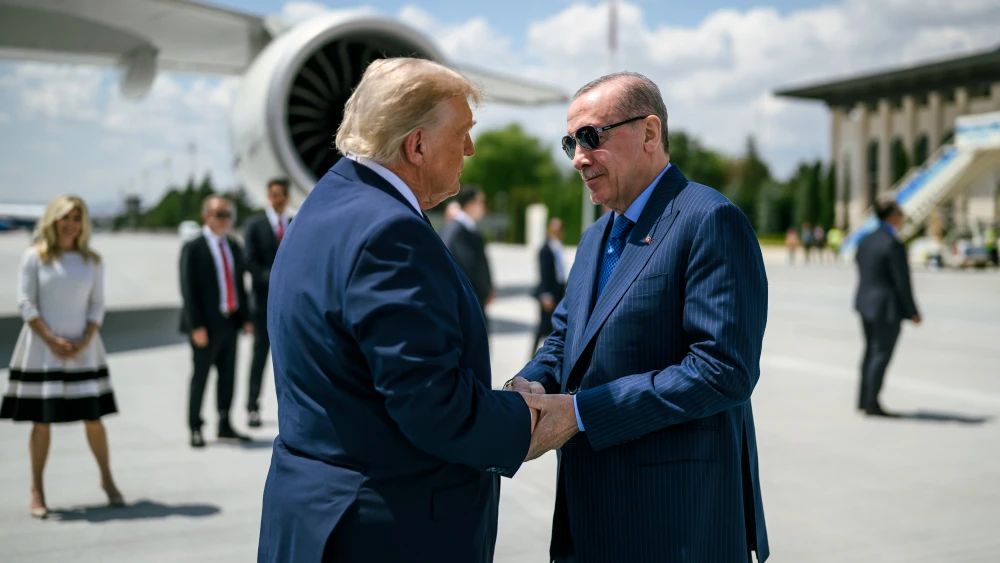
Turkish President Recep Tayyip Erdoğan sent a warm video message blessing the event. Read that again: The head of a NATO member state lent his highest office to a platform where the son of a Hamas chief preached holy war.
This was not a slip or a one-off. It was of a piece with everything he’s said and done.
After the atrocities in southern Israel on Oct. 7, 2023, Erdoğan told the world that Hamas was “not a terrorist organization” but a group of “liberators.” Days later, he called Hamas fighters “mujahideen defending their land.” In April 2024, he warmly received Ismail Haniyeh himself in Istanbul, as a head of state would receive a friend. He suspended trade with Israel and turned the massacre’s aftermath into a recruiting theme.
A man shows you who he is when he keeps showing you who he is, and Erdoğan has stopped bothering to hide it.
I want to be precise, because precision is what this subject deserves and rarely gets. I am not saying that Turkey is a nation of extremists. Most Turks want what most people want: a decent life and a government that leaves them in peace. Many of them loathe what their president has made of their country. The charge is against a regime and the machinery it has built.
Under Erdoğan, the state has turned the Imam Hatip track from a small vocational niche into a pillar of national schooling, from roughly 60,000 pupils in 2002 to well over a million today. In 2017, his government struck the theory of evolution from the national curriculum while adding the concept of jihad. Each year the budget of the Diyanet swells until it rivals that of entire ministries. None of this is accidental. A government that decides what a child is taught is deciding what a country will believe in 20 years.
The Jewish reader hardly needs the danger spelled out. Hamas, a movement whose 1988 founding charter invokes the killing of Jews, was handed a microphone by an arm of a NATO government, and the room applauded.
The problem is larger than a threat to a single community. NATO was founded in 1949 to defend open societies against totalitarian states, and its promise rested on the rule of law and individual liberty. One of its most powerful members now hosts and flatters an Iranian-aligned faction that murders civilians and executes hostages—and does so with every privilege of the Western alliance intact.
Does NATO membership mean standards, or does it mean impunity?
Those privileges are real: Incirlik airbase, control of the Turkish Straits and one of the largest armies in the alliance. That is the uncomfortable part.
The issue goes beyond this, however, because Ankara has learned to wield its NATO membership as a weapon against NATO itself. In 2019, it bought the S-400 air defense system from Vladimir Putin’s Russia—the power NATO exists to deter—and was thrown out of the American F-35 fighter program and sanctioned for it. For almost two years, Turkey blocked Sweden and Finland, two model democracies, from joining NATO, extracting concessions for each month of delay.
This is not an ally that occasionally embarrasses its partners. It is a member that trades on its seat, knowing the others are too frightened of losing it to hold it to account. Geography fixes a nation’s borders. It does not fix its conduct, and it should never buy a pass for it.
How far the Erdoğan government will go is not a matter of guesswork.
When the Turkish Iranian trader Reza Zarrab began cooperating with American prosecutors over a vast scheme to break Iran sanctions through the state bank Halkbank, a scheme that reached into Erdoğan’s circle, there was, according to reporting, an attempt to have him killed inside a New York jail. The plot failed. What it revealed did not.
It showed that Turkey is a state prepared to reach American soil to silence a witness, while sitting at the Western table and drawing a Western salary in trust and protection.
We rightly keep an eye on Putin’s tanks and Chinese President Xi Jinping’s factories. Erdoğan is a quieter problem, and in some ways a more dangerous one, because he works from inside the house. Moscow and Beijing press on the West from without, and we can see them coming. Ankara uses its NATO seat, its veto and its place at the hinge of three continents to shield the very forces sworn to tear the West down. It is subversion with a membership card.
For Cyprus, none of this is theory. We have lived next to this regime, and under part of it, for half a century.
In 1974, Turkey invaded and still occupies the northern third of my country. Tens of thousands of its soldiers remain on our soil. The statelet Turkey props up there is recognized by no country on earth except Turkey, in defiance of the U.N. Security Council. When Ankara began reopening the sealed ghost town of Varosha, the Council condemned it again.
Turkey does not recognize the Republic of Cyprus at all, or the waters that are ours under the law of the sea. It sends warships to shadow the vessels that explore for gas in our own economic zone.
We hold no illusions that a government comfortable giving Hamas a stage will be gentle with a small neighbor it already treats as half-conquered. What a state teaches its young today becomes its officer corps, its foreign ministry and its navy tomorrow, and we are the coastline those people will be taught to covet.
So, the question for Washington, London, Berlin and Paris is simple. And it is a question about principle, not just Turkey alone: Does NATO membership mean standards, or does it mean impunity?
If it means standards, then hosting and legitimizing terror must carry a cost in intelligence sharing, weapons technology and rank within a command structure. After all, an alliance that cannot discipline its own worst member cannot credibly defend anyone.
Turkey is neither untouchable nor indispensable. An ally cannot keep shaking the West’s hand while holding a knife behind its back, and the West cannot keep pretending it does not feel the blade.