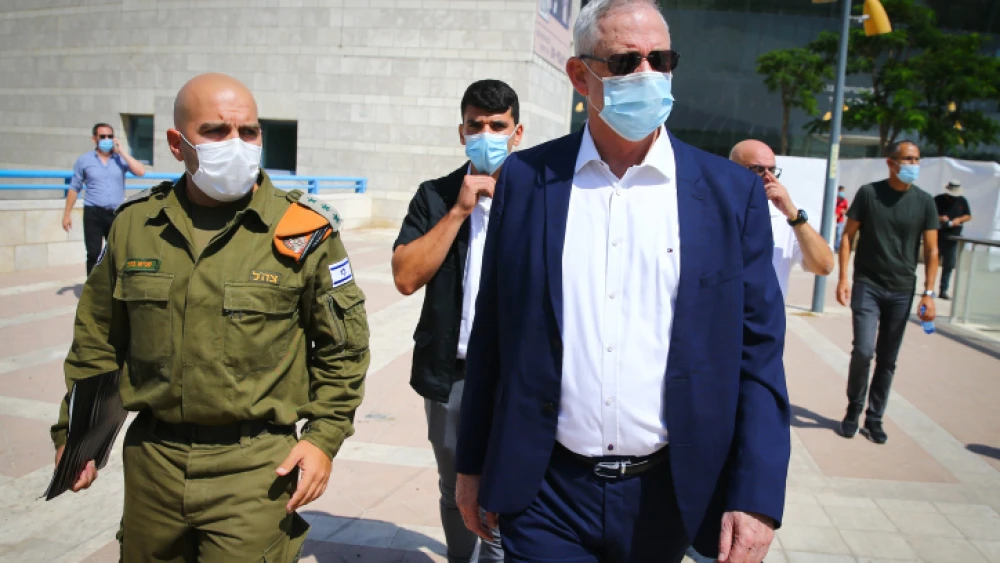
In the wake of a reported U.S.-UAE deal in the works for the sale of F-35 fighter jets, Israel’s Defense Minister Benny Gantz departed for the United States on a brief 24-hour visit on Monday night, where he is scheduled to meet with U.S. Secretary of Defense Mark Esper and other senior members of the Trump administration.
According to a Reuters report, the United States and the UAE “hope to have an initial agreement on the sale of F-35 stealth fighter jets to the Gulf state in place by December, as the Trump administration studies how to structure a deal without running afoul of Israel.”
“I’m heading to the U.S. for a series of very important defense meetings for the future of the State of Israel’s security,” Gantz said ahead of his take-off. “I’ll meet tomorrow with U.S. Secretary of Defense and his colleagues, and we’ll discuss ways for continuing the struggle against Iran and ensuring the qualitative edge of the State of Israel.”
U.S. Congress is committed to ensuring Israel’s Qualitative Military Edge, or QME—a commitment codified in American law—and it approves arms sales accordingly.
According to a Ynet report on Tuesday, Israel is expected to request a “compensation package” in exchange for the expected American F-35 sale to the UAE, which could include an earlier-than-planned delivery of Boeing KC-46 refueling aircraft, which the State Department approved for sale to Israel in March. Israel is expected to purchase eight such planes and accompanying equipment at a cost of $2.4 billion, and as part of the “compensation,” four could arrive early.
Israel is expected to order a third squadron of Lockheed Martin 5th Generation F-35 aircraft and Boeing F-15 EX jets, which will include a series of upgraded capabilities. While it is unclear whether those likely future acquisitions will feature in Tuesday’s talks, the Ynet report said that Gantz is expected to discuss long-range munitions during his visit.
‘We have to build a type of strategic coalition’
Ofer Israeli, an expert on international relations and the Middle East at the Interdisciplinary Center Herzliya, told JNS that U.S.-Israeli agreements in the wake of the F-35 sales should include “compensation” in the form of weapons systems sales that will safeguard Israel’s military advantage, in line with the agreement in place between Washington and Jerusalem.
“So long as Gantz returns with more of the weapons systems that Israel already possesses, even if it’s in greater quantities, I’d view that as a failure,” said Israeli. “There are three things Israel can request—I don’t know if it can get them, but the dialogue on them should begin. The first is a request to acquire the F-22 Raptor,” Israeli said, adding that Israel can comply with all needed restrictions about where it can and cannot fly the F-22.
In addition, he said, Israel can request to purchase cruise missiles—powerful game-changing weapons that America has previously refused to sell to other states. Lastly, added Israeli, the defense minister can request the purchase of bunker-busting bombs, saying “it’s fair to assume that Gantz will ask for these,” stated Israeli.
While the United States will have a difficult time approving some of the requests, the dialogue should nevertheless begin, Israeli argued, “if not now, then when the next treaty—perhaps with Saudi Arabia—is signed.”
Beyond such acquisitions, Israeli said, it is vital for Israel to take part in the creation of a regional alliance that will change the balance of forces in the Middle East. This coalition would be made up of states that are in varying degrees of conflict with Iran, and even though Arab Gulf states have economic ties with the Islamic Republic, they are more threatened by it than even Israel, he stressed. This was most recently highlighted by Iran’s violent threats against Bahrain and the UAE following their recent normalization deals with Israel.
“We have to build a type of strategic coalition, a Middle Eastern NATO, whose goal is similar to the original NATO’s goal at its beginning. As the original NATO blocked the Soviet Union, the Middle Eastern version of NATO is designed to block Iran, as well as any other state with imperialistic intentions in this region,” said Israeli. This entails getting regional states to set up local forces in coordination with one another, under an American protective umbrella over the entire coalition vis-à-vis Iran and potential future adversaries.
“There also must be restrictions in place, so that Israel will not be limited in its freedom of activities, and to also ensure that agreements don’t mean that Israel must join every military adventure of every regional state. The right formula for that must be found,” he added.
Finally, said Israeli, the Jewish state must address the critical question of how any American pledges are kept after Jan. 20, when the winner of the upcoming presidential elections either enters or remains in office. “We have to address this so that Israel doesn’t wake up with only promises without an ability to implement them,” he said.
One precedent for this being done successfully in the past, he said, was the Memorandum of Understanding that the Netanyahu government signed with the Obama administration in 2016, which was sealed prior to the presidential elections.