


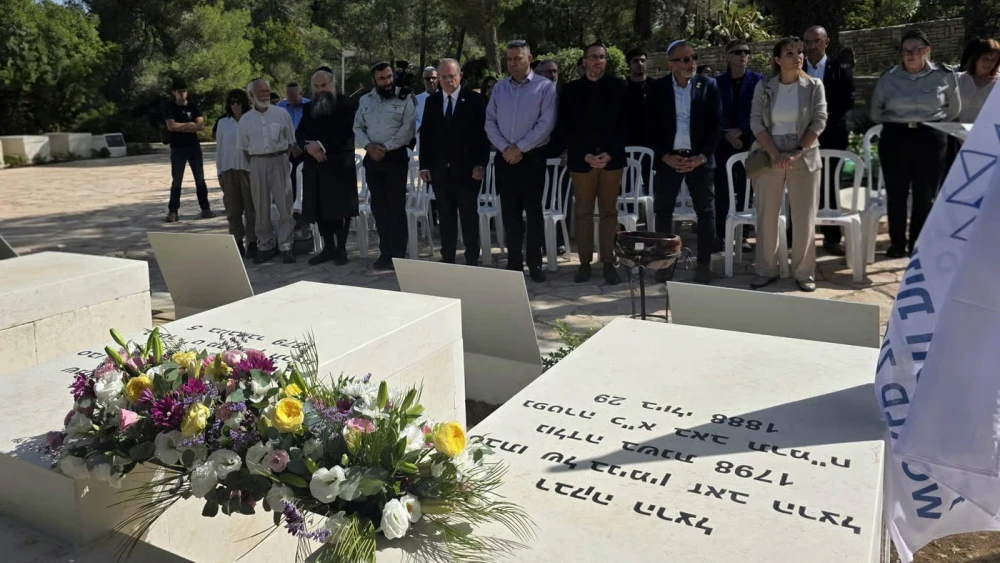
The gravestones of Theodor Herzl’s grandparents were unveiled on Jerusalem’s Mount Herzl on Monday, exactly 109 years after the Balfour Declaration.
Shimon Aryeh (Leib) and Rivka Herzl, grandparents of the founder of modern political Zionism, were reinterred at Mount Herzl in August after their remains were brought to Israel from Serbia.
World Zionist Organization chairman Yaakov Hagoel, Keren Hayesod chairman Eli Hazan and ZAKA Director-General Tzvi Hassid attended Monday’s ceremony, along with public representatives and members of the Herzl family.
“Even today, there are those who try to disconnect Herzl from his Jewish roots and portray Zionism as a movement that broke away from tradition,” Hagoel said at the ceremony. “Today, here on Mount Herzl, the historical truth stands before us. It is no coincidence that we are standing here on the anniversary of the Balfour Declaration.”
The couple was buried on Aug. 5 in the Herzl family plot in a state ceremony attended by Israeli President Isaac Herzog, Israeli Prime Minister Benjamin Netanyahu and Knesset Speaker Amir Ohana.
Their reinterment followed some four years of diplomatic, religious and logistical efforts involving the World Zionist Organization, Israel’s Foreign Ministry, the Military Rabbinate, ZAKA and Serbian authorities.
The effort produced an unexpected discovery when officials opened what was believed to be Shimon Leib’s grave in Zemun, Serbia, in July and found it empty. His remains were eventually located beside his wife Rivka’s grave.
Zionist roots
Shimon Leib Herzl was active in the Jewish community of Zemun, now part of Belgrade, and was a follower of Rabbi Yehuda Alkalai, an early advocate of the Jewish return to the Land of Israel whose ideas preceded the emergence of modern political Zionism.
Herzog noted at the August reinterment that Shimon Leib served as a gabbai at Alkalai’s synagogue and would have been exposed to the rabbi’s ideas about Jewish sovereignty, the revival of Hebrew and the return to the ancestral homeland.
Theodor (Binyamin Ze’ev) Herzl, born in Budapest in 1860, convened the First Zionist Congress in Basel in 1897 and became the central figure in the movement to establish a Jewish homeland.
He died in Vienna in 1904, and his remains were brought to Jerusalem in August 1949, a little more than a year after the establishment of the State of Israel.
Monday’s ceremony was held exactly 109 years after British Foreign Secretary Arthur James Balfour issued the declaration bearing his name on Nov. 2, 1917, expressing the British government’s support for the establishment in Palestine of a “national home for the Jewish people.”
“The declaration, which was addressed to Lord Rothschild and the Zionist Organization, gave the Jewish people international recognition, but Balfour did not give us the right to the land—he merely recognized it,” Hagoel said.
“Our right was born from the longing and prayers of Jews like Shimon and Rivka Herzl,” he continued. “At a time when our enemies are trying to undermine our existential right, their burial here today is a symbol of life and national revival.”
