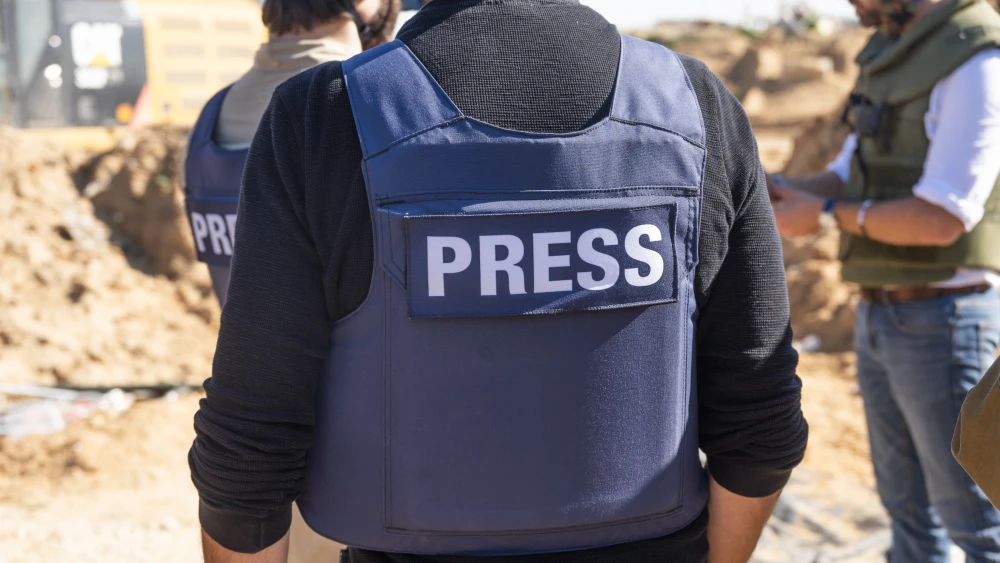
A terrorist wearing a press vest is not an acceptable military target, Francesca Albanese, a U.N. special rapporteur, told JNS in an extended exchange last week.
“If you don’t take part in active combat, if you are not a militant actively involved in combat, you cannot be shot at,” Albanese, whom the United Nations considers an “independent expert,” told JNS at a press briefing, during which she outlined her latest report, in which she accuses Israel of “mediacide.”
The U.N. adviser, who has often accused the Jewish state of “genocide,” said at the beginning of the briefing that she couldn’t attend in person due to U.S. sanctions on her.
She told JNS that Gazans “having been photographed with a uniform” of a terror group “doesn’t make the journalist killable.”
“I’m saying that, because there are Israeli journalists who have been active in the army who have even taken part in the expeditions into Gaza, when they go back to do their journalist work,” she told JNS. “Does it make a target?”
“For me the answer is clear. A person who’s not actively involved into combat doesn’t lose civilian status. That’s it. Israelis or Palestinians alike,” Albanese said.
Brian Cox, a senior fellow at the Macdonald-Laurier Institute in Canada and a U.S. Army military lawyer for seven years, told JNS that Albanese is “taking an unrealistically narrow interpretation of the international law standard.”
The U.N. adviser is “passing that off as if it were the legitimate standard that countries, including Israel, should recognize,” Cox said.
The standard that Albanese described “is just not consistent with any state practice,” said the former military prosecutor, federal prosecutor, brigade judge advocate and military magistrate.
Albanese’s view is “one that wouldn’t even be supported by the International Committee of the Red Cross interpretive guidance,” which was developed because international law on the matter of direct participation in hostilities was left “intentionally vague,” Cox told JNS.
Cox noted the operational law handbook developed by the national security law department at the Judge Advocate General’s Legal Center and School.
“The United States approach begins by recognizing that members of hostile, non-state armed groups are combatants, who may be targeted based on their formal or functional membership in the armed group,” the handbook states.
“In such cases, U.S. forces need not conduct a DPH analysis as group membership provides the proper basis for attack,” it states. (DPH means a “direct part in hostilities.”)
Israel’s view is mainly similar to that of the United States, according to Cox.
“It’s not uncommon for humanitarian advocates and activists like this particular special rapporteur, especially, to misrepresent international law in a way that supports their preferred narrative,” he told JNS. “They’re not experts in this international law involving armed conflict.”
Albanese told JNS at the U.N. press conference that she doesn’t “even enter the quagmire of the, like, conundrum of Hamas and terrorists, because let’s leave the terrorist scheme aside.”
“It’s very convenient. It has been the label to kill everyone to bring famine upon everyone in Gaza to destroy Gaza,” she said.
Albanese told JNS that “I think you have seen the images of Gaza.”
“Labeling everyone as ‘terrorists’ has paid off. Voila. The price is in the rubble. However, what I’m saying in order for—a journalist is a civilian,” she said. “In order to lose his or her civilian status, the journalist needs to take active part in combat.”
“So even assuming that Israel had a right to self-defense, and it doesn’t under international law. Israel doesn’t have and cannot claim the right to wage a war against Gaza,” she told JNS. “The reason why the international community is letting it happen is not even a mystery—is known and it’s very saddening, depressing in fact. But Israel could not be there shooting at everyone just because he claims that these people are terrorists.”
“All the more people who he, Israel, deems have been affiliated to a terrorist organization. Because again, if you don’t take part in active combat, if you’re not a militant actively involved in combat, you cannot be shot,” she said.
International law “makes clear that being affiliated or even sharing information that is seen as coming from a belligerent party” doesn’t suspend the protection “that is guaranteed by international law,” she told JNS.
“It’s only taking active part in combat while the person is hit that makes the person lose protected status,” Albanese told JNS.
The U.N. adviser also told JNS that she didn’t have the same patience as others at the United Nations for questions from JNS.
International law is not clear about what constitutes a journalist taking direct part in hostilities. The International Committee of the Red Cross states that “passing on tactical information” or “engaging in espionage/spying” are “likely to be a direct participation in hostilities.”
The Committee to Protect Journalists took 22 names off its list of media members killed during the war after an internal investigation showed that they had terror ties, and the BBC is conducting a review of its own list based on a report in the Telegraph that 53 people in the BBC database of killed Gazan journalists had links to Hamas, Palestinian Islamic Jihad or other terror groups.
Albanese told JNS that her report relies “on the figures provided by the United Nations, and everything I’ve asserted in my report has been checked and double-checked with U.N. personnel, as well.”
“If any one of the Palestinian journalists had been involved in the attacks, as you claim, in the massacres that Israel suffered on Oct. 7, they were supposed to face justice,” she said. “I don’t have information that this is the case.”
“If you do, I would be happy to receive and review,” she told JNS.
JNS asked the office of Volker Türk, U.N. high commissioner for human rights, for a copy of its list of slain journalists, upon which Albanese said she relied in her report.
“We don’t release lists of verified fatalities. We release numbers and analysis of trends,” a spokesman for Türk told JNS. “Our methodologies are public and explained in detail in all of our reports.”