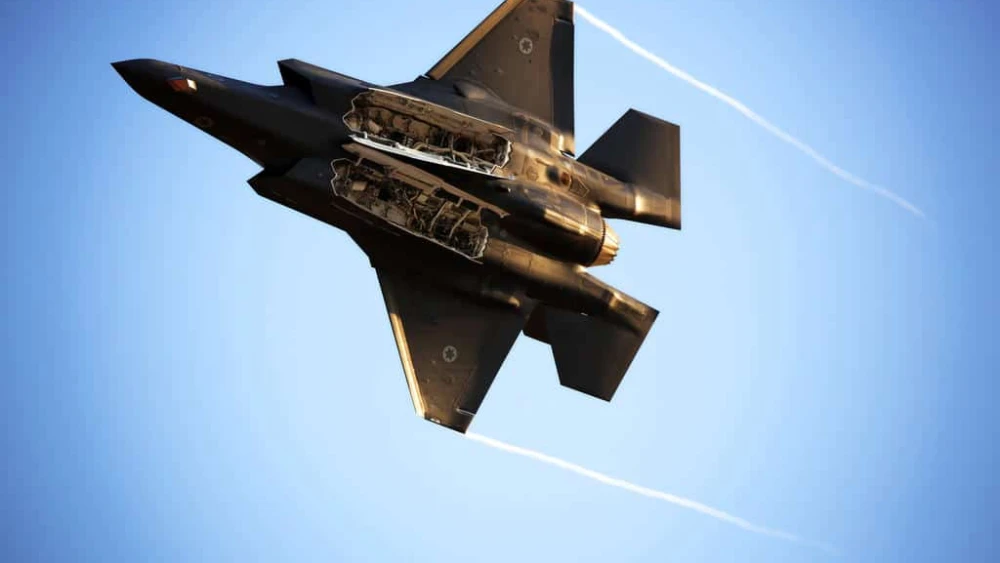
An appeals court in the Netherlands on Monday ordered the government to suspend all exports of spare parts for F-35 fighter jets to Israel over allegations they could be used to commit “serious violations of international humanitarian law” during the war against Hamas.
The Hague Court of Appeal overturned a December 2023 ruling that concluded that the Dutch government did not have to reconsider its export permit for U.S.-owned parts stored in the south of the country.
Under a 2019 U.S. Department of Defense contract, Dutch consortium OneLogistics stores and ships spare parts for the more than 500 F-35s in use by European militaries and the Israel Defense Forces.
The court ordered the state to halt exports to Israel within seven days and dismissed a request to suspend the order pending an appeal to the Supreme Court, which was announced just hours later.
“The State is lodging an appeal in cassation against the judgment of The Hague Court of Appeal on the distribution of American F-35 parts to Israel. In the government’s view, it is up to the State to determine its foreign policy,” Minister for Foreign Trade and Development Cooperation Geoffrey van Leeuwen tweeted on Monday afternoon.
“We have agreements with other F-35 countries on the distribution, and the Netherlands must remain a reliable partner. And Israel needs the F-35 aircraft to defend itself against threats emanating from the region, separate from Gaza,” he added.
Quoting Amnesty International and “various experts affiliated with the United Nations,” Monday’s ruling claimed that the Israeli offensive in Gaza has resulted in “large numbers of civilian casualties, including thousands of children” and the destruction of “thousands of homes.”
“Every residential area is attacked if there is even the slightest indication of terrorist activity; previously applied limits regarding ‘collateral damage’ have been expanded during the current conflict; the policy of warning civilians before an attack has been abandoned,” continued the ruling.
“It is undeniable that there is a clear risk the exported F-35 parts are used in serious violations of international humanitarian law,” the court said.
The court also downplayed concerns that the Israeli Air Force might require F-35 spare parts during “a possible war against countries or other militant groups in the region” such as Iran or Hezbollah, with the ruling saying that “such a war is currently not taking place.”
If the Dutch government complies with Monday’s order, Israel will likely have to procure F-35 components directly from the U.S., which could slow down the supply chain. The Israeli Prime Minister’s Office and IDF declined to comment on the possible consequences of the ruling.
The case against the Dutch government was brought by local anti-Israel pressure groups Oxfam Novib, PAX Netherlands and The Rights Forum.
Israeli ground forces entered Gaza on Oct. 27 following weeks of air strikes in response to Oct. 7 Hamas attacks in which some 1,200 people were murdered, thousands more wounded and 253 taken captive.
One of Jerusalem’s premier goals for the war in Gaza is the complete destruction of Hamas’s military and governing capacities.
During a pre-scheduled meeting with Dutch Prime Minister Mark Rutte in Jerusalem on Monday, Prime Minister Benjamin Netanyahu “emphasized that Israel would not leave intact the terrorist battalions in Rafah and added that the war is expected to continue until total victory over Hamas,” according to a PMO readout.
The Netherlands has previously come out against the looming Israeli counterterror offensive in Rafah. Foreign Minister Hanke Bruins Slot on Sunday called the imminent operation in the city “unjustifiable,” adding that it was “hard to see how large-scale military operations in such a densely populated area would not lead to many civilian casualties.”
Israel maintains that it takes extraordinary measures to prevent harm to uninvolved civilians. Hamas is known to use civilian infrastructure, including schools, hospitals and residential structures, to shield its terrorist activities.
Later on Monday, Rutte was scheduled to meet with Palestinian Authority Prime Minister Mohammad Shtayyeh to discuss the establishment of “a viable Palestinian state, alongside a secure Israel.”