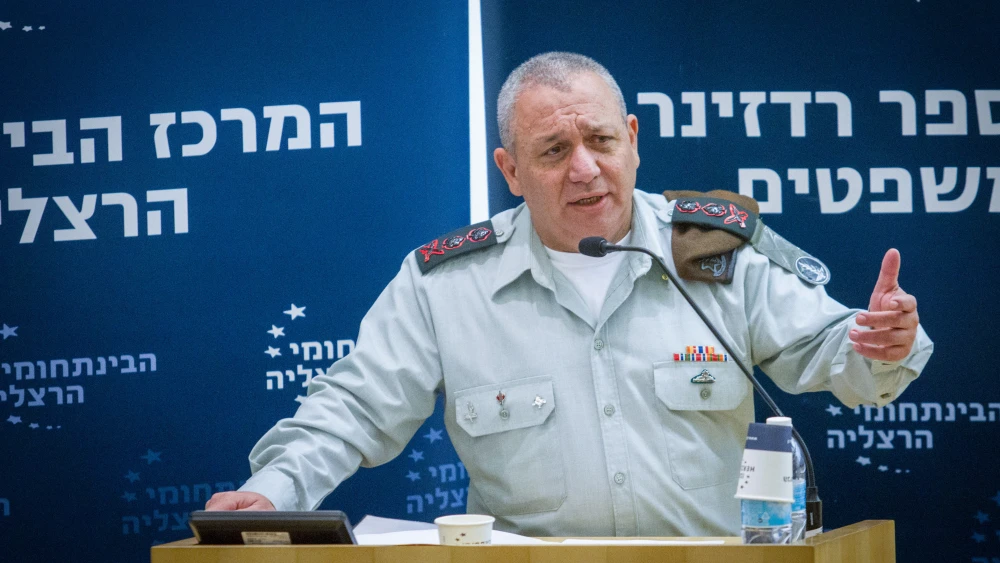
Israel has struck thousands of targets in Syria “without claiming responsibility or asking for credit,” outgoing IDF Chief of Staff Lt. Gen. Gadi Eizenkot told The New York Times in an interview published this weekend.
Israel has to focus its efforts on its most formidable enemy, Iran, as opposed to secondary foes such as Hamas in Gaza, he said.
“When you fight for many years against a weak enemy, it also weakens you,” said Eizenkot, who become the first IDF chief to take Iran head on, in addition to fighting its proxies in Lebanon and elsewhere.
“We operated under a certain threshold until two-and-a-half years ago,” he said of Israel’s past policy of mainly striking weapons shipments destined for Hezbollah in Lebanon.
“And then we noticed a significant change in Iran’s strategy. Their vision was to have significant influence in Syria by building a force of up to 100,000 Shi’ite fighters from Pakistan, Afghanistan and Iraq. They built intelligence bases and an air force base within each Syrian air base. And they brought civilians in order to indoctrinate them,” he said.
By 2016, Eizenkot estimated, Iran’s Islamic Revolutionary Guard Corps had deployed 3,000 fighters in Syria, along with 8,000 Hezbollah fighters and another 11,000 foreign Shi’ite troops. Iran invested $16 billion over seven years in the effort.
In January 2017, the Israeli government gave Eizenkot the green light to change the rules of the game and Israeli attacks became near-daily events.
In May 2018, Iran attempted to retaliate to increasing Israeli attacks by launching “more than 30 rockets toward Israel.” None reached their target and Israel responded harshly in an assault that hit 80 separate Iranian military and Assad regime targets in Syria.
Asked what caused Gen. Qassem Soleimani, the head of the IRGC’s elite Quds Force, to miscalculate, Eizenkot suggested a combination of overconfidence, based on Iran’s success in saving the regime of Syrian President Bashar Assad from collapse and underestimation of Israel’s determination to stop him.
“[Soleimani’s] error was choosing a playground where he is relatively weak,” said Eizenkot. “We have complete intelligence superiority in this area. We enjoy complete aerial superiority. We have strong deterrence and we have the justification to act.”
“The force we faced over the last two years was a determined force, but not very impressive in its capabilities,” he added.
As for Hezbollah and its leader, Hassan Nasrallah, Eizenkot said the terrorist group had devised a three-pronged strategy to invade and conquer parts of Israel’s northern Galilee. It built factories in Lebanon that could produce precision-guided missiles; dug attack tunnels under the Israeli border; and set up a second front on the Syrian side of the Golan Heights.
The plan has thus far failed, according to the outgoing IDF chief. The factories were publicly exposed, the tunnels destroyed, and Israel continues to attack Hezbollah positions on the Golan.
“I can say with confidence that as we speak Hezbollah does not possess accurate [missile] capabilities except for small and negligible ones,” he told the Times. “They were hoping to have hundreds of missiles in the mid- and long-range.”
Consequently, according to The New York Times report, Hezbollah is unlikely to soon start another war with Israel.
Meanwhile, Soleimani has pulled his forces back from the Israeli border and has withdrawn some altogether. The renewal of U.S. sanctions has also squeezed Iran’s ability to finance its regional adventures.
Iran may now turn its focus elsewhere, suggested Eizenkot: “As we push them in Syria, they transfer their efforts to Iraq,” where the U.S. still has thousands of troops.