Faced with the Iranian threat, Israel’s politicians make a show of unity. A new poll finds that the public itself no longer sees Iran as the country’s chief danger, but its own internal condition—and that the external enemy has stopped holding the country together.
On Feb. 2, emerging from a security briefing with the prime minister, opposition leader Yair Lapid kept it short: The entire State of Israel is united against Iran, and on this there is no daylight between the political camps. The day before, those same politicians had been trading sharp blows on social media. The day after, they would scatter back to their respective trenches. But on this day, they sat at one table and spoke of a common threat.
The contrast—open hostility at home, demonstrative unity abroad—has long been the familiar rhythm of Israeli politics. The assumption is that an external threat works like an iron hoop: however bitter the internal scores, the country closes ranks before a common enemy. On this idea—sociologists call it “rallying around the flag”—the sense of Israeli resilience has rested for decades.
A survey conducted in January by the Dor Moriah research center, together with the Geocartography polling firm (1,009 respondents, margin of error plus or minus 3.1%), finds that the hoop no longer holds.
Israelis were asked directly: What will be the country’s chief threat in 2026?
The most common answer—35.0%—was not Iran. It was the internal socioeconomic and political situation. Iran came in second at 25.8%. For the first time in this series of polls, the country’s internal condition worries Israelis more than the external enemy does—and this is not a minor shift in emphasis but a breakdown of the very mechanism long regarded as the bedrock of national unity.
What’s more, the overall figures conceal a far starker picture. Among secular Israelis, 44.2% name the internal threat as paramount—twice the share who name Iran (22%). In the Arab sector the gap is identical: 43.5% against 19.3%. Only among traditional Israelis does the external threat still outrank the internal one.
The pattern is clear. The groups most opposed to the current government no longer see the external enemy as the principal danger; they see it inside the country itself.
Behind this lies more than a difference in anxieties; it is a difference in the lived experience of the year itself. The same 2025 is judged a success for the country by a majority of religious Israelis, and a failure by secular and Arab citizens. And the closer the question moves to daily life—to the economy, a sense of personal safety—the more sharply the groups diverge. The split shows most directly in the answers to a question about how the year affected relations between the parts of society: 60.5% of Israelis said the year deepened the divisions, and only 5% said it eased them. On one thing, the country is nearly unanimous—that it is coming apart ever faster.
These responses were gathered in early January, several weeks before the war with Iran began on Feb. 28. The poll thus captured the state of society on the eve of the most serious external test in years. War is precisely the kind of “common threat” that, by classic logic, should unify. But the snapshot taken on the very eve already showed a society in which the external threat had largely lost that power, and the internal rift had grown stronger than the fear of the enemy.
The conclusion these data point to is uncomfortable but important. “We are united against Iran” still gets said, and as a foreign-policy signal, it works. But inside the country, it has become a ritual—a symbolic gesture that briefly papers over the cracks without knitting them together. The sense of a shared threat washes over Israel in moments of escalation, but that is anesthesia, not treatment. The external enemy no longer produces the internal unity that has long been taken for granted.
For Jewish organizations abroad, this is a reason to recalibrate the lens. Helping Israel has traditionally been conceived through the external perimeter: security, defense, standing against common enemies. The poll says that Israelis themselves set their priorities differently—what alarms them most is the dissolution of common ground within, not the enemy at the border. Support that answers to this means investing in what holds the outer wall up from inside—a civic fabric capable of binding the country’s drifting parts together, rather than adding one more contribution to the wall itself.
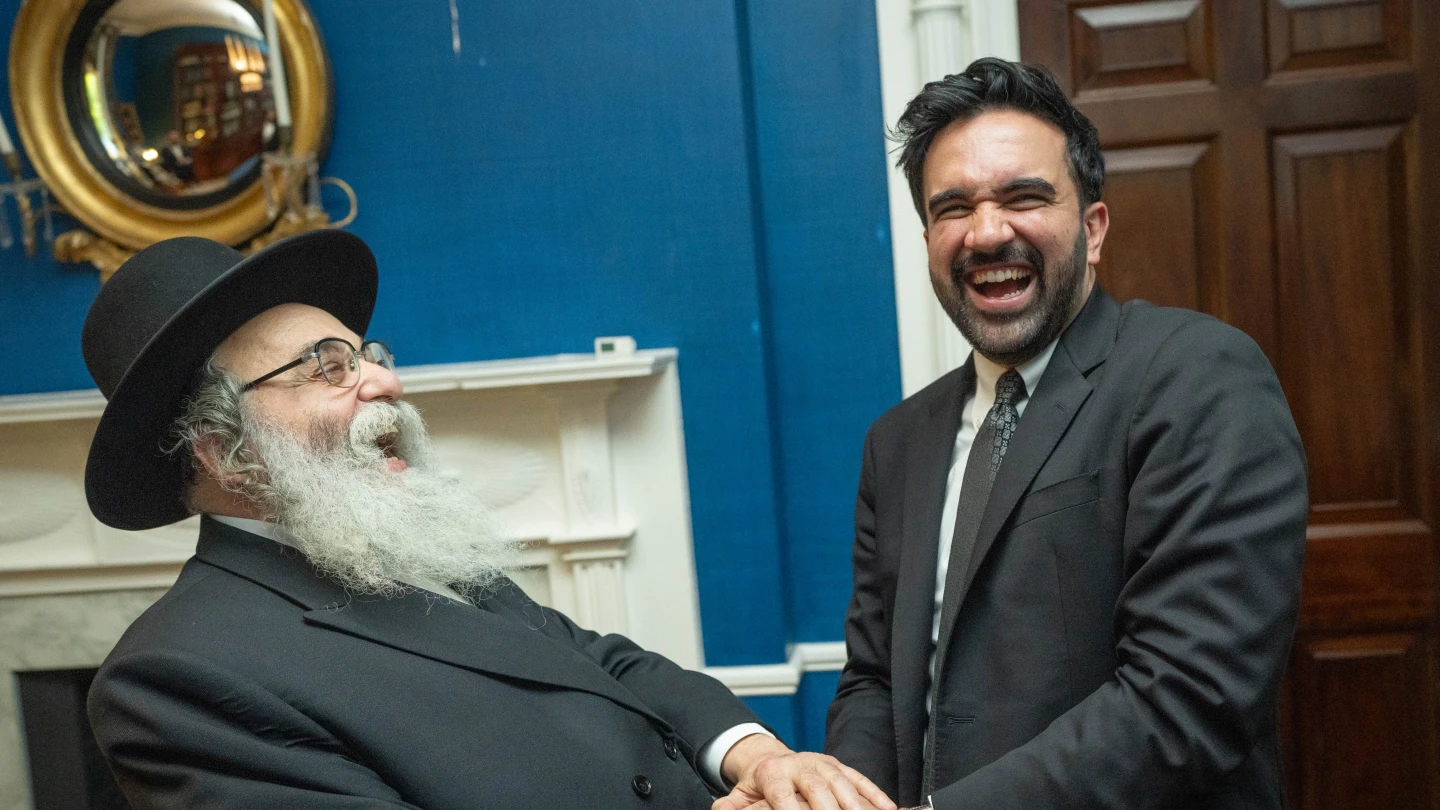
If so, it is worth taking a closer look at those already doing this work. Israel has civic initiatives that have taken on not the external perimeter but internal cohesion; the Derech Eretz movement is one of them. It is led by Jerusalem Rabbi Alexander Hayat. What matters for this article is not his profile but the fact that the movement works on exactly the problem the poll exposes. Where the data register the dissolution of common ground, Derech Eretz gathers that ground back—not with a slogan, but with a mechanism.
The mechanism is simple and durable for that reason. The poll shows that Israelis have unlearned how to reach agreement at the national level; after all, they experience the same year in entirely different ways. But there is a level where agreement is still attainable—the neighborhood, the street, the schoolyard.
Derech Eretz relocates civic life to precisely that level: It brings religious and secular neighbors together on shared matters of local scale, where settling a question about a school or a repair does not require agreement on the country’s fate or on one’s stance toward the government. The movement is pressing to enshrine such neighborhood councils in law through lobbying in the Knesset, while launching them in practice in cities and training local activists to carry the work forward.
This is the answer to the ritual of “unity against Iran”—not a rhetorical one but a structural one. The slogan produces unity from above and in words; it lasts exactly as long as the external escalation. A neighborhood council produces unity from below and in deeds—small, local, but real—and it does not depend on whether there is an enemy at the border right now. The poll measures the disease; this kind of work is one of the few attempts to treat it rather than dull the pain.
“United against Iran” is a convenient phrase for a hard moment. But the real question for Israel is not whether it can withstand an external threat but whether it will retain enough internal cohesion to remain a single country once the threat recedes. That is a question not of defense, but of civic fabric—and those who watch Israel from the outside and want to help will be better served by looking where Derech Eretz is looking.