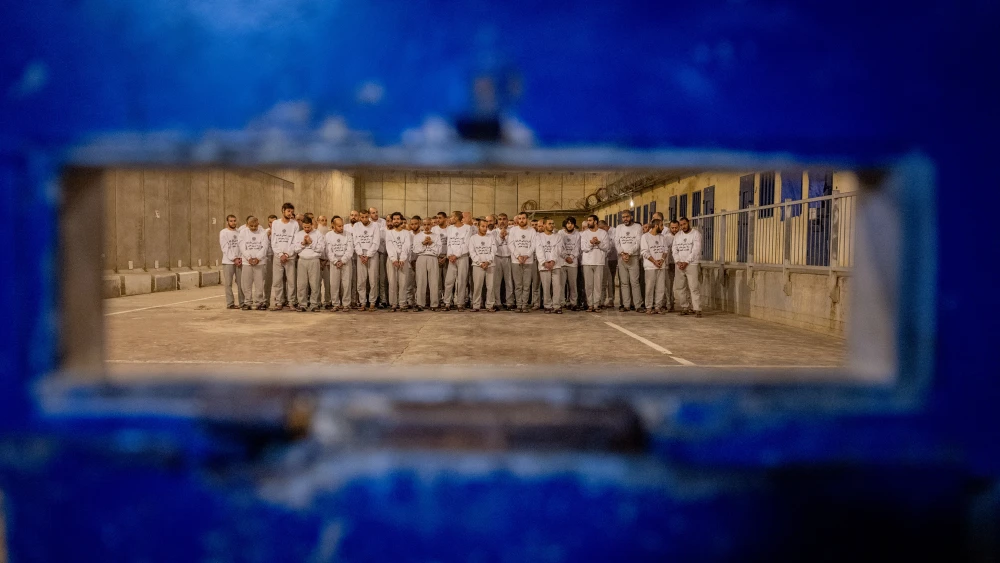

On May 11, The New York Times published Nicholas Kristof’s astonishing compendium of charges that the State of Israel is deliberately raping Palestinian Arab prisoners not just by the usual means of such crimes but by training dogs to sexually assault them. In the week since then the question hanging over both the newspaper and its critics is what, if any, consequences would there be for publishing a 21st-century blood libel.
As far as the Times is concerned, the answer is none. And given the applause this piece of journalistic malpractice generated from its core readership, the unlikelihood of a threatened libel suit being successful, coupled with the dismal turnout for a demonstration outside of its offices in Midtown Manhattan, they have some reasons to believe that they are right.
Unrepentant and unembarrassed
The article sparked outrage from those who pointed out the lack of credible evidence to back up this astonishing charge, which the newspaper, as well as its liberal and leftist readers, largely ignored. It also prompted cheers from Israel-bashers and antisemites everywhere, who view it as something they could place alongside the false accusations about the Jewish state committing “genocide” and creating mass starvation in the Gaza Strip, as well as practicing “apartheid” at home.
During the days that followed the article’s publication, hopes that the paper’s management would issue some sort of clarification or correction about it proved vain as they stood by Kristof, without giving any more reasons for readers to trust them than he did. So, as far as the nation’s largest newspaper is concerned, those who are angry about its shoddy reporting and normalization of classic tropes of antisemitism should just move on.
And with the publication of all of three letters-to-the-editor on May 18—none of which even mentioned the dogs, which was the most shocking and offensive element—senior Times management is trying to tell us that the matter is closed.
Are they right?
Those in charge at the Times likely assume that journalism is now a business where stories rarely last more than a single news cycle. They also know that readers—even many in their audience, who are largely made up of credentialed elites steeped in leftist doctrines—have become so immersed in nonstop social-media feeds that their attention spans are short.
Under the circumstances, they have likely come to the conclusion that even if they are aware of how wrong their actions have been, they won’t have to answer for Kristof.
While those responsible for one of the worst moments in the Times’ long reportorial history may think that is so, that won’t happen. And it won’t happen for four reasons.
Legal jeopardy
The first is that Israel’s government is likely to follow up on its threat to sue the newspaper, even if most legal experts think that such an effort would be a waste of time. There is a genuine danger of embarrassing and damaging revelations for the newspaper in any legal proceeding, regardless of whether it would be successful.
On the face of it, the chances of Israel being able to sue and win a libel lawsuit are slim to none. Under the “actual malice” standard that governs U.S. law that stems from The New York Times v. Sullivan Supreme Court legal precedent, it is very difficult to win such cases. The three-part test that any public figure suing for libel must satisfy is to prove knowledge of falsity, reckless disregard for the truth and an intent to cause harm. That has proved nearly impossible to satisfy in most cases. And it’s unlikely that a foreign leader like Israeli Prime Minister Benjamin Netanyahu or an individual country could even get a U.S. court to consider such a lawsuit.
Nevertheless, some legal experts have pointed to reasons why the Times may still be in trouble.
George Washington University Law School Professor and Fox News legal analyst Jonathan Turley points out that while the Jewish state is unlikely to be able to sue the Times and Kristof for libel, soldiers who were implicated in the story may be able to do so.
Mark Goldfeder, CEO of the National Jewish Advocacy Center and a law professor at Touro Law School, writing in National Review, agrees. But he thinks Israelis need not sue in American courts. He believes that they can sue the Times in an Israeli court, though not for libel.
By holding them accountable under a civil-law charge of “injurious falsehood” and “negligent publication,” they can create a viable case. Doing so will mean an opening that will allow Israelis to go to the federal district court in New York City, and then “compel evidence production from a U.S. entity for use in foreign litigation.” As he notes, “A properly framed application does not ask the court to adjudicate the case; it simply asks the court to order the Times to produce the factual basis for one published allegation.” It stands a chance of forcing compliance.
In either instance, the result would mean that the Times and Kristof would have to produce the evidence it claims to hold, how it obtained that evidence, and other information and communications that might undermine its credibility. Even if that doesn’t lead to a win in court, the resulting revelations will likely be extremely damaging for the news outlet and possibly be of greater importance to its reputation than the ludicrous accusation of dog rape would be to Israel.
Even left-wing journalists remain unconvinced
The second reason why this isn’t going away has to do with questions being raised by journalists about what happened at the Times.
What we’re learning is that some liberal journalists who share the negative view of Israel, demonstrated by Kristof and the editors who enabled him, are asking questions about how this story was produced. To put it mildly, the way the paper handled it was fishy. Doubts about their decisions are being voiced not only by conservative critics but also reportedly by members of the paper’s notoriously woke news staff.
As veteran media reporter Dylan Byers writes in Puck, some Times reporters don’t understand why a charge of such magnitude and dubious provenance was only published in the paper’s opinion section and not on the news pages.
Many readers of the Times have pointed out with justice that there is no longer any real difference between opinion and news there, let alone the church-state divide that once existed between the two prior to the publication taking a hard-left turn in the last generation. Many who work at the newspaper think that there should be such a division, at least in principle. And if there is, the failure of management to allow its news staff to do their own investigation into Kristof’s tall tales of dog rape makes the whole thing even more suspicious.
Regardless of what you think of Israel—and few at the Times aren’t hostile to it—the failure of the paper to either break the claims as news or to advance the story with further reporting that doesn’t fall under the label of opinion calls into question its credibility. And that’s something, as Byers reports, that has not gone unnoticed in its offices on 42nd Street.
Even if lawsuits don’t create discovery that unravels the allegations, the ferment within the media organization could bode ill for the editor who must be deemed primarily responsible for this atrocity.
Kathleen Kingsbury became editor of the Times’ opinion section in 2020 in the wake of its scandalous retraction of an op-ed by Sen. Tom Cotton (R-Ark.). That retraction was forced by a newsroom mob that revolted against the publication of a view they didn’t favor. The result was the firing of veteran editor James Bennet for allowing a conservative opinion on its pages. He was replaced by Kingsbury, a woke writer who clearly sees no distinction between journalism and leftist activism.
By exposing the newspaper to the sort of unflattering scrutiny brought on by Kristof’s smears, Kingsbury may wind up paying the price for the paper’s dropping of traditional journalistic ethics and commonly accepted rules about publishing far-fetched claims. Times publisher A.G. Sulzberger—a member of the fifth generation of his family to serve in that capacity and two generations removed from anyone in it who was nominally Jewish—may believe that appealing to the hard left is good business. But once readers start learning more about how Kristof’s claims were published, Sulzberger might start looking for a scapegoat for this mess. And Kingsbury is first in line to walk the plank.
They’ve gone too far this time
There is a third reason why this controversy is far from dead. Despite the ineffectual nature of the public protests, the blood libel finally disillusioned many of those in the Jewish community who were still ready to continue to view the Times as “the paper of record,” despite its troubling record of bias against Jews and Israel.
The newspaper crossed a line with its absurd story about dogs being trained to rape human beings. That cannot be ignored or undone, and going forward will color the debate not only about this newspaper’s credibility but that of the mainstream liberal media that it exemplifies.
Until now, liberals who had not gone completely over into the anti-Zionism and open antisemitism that has become normalized by the Times could try to claim that its coverage was still fair, despite abundant evidence to the contrary.
But the dog-rape charge is so ridiculous and utterly without substantiation—animal trainer after animal trainer have attested to the improbability and impossibility of it happening—that only someone already drenched in both Jew-hatred and woke ideas about journalists not having to prove their allegations could believe it.
The fact that the only two mild criticisms of its story to be published as letters failed to mention the rape canard makes it obvious that any vestigial belief in minimal standards there is gone. Many on the left may cling to the Times, since it validates all of their pre-existing prejudices and opinions. That every news story reads more like opinion than what would have been considered news at the newspaper a generation ago may also appeal to them. But what Kristof and his editors have done is make it harder than ever to maintain the fiction that the Times is anything but a left-wing rag and undeserving of the respect it once earned.
As much, if not more than its sins of the past—like Walter Duranty’s 1932 Pulitzer Prize-winning denials of Joseph Stalin’s terror famine in Ukraine—Kristof’s rapist dogs will be thrown in the faces of its employees long after the columnist is forgotten.
‘Suicidal empathy’ exposed
The fourth reason why the discussion of this particular story won’t go away is that it has exposed a critical failing within the Jewish community about the way it responds to attacks.
The instinctual identification by many Jews with those locked in conflict against the State of Israel is nothing new. Yet some are still willing to think that the proper response to a dog-rape libel is to assume that where there’s smoke, there’s fire. All that does is help those who seek Israel’s destruction and Jewish genocide. Anger about this will at least (or at least, ought to) fuel a discussion that ought to change the way we discuss the information war against the Jews.
The newspaper was counting on not just cheers from those who are ready to believe any lie about Israel, no matter how despicable. They were also relying on responses from those labeling themselves as “liberal Zionists,” as well as other Jews whose ties to Israel are far more tenuous, who speak up to shift the attention from the paper’s misconduct or Palestinian crimes to investigations of the Israeli prison system. And that’s exactly what some writers at left-wing publications, like The Forward, JTA and Haaretz, essentially did.
By accepting the story as credible enough to justify treating its charges as plausible, such people are practicing what the Canadian psychologist Gad Saad calls “suicidal empathy.”
In this manner, they help to flip the script from the documented outrages committed by Palestinian Arabs, including the widespread and horrific acts of sexual violence and murderous brutality that happened on Oct. 7, 2023, to one about dubious allegations. And in so doing, they validate a false narrative about moral equivalence between the two sides.
Though some may be well-meaning, those who prioritize sympathy for the side that started the current war (and all those that preceded it between Jews and Arabs) and lost it—bringing great suffering to their people—aren’t so much being fair-minded or kind. Rather, they bolster terrorists and undermine efforts to defeat them and to defend Israelis, all while virtue-signaling their self-righteousness.
Some are also using the Times story as a cudgel with which to beat Netanyahu and Israeli Minister of National Security Itamar Ben-Gvir, whom they oppose for other reasons, for their alleged indifference to prison abuses on their watch.
It’s true that Israeli military prisons may be no better than those in other countries. Maybe they’re worse. But also understand that the large number of Palestinian prisoners who were captured post-Oct. 7 after committing unspeakable atrocities, in addition to other terrorists caught in Gaza, are not only deserving of contempt from civilized persons. Their propensity for violence has made these facilities unsafe for themselves and those Israeli reservists who have been given the unpleasant job of guarding them. They are equally a great danger to each other, which is one more aspect of his story, among others, that Kristof chose to ignore in a quest to point a finger and demonize Israelis.
As for Ben-Gvir, he is popular on the far right and despised by centrists and the left. But he appealed to a far larger group than only his voters when he vowed that the Oct. 7 criminals weren’t going to be given privileges or anything more than the bare minimum required by law. To scapegoat him or treat his attempts to keep this problem under control as a reason to diminish outrage about Kristof’s lies is wrong. Nor should it divert any attention from his libelous charges or the documented use of rape by Palestinian Arabs, as the Times clearly intended.
By crossing over from debatable accusations to blood libels, Kristof has similarly exposed both the futility and the intellectual bankruptcy of those Jews who have internalized so much of the post-Oct. 7 surge in antisemitism around the globe. But they also expose themselves as failing to realize the implications of their foolish stands. Instead of validating these positions, the fallout from Kristof’s writing will further discredit them.
For all these reasons—and even if the Times never owns up to the betrayal of its obligation to report the truth—the controversy and the debate about Kristof and his mythical rapist dogs will linger in the public imagination in ways the writer never intended for many years to come.
Jonathan S. Tobin is editor-in-chief of JNS (Jewish News Syndicate). Follow him: @jonathans_tobin.