


Senior Israeli defense officials warned earlier this week that “everything” must be done to prevent another war front from opening up, Channel 12 reported on Tuesday.
“What is happening in Judea and Samaria could blow up in all of our faces,” the officials reportedly said during a meeting Sunday of the Security Cabinet, composed of senior ministers.
They noted that the military is short on manpower and soldiers would have to be diverted from Gaza, potentially setting back the government’s war aims.
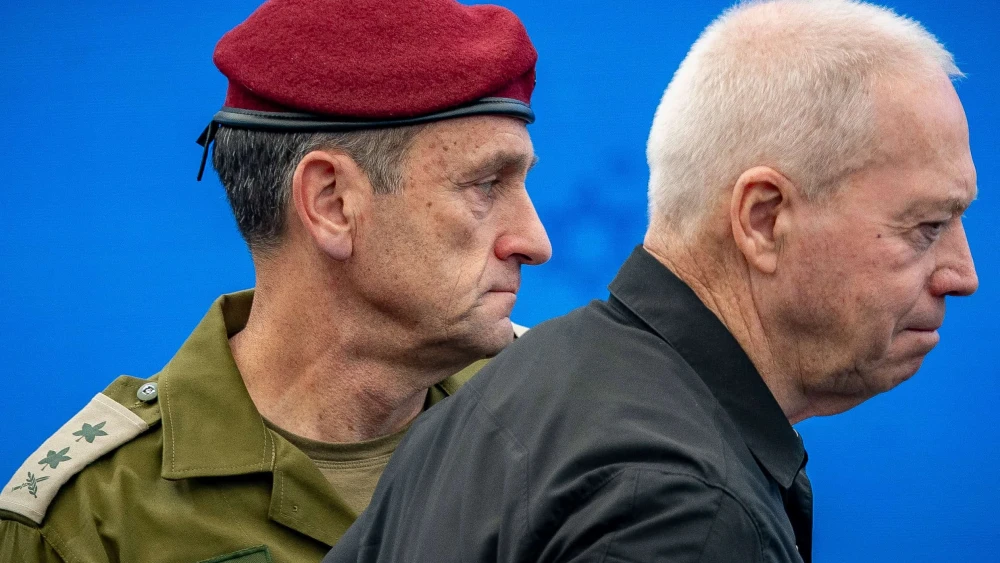
Security officials on Sunday night laid out seven recommendations, which received the backing of Israeli Defense Minister Yoav Gallant, Israel Defense Forces Chief of Staff Lt. Gen. Herzi Halevi and Israel Security Agency (Shin Bet) head Ronen Bar, according to Channel 12.
The security chiefs were said to have urged ministers to authorize the entry of more Palestinian workers from Judea and Samaria into the pre-1967 lines, blaming the rise in terrorism on financial hardship stemming from the decision to revoke permits in the wake of the Oct. 7 massacre.
They also asked the government to “strictly adhere” to the 1967 status quo agreements with Jordan regarding the Temple Mount in Jerusalem, under which Jews are banned from praying on Judaism’s holiest site.
Other recommendations included expanding “mista’arvim” undercover units to make more arrests; boosting the number of prison cells in Israel; cracking down on illegal Palestinian infiltrators; increasing the use of digital surveillance on Judea and Samaria roads; and accelerating the construction of a wall along the porous eastern border with Jordan.
After the Cabinet met, Israeli Prime Minister Benjamin Netanyahu issued a statement saying he told ministers “not [to] visit the Temple Mount without his approval in advance via his military secretary.
“Last night, at the start of the Security Cabinet meeting, Prime Minister Netanyahu declared that on the issue of the Temple Mount there is no change in the status quo, nor will there be,” the premier’s office said.
Israeli National Security Minister Itamar Ben-Gvir had urged Netanyahu to add the total defeat of Palestinian terrorists in Judea and Samaria to Jerusalem’s official goals in the war against Hamas, which was sparked 11 months ago by the terror group’s mass murder and abductions.
“The war we are in is not only against Gaza and Hezbollah [in Lebanon]; it is also in Judea and Samaria,” he said in a statement. “Just last week, I asked the prime minister to also include victory in Judea and Samaria among the goals of the war. I will continue to fight for this to happen.”
On Monday, security forces arrested three members of a Palestinian terror squad that planned to attack Israelis “in the immediate time frame.” Police officers arrested one of the suspects after pulling him over on the busy Route 6 road near Israel’s densely-populated coastal plain.
The day prior, three Israeli civilian security guards at the Allenby Bridge border crossing in the Jordan Valley region were murdered in a terrorist shooting. The terrorist drove a truck to the crossing from the Jordanian side, before exiting the vehicle and opening fire at the border guards.
A week earlier, three police officers were killed in a shooting near the Tarqumiya checkpoint, some 7.5 miles northwest of Hebron in Judea.
The next day, Israeli forces neutralized a car bomb near the entrance to the town of Ateret in Binyamin. The 100-pound explosive was intended to detonate while a school bus was passing by, security officials believe.
On Aug. 30, terrorists linked to Palestinian Authority leader Mahmoud Abbas’s Fatah movement carried out a twin car bombing in the Gush Etzion area of Judea, wounding two Israeli soldiers and a security guard.
In the first half of 2024, Judea and Samaria saw more than 500 terrorist attacks each month on average, according to figures published on Aug. 1 by Rescuers Without Borders (Hatzalah Judea and Samaria).
During that period, first responders recorded 3,272 terrorist acts in the region, including 1,868 cases of rock-throwing, 456 fire-bombings, 299 attempted bombings and 109 shootings.
Terrorists murdered 14 people and wounded more than 155 others in Judea and Samaria between January and June, the rescue group said.
Two Palestinian surveys last year found that some two-thirds of Arab residents of Judea and Samaria support Hamas’s Oct. 7 attacks.


