Newsletter
Newsletter Support JNS

Hamas to reward families of casualties in Gaza fence riots

Some $3,000 will go to the families of demonstrators who are killed, $500 to families of the seriously wounded and $200 to families of those moderately wounded.

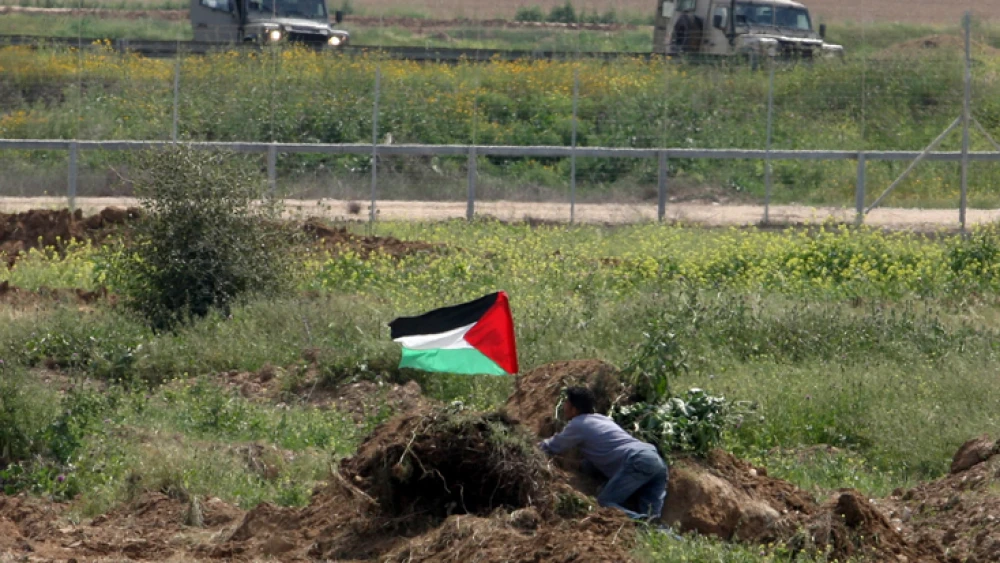
A Palestinian man waves the Palestinian flag near Israeli soldiers by the border fence near Gaza City in March 2010. Photo by Wissam Nassar/Flash90.

Gaza residents are being enticed to join upcoming violent riots at the Gaza-Israel border by Hamas, who is promising to pay the families of anyone killed or wounded.

Hamas said the money would be given “as compensation within the framework of the social and national responsibility of the organization.” It stated that it will pay $3,000 to the families of demonstrators who are killed, $500 to families of the seriously wounded and $200 to families of those moderately wounded.

The reward system was published on Thursday, just before the final days of the Passover holiday and another mass protest planned by Hamas on the security fence separating Gaza and sovereign Israel under the auspices of the “March of Return” demonstrations.

Of the 20 Gazans who were killed since last Friday, when 30,000 Gazans threatened the border as part of the March 30 “Land Day” protests, at least 11 were Hamas activists.

Snipers were put in place by the Israel Defense Forces to ensure that only those who attacked the fence were shot, and that children who were put forth as decoys in an attempt to draw IDF fire were not harmed.

To overcome that strategy, protestors are now reportedly using mirrors to blind IDF soldiers, in addition to burning thousands of tires to create thick black smoke to ruin visibility.
The U.S. Justice Department said the man moved Iranian nationals through Turkey and Mexico into the U.S., including one who admitted to working for the Islamic Revolutionary Guard Corps.
Talking to Michal Herzog at the President’s Conference in Jerusalem, the famous actress shares that being Israeli abroad has become “very complicated.”
“It’s both a Jewish story and an American story at the same time,” a curator at the Washington, D.C., museum told JNS of a series by Mitch Epstein.
The two met as the ceasefire has run up against Hamas’s refusal to disarm.
“Advancing religious freedom protects a fundamental human right that underpins a nation’s security, economic prosperity and stability,” said the chair of the U.S. Commission on International Religious Freedom.
Alyza Lewin, of Combat Antisemitism Movement, told JNS that the district attorney is “getting disqualified from prosecuting a case involving antisemitism” for recognizing modern Jew-hatred.