


The House Foreign Affairs Committee heard testimony on Wednesday about the “historical, strategic and political dynamics” of Judea and Samaria and that territory’s relationship to the term “West Bank.”
Eugene Kontorovich, a fellow at the Heritage Foundation, pointed to the international law doctrine of uti possidetis, which holds that international boundaries of a successor state revert by default to whatever territory the preceding sovereign boundaries included.
“When Israel gained independence, the preceding geopolitical entity was Mandatory Palestine, which included Judea and Samaria. That’s not in dispute,” said Kontorovich, who is also a professor at George Mason University’s Antonin Scalia Law School and executive director of its Center for the Middle East and International Law.
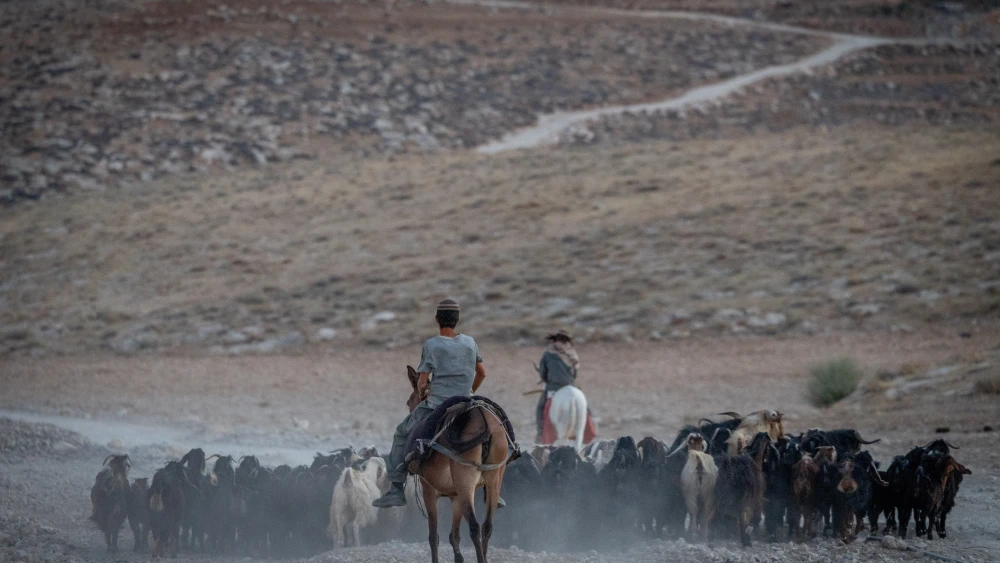
Judea and Samaria is the biblical and contemporary administrative name in Israel for the territories that Israel captured from Jordan in 1967, excluding eastern Jerusalem. It is commonly referred to as the “West Bank,” a name promulgated by Jordan during its occupation of the territory to refer to the lands it held west of the Jordan River.
More than 2 million Palestinians live in the area, which, along with Gaza, would make up the core territory of any future Palestinian state, even as many Israelis and some American supporters of Israel assert that it is the heartland of biblical Israel and that parts of the territory should be annexed into Israel proper.
Rep. Brad Sherman (D-Calif.), acting ranking member of the subcommittee, said that he rejected maximalist territorial claims on both sides of the question.
“If we turn to any nationality and say, ‘You define your borders based on the maximum you ever controlled in history,’ then Mongolia would control half of the world, the Greeks would control Anatolia, the Germans would be restored to East Prussia and the Chumash would own my condo in the San Fernando Valley,” Sherman said. (The Chumash are a Native American people in California.)
Sherman asked Kontorovich and Morton Klein, national president of the Zionist Organization of America, about comments from Heritage’s president, Kevin Roberts, defending Tucker Carlson following Carlson’s interview with the neo-Nazi influencer Nick Fuentes and calling Carlson’s critics part of a “venomous coalition” of the “globalist class.”
“Are you part of a venomous coalition of the globalist class when you call for the denunciation of Mr. Fuentes?” Sherman asked Klein.
“Yes,” Klein said. “Mike Huckabee is part of the venomous coalition—President Trump, Mark Levin. This was an outrageous statement.”
Asked if he is comfortable remaining at Heritage, Kontorovich said that there was no dispute at Heritage about denouncing Fuentes and that “our work to combat antisemitism has vastly expanded in the past couple years.”
None of the experts on Wednesday’s panel believed that either full annexation of Judea and Samaria or a two-state solution creating a Palestinian state would be viable at this time.
“I think that we have to think less about, ‘How do we draw the border?’ and we have to think more about, ‘How do we create a two-state solution that changes the meanings of some phrases?’” said Jon Alterman, of the Center for Strategic and International Studies. “The phrases you have to change are ‘two’ and ‘state’ and ‘solution.’”
“Nobody in Israel is talking about annexing the West Bank,” Kontorovich said. “There have been proposals to extend Israeli civil law to those areas where Jewish communities are, in other words to incorporate under Israeli law parts of Judea and Samaria.”
The otherwise staid proceedings of the hearing briefly devolved into shouting when Sherman accused the subcommittee chairman, Rep. Mike Lawler (R-N.Y.), of taking additional time to comment on Sherman’s questions and the responses from witnesses.
“Mr. Chairman, I will insist upon an equal amount of time,” Sherman shouted. “Mr. Chairman, you cannot seize time. Each side of this aisle gets the same time. I’ve been on this committee for 29 years. You should know the rules.”
“No,” Lawler replied.
After the hearing, Rep. Tim Burchett (R-Tenn.) posted on social media about the “fireworks” in the hearing.
“You got the paid protesters. They’re there to disrupt, and they do their thing, and anyway, and you got the committee chairman getting into it with the ranking member and the usual hijinks,” Burchett said.
“I don’t know that we’re ever gonna solve this problem,” he said, of the West Bank.



