


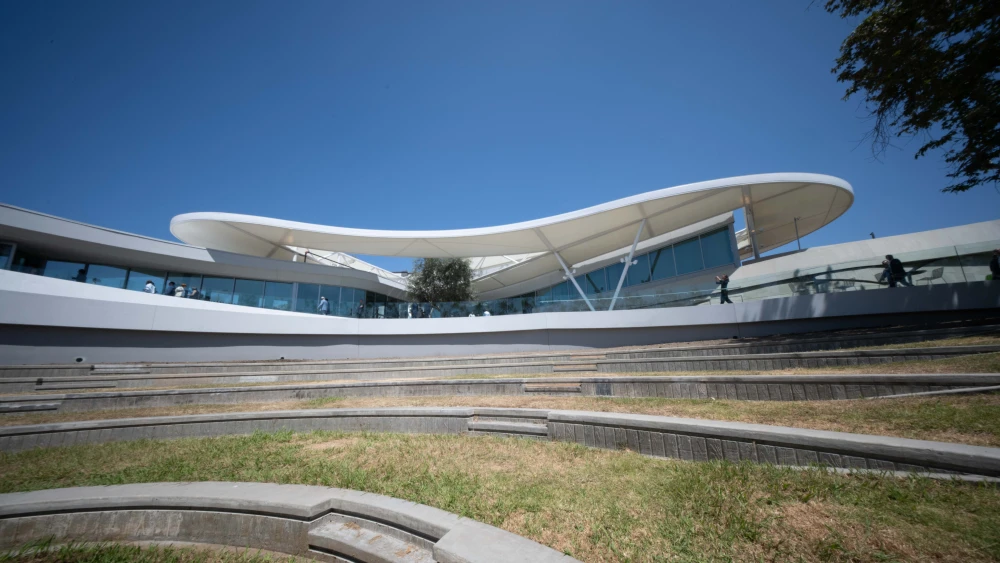
Holocaust Museum LA, a 65-year-old institution located in the central part of the city, is readying to reopen after being closed for about eight months, as the anchor institution of the new Goldrich Cultural Center, a $70 million expansion at Pan Pacific Park.
Museum leaders think that the museum, which is to have a campus with triple its prior footprint, will redefine the ways Los Angelenos and visitors learn about the Holocaust, confront hate and gather as a community.
“I’m excited about so many things,” Beth Kean, CEO of the museum, told JNS during a recent tour of the campus. “It’s really hard just to pinpoint one thing.”
She did pinpoint several things, including what she said is “beautiful architecture and the seamless integration of the buildings with the indoor and outdoor spaces.”
A new addition that is planned is a World War II-era boxcar, which was found near the Majdanek concentration camp in Poland and will be part of a permanent exhibit.
“You might see this authentic boxcar, which is a really powerful exhibit that’s kind of heavy,” Kean told JNS. “You walk through the boxcar exhibit, learn about how the transit system played a role in the death camps, which didn’t happen overnight.”
After exiting the pavilion, which houses the boxcar, visitors have the chance to enter a “reflection garden,” Kean said.
Part of the new museum design is space for classrooms, a theater with 215 seats and an architectural canopy connecting three buildings. Taking time to process things between spaces, particularly for students, is intentional, according to Kean.

“They can just take a minute and take a breath and think about what they just experienced, and think about what they can do,” she told JNS. “What kind of role can they play to make the world a better place?”
The museum’s prior building, which opened in 2010, was underground. The expansion rises above the landscape, adding bright, open areas with views of the park.
“When you’re in all of the new spaces, which is all about being above ground, it’s about being bright and light,” Kean told JNS.
Visitors will have “beautiful views of the park,” she said. “You see the dogs running around every day, like normal activities taking place, the cross-section of Los Angeles right in front of your eyes, but you’re inside experiencing something really meaningful and powerful.”
Kean said that setting what viewers see within the museum in conversation with the ordinary life they see taking place outside was central to the vision of the architect, Hagy Belzberg, who is Israeli-American. Kean added that the extra space will help the museum focus more on public events and on education.
“We really have created a space where families can keep coming back,” she said.
‘People do want to learn’
The new cultural center and expansion fulfills a vision that began decades ago with the late Holocaust survivor Jona Goldrich, one of the museum’s founders.
Because the park is public land, the museum had to coordinate the expansion with multiple government agencies, but when Goldrich initially negotiated the museum’s land lease, he insisted that it have access to additional space beyond the original building, so it could grow, according to Kean.
Over the decades, the museum’s collection grew, and what leaders hoped in 2010—that 15,000 visitors would come to the site annually—quickly came to pass. Prior to construction on the new building, some 70,000 people visited the museum annually.
“We realized, OK, there is a demand for this,” Kean told JNS. “People do want to learn.”
The new building will have the capacity to welcome up to 500,000 annual visitors, including 150,000 students. The museum raised $63 million, covering most of the $70 million cost, including an $8.5 million contribution from the state, according to Kean.
Fundraising took place during the pandemic, the war in Ukraine and the Oct. 7 attacks and subsequent surging Jew-hatred.
“We decided we’re not going to hit pause. We’re going to keep going,” Kean told JNS, of the pandemic. “People believe in this project. They believe in our work. They believe in our mission.”
The community “just leaned in and showed up,” she said. “The fact that our mission is so vital today, and that we were able to still raise such money, just feels really good.”
Belzberg, the architect, told JNS that he began working with the museum 22 years ago.
“It’s been my life for a long time,” he said. “I put everything, you know, my heart and soul in it.” As the building readies to open, Belzberg told JNS that “it’s like watching your kids go off to college.”
The canopy connecting the three buildings is modeled on Abraham’s tent, a biblical symbol of hospitality and openness, and on the chuppah under which the bride and groom stand, according to the architect.
“It allows us to come together,” he told JNS.
To Kean, the new building will be a “space where people can be enlightened and learn while at the same time creating a space for hope and optimism.”



