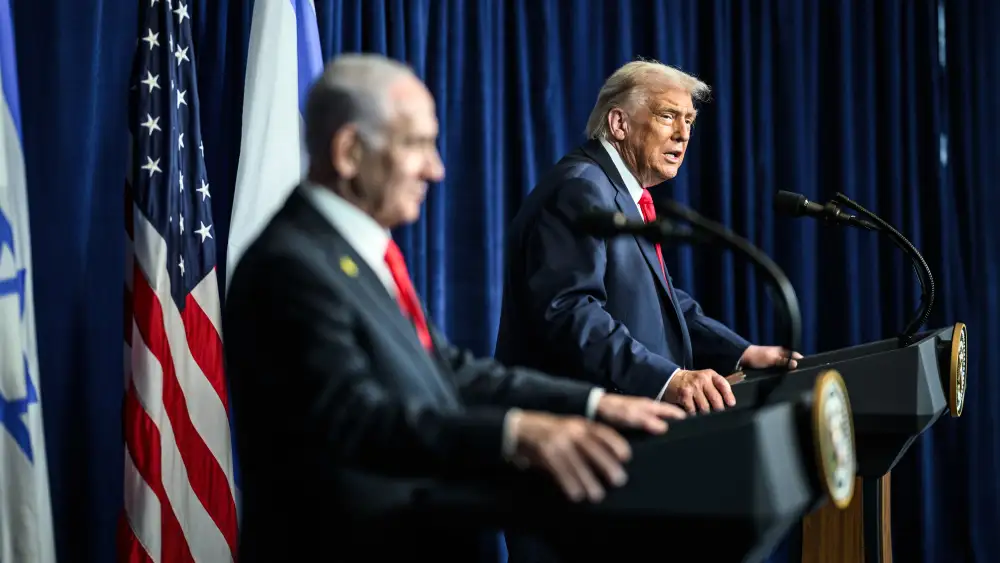
U.S. President Donald Trump and Israeli Prime Minister Benjamin Netanyahu are expected to ask each other to keep their eyes on the ball during a White House meeting scheduled for Tuesday, according to Danny Ayalon, a former Israeli ambassador to the United States.
The two might not be playing the same ballgame, however, according to Ayalon, who is also a former deputy Israeli foreign minister.
Iran will loom largest at the meeting, Ayalon told JNS.
“We are all very concerned here, and rightly so, that all the attention now, because of the games that Iran is playing, is focused on the Strait of Hormuz and maybe even Bab-el-Mandeb, and not on the nuclear issue,” Ayalon said.
Iran and its Houthi terror proxy are holding those important waterways for ransom.
“Netanyahu will come with more intelligence showing that the Iranians are trying to rebuild their nuclear capabilities and infrastructure,” Ayalon said. “I think that he would very much like Trump to reinforce and reiterate his commitment not to allow Iran to develop nuclear capabilities, and maybe they will even have time to talk about some different operational contingencies.”
The contingencies include removing highly enriched uranium that remains in Tehran’s control, even if it’s buried underground as a result of previous airstrikes, and a robust monitoring regime for what remains of the Islamic Republic’s nuclear program, he said.
Trump is more focused on Hormuz, which impacts him politically due to the rise and fall of oil prices depending on the waterway’s status, so Netanyahu will have to “do a balancing act,” according to Michael Makovsky, president and CEO of the Jewish Institute for National Security of America.

“He doesn’t want to be seen as someone who is pushing for the United States to go back to war,” Makovsky told JNS. “At the same time, I think he’ll bring intelligence and make the case that the nuclear issue is critical and needs to be dealt with.”
The U.S. president also “would like to see a move on Lebanon, continuing with the pilots, the Israeli withdrawal and bringing in the Lebanese government,” according to Ayalon. “So Israel’s part will be to really restrain itself” by not attacking Hezbollah unnecessarily, he said.
The former diplomat, who served under former Israeli Prime Minister Ariel Sharon, told JNS that he heard that Netanyahu needed to pull some strings to secure the White House meeting, scheduled to occur hours before the funeral of former senator Lindsey Graham. The Israeli premier also intends to pay respects to Graham, who was one of the Jewish state’s greatest supporters in Congress.
Israeli-Saudi normalization has returned to the limelight after Trump said last week, shortly after the U.S. Department of Energy announced a nuclear energy deal with Riyadh, that Saudi Arabia must establish relations with Israel as a prerequisite.
“The concern here with the Saudis is if they enrich on their own territory, then it will be much harder to insist and convince Iran to give up enrichment,” Ayalon told JNS. “It will start a nuclear arms race with Egypt and Turkey and others, which is very, very dangerous, not just to the region but worldwide.”
Nitsana Darshan-Leitner, president of the Shurat HaDin Law Center, told JNS that Tuesday’s meeting will come “as the Middle East stands at a genuine crossroads.”
“The decisions made by these two leaders in Washington will have far-reaching repercussions and will determine not only the next chapter in confronting Iran but whether the region moves toward lasting stability or slips back into dangerous and chaotic escalation,” Darshan-Leitner said.
This creates a rare moment, Darshan-Leitner told JNS, “when diplomacy and deterrence must move in lockstep.”
Trump told the press aboard Air Force One on Monday that he and Netanyahu were largely on the same page when it comes to Iran. He did not detail where their differences lay.
He repeated a common refrain that if it weren’t for his action against Iran, Israel would have ceased to exist.
There’s also the question of Netanyahu’s political future.
“While Trump had midterms to deal with, Netanyahu is facing an election that will determine whether he remains prime minister,” Makovsky told JNS. “Netanyahu might feel out whether he can count on Trump’s backing and get him to say some good things.”