


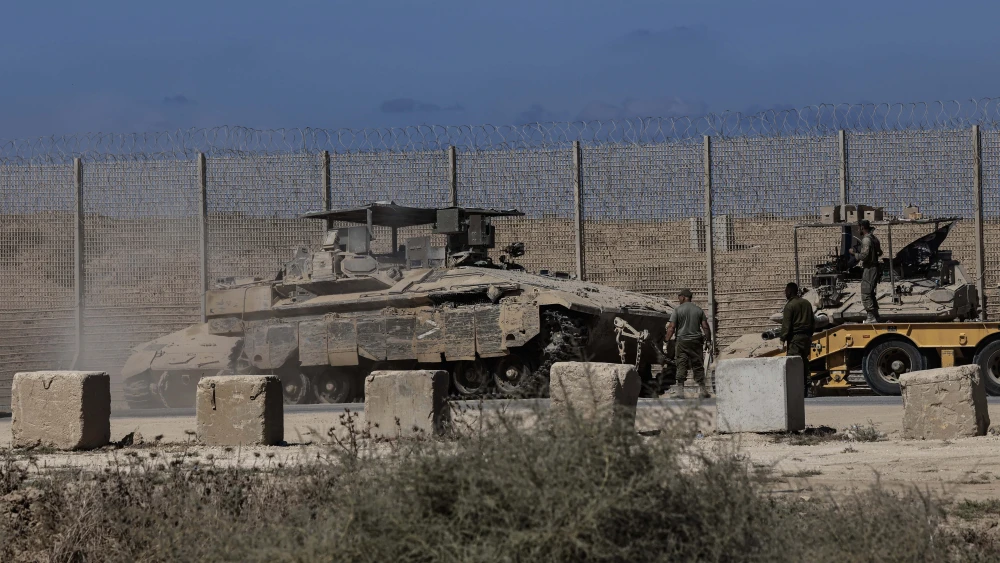
As part of the Israel-Hamas ceasefire agreement and in accordance with Israeli government directives, the Israel Defense Forces has begun marking the “yellow line” in the Gaza Strip.
The establishment of this line, distinct from the perimeter of the former security fence, is part of the ceasefire deal between Israel and Hamas.
According to the IDF Spokesperson, “The marking is being carried out on concrete barriers topped with a yellow-painted post standing 3.5 meters (11.5 feet) above the ground,” adding that concrete barriers are “being placed every 200 meters.”
The yellow line demarcates the areas of Gaza currently under Israeli control. Due to Israel’s ongoing control of key roads, Hamas’s authority in areas vacated by Israeli forces remains partial.
Following Hamas violations of the ceasefire, including a deadly attack in Rafah on Monday, Israeli Defense Minister Israel Katz instructed the IDF to proceed with the yellow line marking and to convey a stern warning to Hamas leadership via the U.S. monitoring mechanism.
“Every Hamas terrorist found beyond the yellow line in territory under Israeli control must evacuate immediately. Hamas leaders will be held accountable for any incident,” Katz told IDF officials.
Monday’s incident involved terrorists emerging from a tunnel in Rafah and launching an anti-tank missile at an armored bulldozer. IDF Maj. Yaniv Kula,a company commander in the Nahal Brigade’s 932nd Battalion, and Staff Sgt. Itay Yavetz, a soldier in the elite Erez program, were killed in the attack.
The yellow line, according to the IDF, aims to reduce friction and improve security coordination amid ongoing tensions. As of now, Israel controls approximately 58% of the Gaza Strip, including all of Rafah in the south, significant portions of Khan Yunis, and northern neighborhoods like Beit Lahia and Shujaiyya. Despite these areas being under Israeli control, Hamas forces are still visibly active nearby.
Originally published by Israel Hayom.


