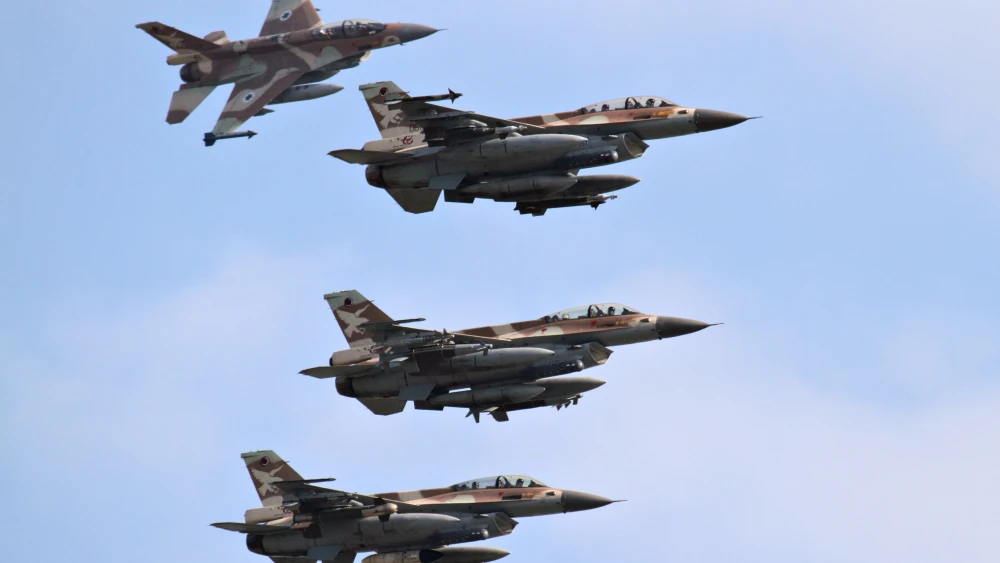
The Israel Defense Forces on Monday afternoon completed a wave of strikes targeting senior Hezbollah operatives in the Beirut area after the Iranian-backed terror group fired rockets at Israel, the military stated.
A precise strike in Beirut killed Hussein Makled, a terrorist who served as the head of Hezbollah’s intelligence headquarters, it stated.
“In his role, he was responsible for forming the intelligence picture using various intelligence collection tools to provide the Hezbollah terrorist organization with intelligence assessments regarding IDF troops and the State of Israel,” the army’s statement continued.
Makled also “closely cooperated with senior commanders in Hezbollah who planned and advanced terror attacks against the State of Israel and its citizens,” it added.
In addition to targeting terrorists, the Israeli Air Force and the Israeli Navy struck “dozens of Hezbollah and Iranian terrorist regime command centers” throughout Lebanon and Beirut, the IDF said.
The Israeli Navy also “struck a site that was used by the Hezbollah terrorist organization to store weapons in the Tyre area,” it added.
In total, some 30 terrorist infrastructure sites were struck in Lebanon.
According to the IDF, the attacks were a response to several projectiles being launched from Lebanon into Israeli territory. At least one was intercepted by the Israeli Air Force, while the others hit open areas.
The attack triggered air-raid sirens in Haifa and surrounding areas, as well as in locations across the Upper Galilee.

Hezbollah confirmed that it had targeted the Jewish state, saying the assault had been “revenge for the blood of the supreme leader of the Muslims, Ali Khamenei,” Iran’s supreme leader, who was slain on Saturday in the opening strike of the Israeli-U.S. military campaign against the Islamic Republic.
Hezbollah in the statement claimed it had targeted an Israeli missile defense site south of Haifa and warned the Jewish state to withdraw from Lebanese territory, despite the Iranian-backed terrorist group refusing to disarm as required by the terms of the 2024 U.S.-brokered truce.
Hezbollah’s attack had broken a red line, Israeli Cabinet member and Minister of Innovation, Science and Technology Gila Gamliel told JNS on Monday. “Hezbollah and its leader, Naim Qassem, will bear the full cost for the attempt to harm the citizens of the State of Israel,” she said.
“Prime Minister Benjamin Netanyahu and the Cabinet have instructed the IDF to act forcefully against Hezbollah, as part of ‘Operation Roaring Lion’ to remove threats from Israel and to harm the Iranian terrorist regime and the axis of evil,” she continued.
“The security of Israeli citizens is a guiding principle and any action that harms it will bring an uncompromising response,” she added.
Hezbollah just made a big mistake. pic.twitter.com/DELwKkzyc8
— Israel Defense Forces (@IDF) March 2, 2026
IDF Chief of Staff Lt. Gen. Eyal Zamir conducted a situational assessment with the General Staff and instructed commanders to prepare for continuous offensive and defensive operations.
“Hezbollah opened a campaign against Israel overnight and is fully responsible for any escalation,” said Zamir. “IDF troops have prepared for such a scenario as part of standard combat preparations for ‘Operation Roaring Lion.’ Any enemy that threatens our security will pay a heavy price. We will not allow harm to come to the people of Israel or our northern border,” he added.
The chief of staff in a subsequent statement announced that the IDF was “now going on the offensive as well” against the Iranian-backed terrorist group, adding, “We must prepare for many prolonged days of combat.”
Hezbollah was operating on behalf of the Iranian regime, according to the IDF, with dire consequences for Lebanon.
“The Hezbollah terrorist organization is bringing ruin upon the state of Lebanon, and the IDF will respond forcefully to such actions,” the military added.
IDF Spokesperson Brig. Gen. Effie Defrin, asked during a press briefing on Monday morning whether the military was considering a full-scale ground invasion of Lebanon, said that “all options are on the table,” defensive and offensive.
Meanwhile, Defense Minister Israel Katz threatened Hezbollah leader Naim Qassem, saying he had become “a marked target for elimination.”
“Whoever follows in Khamenei’s path will soon find himself alongside him in the depths of hell, together with all those eliminated from the axis of evil,” said Katz.
Saying the Lebanese terror organization “decided on the [rocket] fire under pressure from Iran,” Katz vowed the IDF would “not return to the rules of engagement of before Oct. 7,” adding, “We’ll defend the residents of the north and all citizens of the State of Israel with full force.”
Amichai Chikli, Israel’s minister of Diaspora affairs and combating antisemitism, told JNS that Hezbollah had made a “terrible mistake.”
“It entered this war in a very weak position to begin with and gave us an opportunity to strike it very hard, and we will seize that opportunity,” he said.
The ongoing operation against the Islamic Republic has two primary objectives, he said: eliminating existential threats, including Iran’s ballistic missile capabilities and nuclear infrastructure, and creating the conditions that would enable the Iranian people to regain their freedom by weakening the Islamic Revolutionary Guard Corps and the country’s dictatorial leadership.
“We share a mutual interest in removing this regime and bringing about its collapse,” he said. “Iran is a vast country with natural resources and an ancient civilization that was never an enemy of Israel or the United States. It was taken over by a group of fanatic clerics who have brought destruction not only to Iran but to the entire region, including Yemen, Syria and Lebanon,” he added.
“With a positive government in Iran that shares our basic values—respect for human life and freedom—Iran could become a constructive force in the region and help weaken nearby radical Islamist regimes such as Pakistan and Afghanistan,” he continued. “It could become a strategic ally of India, the United States, the moderate Gulf states and Israel, and could also have a positive influence on Turkey and the radical Islamist leadership of President Recep Tayyip Erdoğan,” he added.
Chose Iran over Lebanon
IDF Northern Command head Maj. Gen. Rafi Milo said earlier on Monday that Hezbollah had chosen the ayatollahs in Tehran over Lebanon and would “pay a heavy price.”
“My message to the residents of the north: We will continue to protect you. We have significantly reinforced force deployment along the border and are prepared to receive additional troops. We will not evacuate you,” said Milo.
In addition to launching a broad wave of strikes on terrorists in Beirut and Southern Lebanon, targeting senior operatives, headquarters and infrastructure, “We are also acting to evacuate civilians in Southern Lebanon ahead of further strikes,” he continued, adding that their intensity “will increase.”

Hezbollah on Saturday condemned the Israeli-U.S. military operation against Iran, calling on “countries and people of the region to stand strong in the face of these hostile designs” and warning that their “dire consequences will affect everyone without exception if left unchecked.
“We’re certain that the American-Israeli enemy will be dealt a major blow, and reap nothing but failure from its criminal, tyrannical aggression,” said the terrorist group.
Two senior Lebanese officials told Reuters last week that Jerusalem had warned Beirut, through intermediaries, that it could carry out heavy airstrikes on Lebanese territory—including against civilian infrastructure such as Beirut-Rafic Hariri International Airport—if Hezbollah enters the war.
Lebanon’s government has pledged to disarm Hezbollah under a U.S.-brokered ceasefire agreement reached in November 2024, which ended the fighting that began when the terrorist group joined Hamas’s war against Israel on Oct. 8, 2023.
Hezbollah has recently stepped up military and security meetings as it braces for another battle against the Jewish state, according to a report by the Saudi-owned Al Arabiya network.
Unnamed sources close to the Lebanese terrorist group told the Saudi network that Hezbollah is effectively being run by officers from Iran’s Islamic Revolutionary Guard Corps.
“After Hezbollah’s attacks in the north, I spoke with the heads of local authorities and reminded them that I am here to assist with anything they need from the government,” Minister of the Negev, Galilee and National Resilience Yitzhak Wasserlauf told JNS. “Unfortunately, the Hezbollah threat has not yet been removed. Now we have an opportunity to eliminate it, and we are determined to take advantage of it.
“I am proud of the residents of the north, and of all Israeli citizens, who are demonstrating great strength and courage on the home front in the face of our enemy,” Wasserlauf continued. “The State of Israel is currently fighting for its existence, and it will win.”