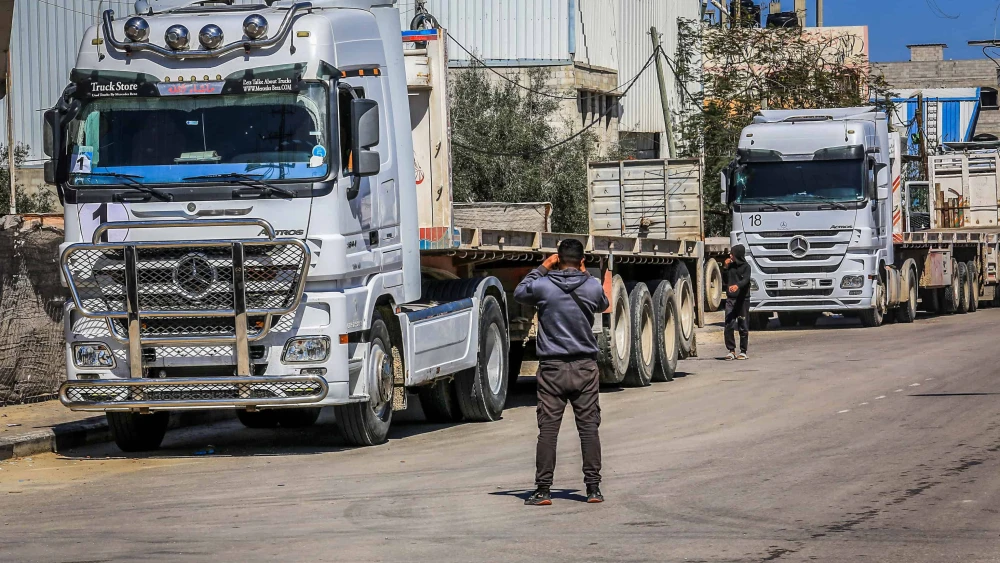
Approximately 150,000 liters (40,000 gallons) of fuel were transferred this week through Israel’s Kerem Shalom Crossing to support “essential humanitarian systems” in the Gaza Strip, according to the Coordinator for Government Activities in the Territories (COGAT).
The fuel was delivered “in accordance with a directive of the political echelon, and following a thorough security inspection,” said COGAT, a unit in the Israeli Defense Ministry.
Kaja Kallas, European Union high representative for foreign affairs and security policy, said on Thursday that Israel has agreed to “significant steps” to improve aid distribution in the Palestinian enclave.
Measures include increasing the number of trucks entering Gaza each day, opening additional crossings into the north and south of the Strip, reopening the Jordanian and Egyptian aid routes, resuming fuel deliveries and repairing vital infrastructure.
Aid will be delivered directly to the Gazan population while ensuring it is not diverted to the Hamas terrorist group, Kallas said.
On Thursday, Israeli Foreign Minister Gideon Sa’ar, in Vienna for meetings with his Austrian and German counterparts, addressed the discussions with the European Union.
“Following our dialogue with the E.U., our Security Cabinet made further decisions last Sunday to improve the humanitarian situation in Gaza,” he said. “And they include more trucks, more crossings and more routes for the humanitarian efforts.”
The U.S.- and Israel-backed Gaza Humanitarian Foundation (GHF) on Friday welcomed recent developments aimed at improving aid delivery, saying it has “consistently called for greater access for aid—through all available mechanisms—and we strongly support any step that helps feed more people, faster and safely.”
In a statement, the organization added, “GHF also continues to press the government of Israel to live up to its commitment to allow us to open additional sites, including in the north of Gaza. We also stand ready to help other humanitarian groups deliver their aid directly to the Palestinian people in need.”
GHF announced on Wednesday the successful completion of a pilot program aimed at delivering food aid directly to Gazan civilians—bypassing Hamas. Conducted in partnership with Al-Amal, a local nongovernmental organization, the pilot distributed more than 2,000 boxes of food to residents in central Gaza.
GHF said it plans to expand the program across several communities by collaborating with additional local NGOs. The long-term goal is to deliver more than 20,000 food boxes—equivalent to 1.2 million meals—daily across all regions of Gaza.
Under the program, food distribution begins when a community leader contacts GHF, directly or through an NGO partner. GHF then vets the leader, assesses the community’s needs and coordinates the delivery of an initial shipment of food aid.
The community leader collects the boxes at a predetermined location and distributes them to known members of their community. To ensure accountability, GHF verifies that all aid reaches those in need by cross-checking deliveries against a list of recipients provided by the community leader.
U.S. State Department documents confirm that Hamas is targeting GHF personnel through a campaign of bounties and violence, The Washington Free Beacon reported on Monday.
A June 30 cable sent from the U.S. embassy in Jerusalem states that the terrorist group has “formally placed bounties” on U.S. and Palestinian workers of GHF, a joint U.S.-Israeli aid effort formed in February to replace the United Nations Relief and Works Agency (UNRWA).
The bounties imperil “Palestinian workers and the U.S. security contractors helping to protect the GHF distribution sites,” the cable, marked “sensitive but unclassified,” reads, according to the Free Beacon’s report.
Last Saturday, two American aid workers were wounded in a terrorist attack during food distribution efforts at a GHF site in southern Gaza. According to a preliminary probe, two assailants threw fragmentation grenades at the aid workers as food distribution concluded. The injured Americans received medical treatment and were in stable condition.