Newsletter
Newsletter Support JNS

Israel and UAE sign historic free-trade agreement

The deal is the first of its kind between the Jewish state and an Arab country • “We have written a new chapter in the history of the Middle East,” says UAE minister for foreign trade.

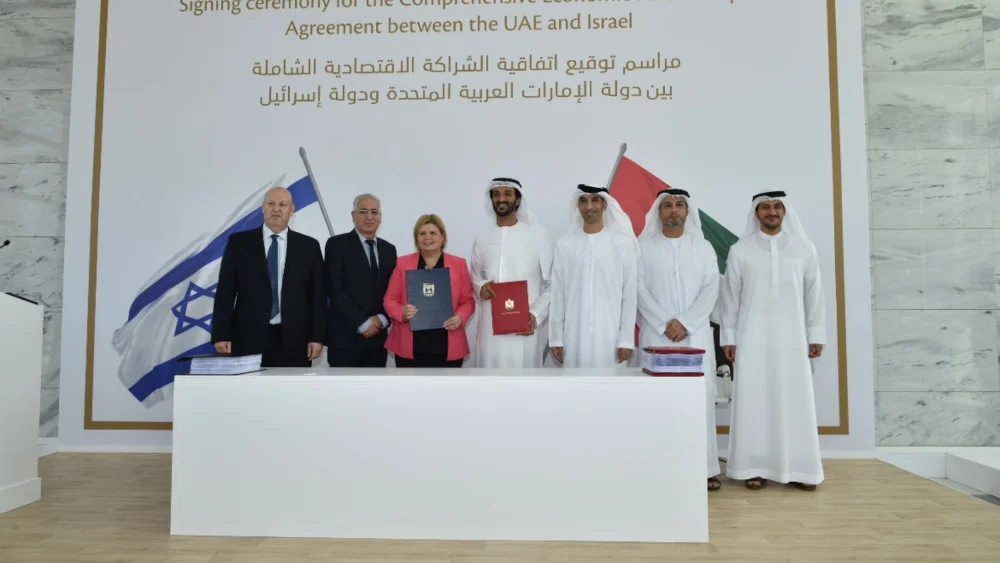
Israeli Economy Minister Orna Barbivai (third from left) and UAE Economy Minister Abdulla bin Touq Al Marri (fourth from left) at the signing of a free-trade agreement between Israel and the United Arab Emirates, in Dubai on May 30, 2022. Source: Twitter.

Israel and the United Arab Emirates signed a free trade agreement on Tuesday in Dubai. The deal is the first of its kind between Israel and an Arab state.

Israeli Foreign Minister Yair Lapid hailed the agreement, calling it historic, and thanked Israel’s Economy and Industry Minister Orna Barbivai for her contribution to achieving it. Barbivai attended the signing ceremony in Dubai, together with her UAE counterpart Abdulla bin Touq Al Marri and UAE Minister for Foreign Trade Thani bin Ahmed Al Zeyoudi.

Barbivai said on Monday that customs duties will be eliminated on 96 percent of products, including food, agriculture, cosmetics, medical equipment and medicine, according to Reuters.

The agreement also includes regulation, customs, services and government procurement.

Minister Al Zeyoudi tweeted on Tuesday: “Today, we signed a Comprehensive Economic Partnership Agreement with #Israel that builds on the strong foundations laid by the Abraham Accords. It will push the value of our non-oil bilateral trade beyond $10 billion within five years.”

The UAE and Israel normalized relations in September 2020 as part of the U.S.-brokered Abraham Accords that also included Bahrain and Morocco, and later Sudan.

In March of this year, academic institutions in Israel and the United Arab Emirates signed their first agreement to date for academic cooperation, further strengthening ties between the two countries.

In the same month, Israel, the United States and the UAE began a new program to promote interfaith and intercultural dialogue, as well as counter religious intolerance and hatred at the inaugural meeting of the Trilateral Religious Coexistence Working Group in Dubai.

The former IDF chief and defense minister told JNS that the Jewish state must remain strong against Iran and its proxies while building domestic consensus and new regional alliances.
“I didn’t serve this country to watch it get sold out by a career politician, who would rather protect his party than his constituents,” Cait Conley stated.
“I have to get even more involved because, apparently, the progressive movement is taking such a deep root in New York City, we have no choice,” Sid Winston, of Brooklyn, told JNS.
Darializa Avila Chevalier’s victory over incumbent Rep. Adriano Espaillat caps off a trio of wins for candidates who made opposition to Israel a focus of their campaigns for New York congressional seats.
AIPAC spokeswoman Deryn Sousa told JNS that Adrian Boafo “has made clear his vision to carry forward the strong pro-Israel legacy of Congressman Steny Hoyer, one of Congress’s most steadfast champions of the U.S.-Israel relationship.”
The Associated Press called the race early for the Jewish Democrat, whom the mayor has backed.
Benny Gantz, JNS editor-in-chief Jonathan S. Tobin, Gilad Erdan, Mosab Hassan Yousef, Nissim Black and leading voices in security, diplomacy, media, law and Jewish communal affairs headline the summit’s third day in Jerusalem.