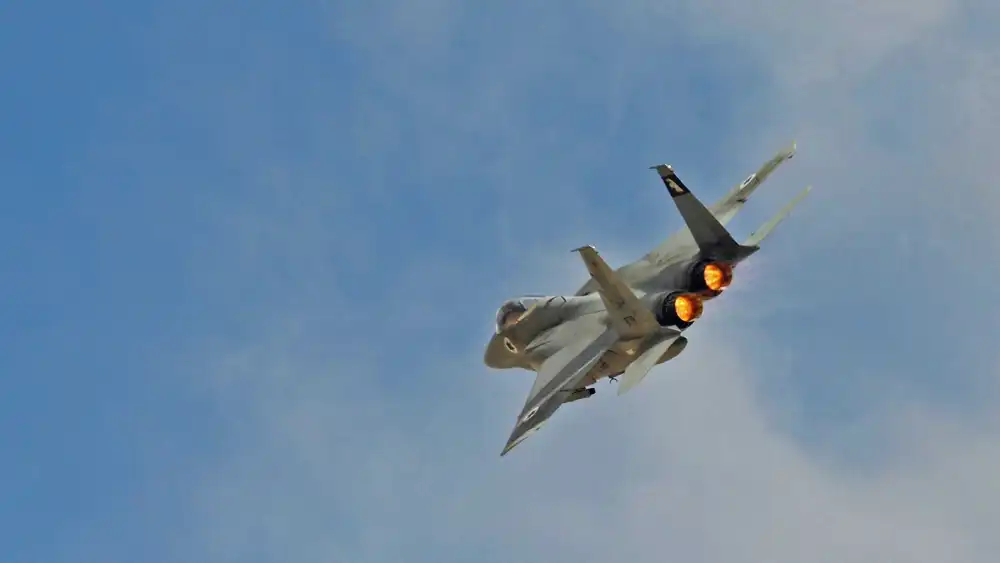
Israeli Air Force fighter jets carried out dozens of airstrikes on Houthi terrorist targets in the area of Yemen’s port city of Hodeidah on Sunday afternoon, the Israel Defense Forces confirmed in a statement.
“In a large-scale operation, dozens of Air Force aircraft, including fighter jets, refueling and intelligence planes, under the direction of the Military Intelligence Directorate, attacked military targets of the Houthi terrorist regime in the areas of Ras Issa and Hodeidah in Yemen,” the IDF said.
“The targets included power plants and a seaport, which were used by the Houthis to transfer Iranian weapons to the region, in addition to military supplies and oil,” according to the military statement.
“The attack was carried out in response to the latest attacks carried out by the Houthi regime against the State of Israel,” it added. “the Houthis have been operating under the direction and funding of Iran, and in cooperation with Iraqi militias, in order to attack the State of Israel, undermine regional stability and disrupt global freedom of navigation.”
#BREAKING: Reports that #Israel conducted another strike on the Port of Hodeidah in #Yemen which is used by #IRGCterrorists and the #Houthis for weapons smuggling. Follows a previous strike there and a couple of Houthi attacks targeting Tel Aviv and Ben Gurion Airport. pic.twitter.com/MrSaq3Cq5i
— Jason Brodsky (@JasonMBrodsky) September 29, 2024
“‘I pursued my enemies and overtook them; I did not turn back till I destroyed them’ (Psalms, chapter 18, verse 38),” Israeli Defense Minister Yoav Gallant said in a statement following the attack.
”I followed the attack against the Houthis from the control room of the Air Force. The message is clear—for us, no place is too far,” he added.
Unnamed senior officials in Jerusalem told Israel’s Channel 12 that the damage following the airstrikes was “enormous,” adding that it will take the Houthis “a long time” to recover from the unprecedented attack.
“The purpose of the attack is to exact a heavy price for the attacks by the Houthis. If they continue to attack Israel, the attacks will increase,” an Israeli official told the country’s Ynet outlet. “The message to Iran is that Israel can attack with tremendous power even at a distance of 2,000 kilometers [≈1,200 miles]. It can do it simultaneously in several arenas.
“Today, we attacked in Gaza, Lebanon, Syria and Yemen,” the official said.
The leader of the Houthis, Abdul Malik al-Houthi, on Saturday night claimed that a surface-to-surface missile it had launched at central Israel hours earlier was timed to coincide with Israeli Prime Minister Benjamin Netanyahu’s return to the Jewish state from the United States.
The IDF announced that the military’s aerial defense array had downed the Houthi terrorist missile “outside of the country’s borders.”
In a televised speech, the Houthi leader also vowed that the targeted killing of Hezbollah chief Hassan Nasrallah in Beirut on Friday would “not be in vain.”
Yemen’s Houthi militia, an Iranian proxy force, has launched numerous attacks on the Jewish state in support of Hamas in the wake of the Palestinian terrorist group’s Oct. 7 invasion of southern Israel.
Israel’s “Arrow” defense system intercepted a surface-to-surface ballistic missile fired at the Jewish state from Yemen on Friday, the IDF said.
On Sept. 15, Israeli air defenses intercepted fragments of a surface-to-surface missile launched from Yemen that exploded over central Israel.
In July, a Houthi suicide drone killed an Israeli civilian in central Tel Aviv, in response to which Israel struck Hodeidah port in a major attack.
The strikes, which Jerusalem said hit “dual-use infrastructure used for terrorist activities, including energy infrastructures,” appeared to be the first on Yemeni soil since the Houthis joined the war against Israel.
Netanyahu said the strikes were a “direct response to the drone attack that killed an Israeli citizen and wounded several others. It also followed the Houthi’s aggression against the State of Israel since the start of the war. Over the past eight months, the Houthis have launched hundreds of ballistic missiles, cruise missiles and drones towards Israel.”