Newsletter
Newsletter Support JNS

Israeli lawmakers expedite bill to dissolve the 22nd Knesset

If a coalition deal is not inked by midnight, then Israel will head to new elections on March 2, 2020.

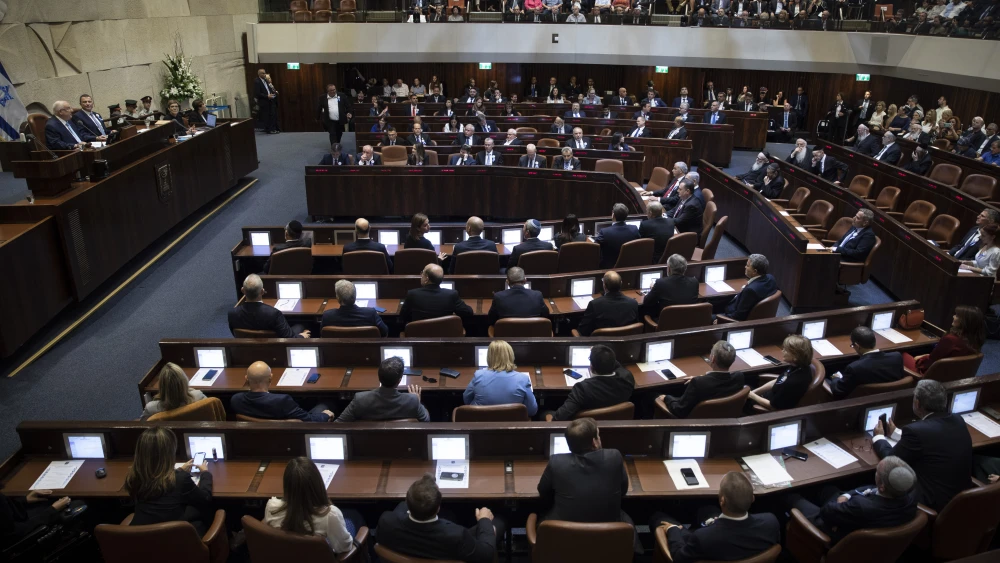
The Knesset plenum hall on the opening of the 22nd Knesset in Jerusalem, Oct. 3, 2019. Photo by Hadas Parush/Flash90.

A bill to dissolve Israel’s 22nd Knesset and set a date for new elections was expedited by lawmakers on Wednesday. If a coalition deal is not inked by midnight, then the country will head into an unprecedented third round of national elections within a one-year period.

The Knesset Arrangements Committee approved a special, fast-tracked legislative process that will allow Knesset members to hold four plenum votes and a committee amendments process in a single day.

Israeli law sets the election date 90 days after the deadline for forming a government passes, but since that would have put election day on the Jewish holiday of Purim, which falls this year on March 10, the bill seeks to set an election date of March 2, 2020.

As the bill already has the support of both the Likud, and Blue and White parties, which together constitute a Knesset majority, it is expected to pass without issue.

The New York City Police Department told JNS that the suspect is being charged with “attempted murder as a hate crime, attempted murder, assault as a hate crime, two counts of assault and two counts of criminal possession of a weapon.”
The teacher alleged Portland Public Schools allowed Palestinian flags and anti-Israel displays while administrators told him that displaying “an Israeli flag or related symbols would be too disruptive.”
The Islamic Republic’s foreign minister threatened on Friday to kill a U.S. soldier for every Iranian killed in the war, as Trump speculated that regime leaders might “cry uncle” or “go into a cave and hide.”
Art historian Jacob Wisse told JNS that he is concerned “when museums, which I value for the rigor, depth and richness of their curatorial voice, fall back, lazily, on untruths.”
“Shame on Mamdani and those who continue to parade this dangerous rhetoric,” Daniel S. Mariaschin of B’nai B’rith International told JNS.
“Every community deserves a seat at the table when healthcare policy is being shaped,” Eveline Shekhman, CEO of the American Jewish Medical Association, told JNS.