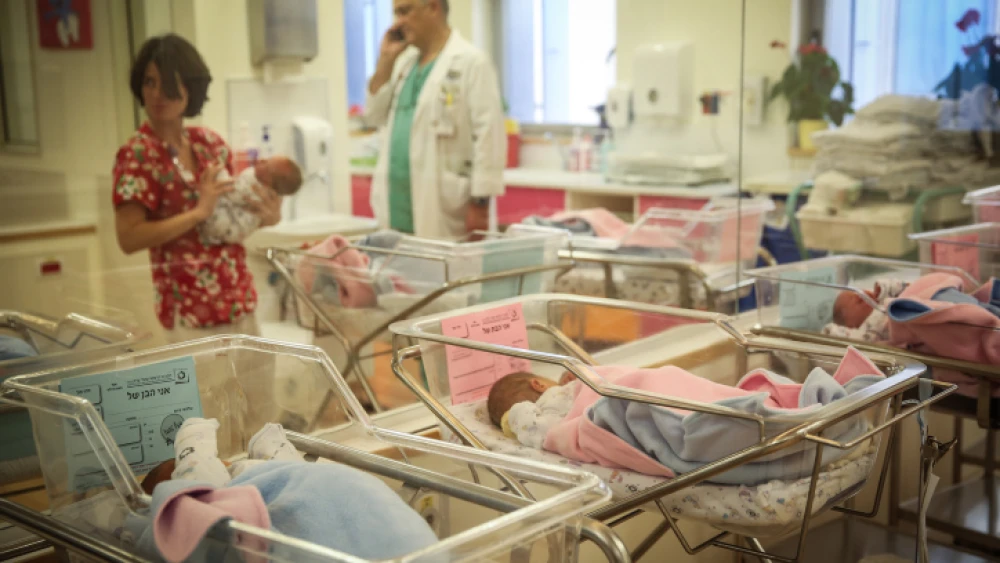
The Jewish fertility rate overtook the Arab rate in 2018 for the first time in the history of the State of Israel, according to data released by Israel’s Central Bureau of Statistics (CBS) on the last day of 2019.
The Jewish fertility rate hit 3.05 children per woman in 2018, compared to 3.04 for Arab women. Only Israeli citizens were included in the survey.
Israel’s overall fertility rate in 2018 was 3.08 children per woman, down from 3.11 in 2017. The OECD average in 2017 was 1.65.
The CBS also reported that Israel began 2020 with 9,136,000 citizens, of which Jews accounted for 6,772,000 people (74.1 percent) and Arabs 1,916,000 million (21 percent).
In the past decade, Israel’s population has grown by 17.8 percent, and is expected to top 10 million by the end of 2024.
In 2019, 177,000 babies were born in Israel, 34,000 people immigrated to the country and 45,000 people died.