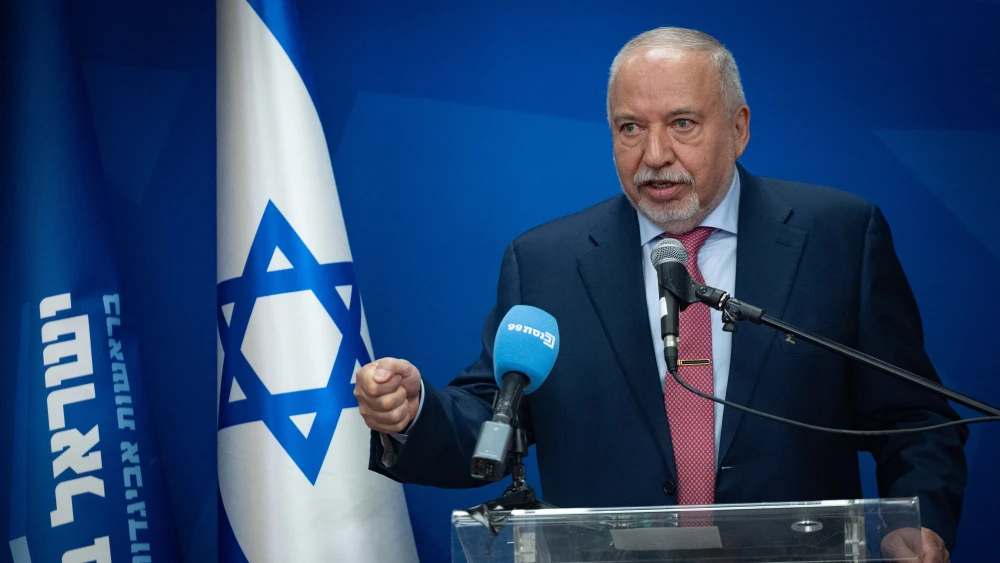
Yisrael Beiteinu leader Avigdor Liberman said on Friday that he is prepared to compromise on legislation governing haredi military conscription, marking a significant shift that could open a path to a 61-seat government led by Yashar chairman Gadi Eisenkot.
“The election results require all of us to recalculate our route and understand that there are no good alternatives or magic solutions before us,” Liberman wrote on X.
“In the political reality that has been created, national responsibility requires us to make difficult decisions and be prepared for painful compromises,” he said.
Liberman maintained three red lines: ending Israeli Prime Minister Benjamin Netanyahu’s tenure, avoiding another election and refusing to establish a government dependent on the abstention in votes of no-confidence of the Joint List or Ra’am, the Arab parties.
On other issues, however, he said compromise was necessary—including on one of the issues most closely associated with Yisrael Beiteinu.
“On all other issues, it is permissible and desirable to be flexible and compromise, and to understand that if you grasp too much, you grasp nothing,” Liberman said. “That includes the issue of the conscription law.
“It pains me, and I know it pains many others as well,” he added. “But in light of the many challenges we face today, the national interest of the State of Israel and the Jewish people must stand above every other consideration.”
UTJ welcomes opening
United Torah Judaism chairman Yaakov Asher welcomed Liberman’s change of position but stressed that no agreement had been reached.
“It is encouraging to discover the flexibility of all the political players on the issue of conscription,” Asher said. “It is painful to think how much incitement and fraternal hatred could have been spared had that same flexibility been shown in recent years.”
UTJ officials said the party welcomed “every outstretched hand,” while Asher stressed that “there is still no proposal.”
The seven-seat haredi party declined during consultations at the President’s Residence on Thursday to recommend either Netanyahu or Eisenkot to form the next government.
UTJ has not endorsed an Eisenkot-led government or committed itself to joining one. Party representatives told President Isaac Herzog that their support for any future government would depend on legislation regulating the status of haredi yeshivah students and military conscription.
Political sources cited by Ynet said Jerusalem Mayor Moshe Lion, who has close ties with both Liberman and haredi leaders, was mediating between the sides in an effort to facilitate an agreement.
A possible path to 61
Liberman’s shift creates a mathematical path to a 61-seat government without Netanyahu or the Arab parties, although there is no indication at this stage that all six parties needed for such a coalition have agreed to it.
Yashar’s 21 seats, B’Yachad’s 12, The Democrats’ eight and Yisrael Beiteinu’s seven, together with UTJ’s seven and Shas’s six, would produce exactly 61 seats—the minimum required for a Knesset majority.
The political obstacles remain substantial.
UTJ formally endorsed neither candidate during Herzog’s consultations and has not expressed support for the proposed six-party coalition.
Shas, meanwhile, formally recommended Netanyahu to Herzog and has so far remained publicly committed to him.
Neither Yashar nor B’Yachad had publicly endorsed Liberman’s willingness to compromise on ultra-Orthodox conscription as of Friday.
The 61-seat combination therefore remains a possible coalition based on the Knesset arithmetic rather than an agreement in place. The haredi parties could change their positions during coalition negotiations, but neither has committed to doing so.
Liberman said the goal should be to assemble a 61-seat coalition without relying on the Arab parties.
“We must make every possible effort to establish a coalition of 61 Knesset members, without the Joint List and Ra’am,” he said.
He predicted that once such a government was established, additional lawmakers could be persuaded to join it.
“After it is established, there is a high probability that another three or four Knesset members from Likud can be brought in,” he said.
Liberman also rejected reports that he had discussed a rotation agreement for the premiership, calling the mechanism harmful to effective government.
“Whoever succeeds in forming a government should receive full authority for the entire term,” he said.
Golan: ‘Real progress’
The Democrats chairman Yair Golan said Friday that negotiations to replace Netanyahu were making “real progress,” adding to signs of intensified efforts to assemble an alternative coalition.
“There is progress. There is willingness. And there is serious work taking place every day to turn the election results into a government of change,” Golan wrote on X. “There are difficulties, and I do not intend to hide them. But there is also real progress.”
Golan said negotiating teams from The Democrats and Yashar, which is leading the coalition talks, had met several times this week.
“We are working seriously, responsibly and determinedly to advance the formation of the government as quickly as possible,” he said.
Golan said the coalition negotiations were not the only avenue being pursued. The parties were also increasing public and political pressure on Netanyahu and his allies, working with other members of the anti-Netanyahu bloc and preparing to “take control of the Knesset” when the newly elected parliament is sworn in on Tuesday.
“The public gave us a great opportunity. Now it is our responsibility to turn it into reality,” Golan said. “It will not be simple. But it is possible.
“We have a majority. We have an opportunity. And we have a historic responsibility not to miss it,” he added.
Neither Yashar nor B’Yachad, however, had publicly weighed in by Friday afternoon on Liberman’s willingness to compromise on haredi conscription or confirmed that an agreement with the haredi parties was taking shape.
That is significant because Yashar, as the largest party in the prospective coalition, is leading negotiations, while B’Yachad would be its second-largest component. Both would have to support any agreement bringing the ultra-Orthodox parties into such a government.
The Joint List and Ra’am have meanwhile requested a vote to replace Knesset Speaker Amir Ohana at the first sitting of the 26th Knesset. Together with the parties seeking to replace Netanyahu, they provide the parliamentary majority needed to elect a new speaker.
Herzog to decide Sunday
The political maneuvering comes ahead of Herzog’s expected decision on Sunday on whom to task with forming Israel’s next government.
During two days of consultations at the President’s Residence, parties representing 67 Knesset members recommended Eisenkot, while 46 recommended Netanyahu. UTJ’s seven lawmakers declined to recommend either candidate.
The 67 recommendations for Eisenkot do not amount to a prospective governing coalition. They include the 19 lawmakers from the Joint List and Ra’am, while Liberman has ruled out joining a government dependent on either Arab party.
Herzog stressed on Thursday that the number of recommendations alone would not determine his decision, noting the mutual vetoes among and within the political blocs and the need to determine which candidate has the best chance of assembling a government.
Liberman said Friday that the election results required political leaders to reconsider positions that had previously appeared nonnegotiable.
“We must prevent the destruction of the Third Temple,” he said.
“This is the only strategy that reflects the good of the State of Israel and the Jewish people,” Liberman added. “This is the way out of the deadlock and toward establishing a stable government for the next four years.”