Newsletter
Newsletter Support JNS

Jewish fertility rate outstrips Arab one for the first time in Israel’s history

According to Israel’s Central Bureau of Statistics, the country started 2020 with 9,136,000 citizens, of which 6,772,000 are Jews and 1,916,000 million Arabs.

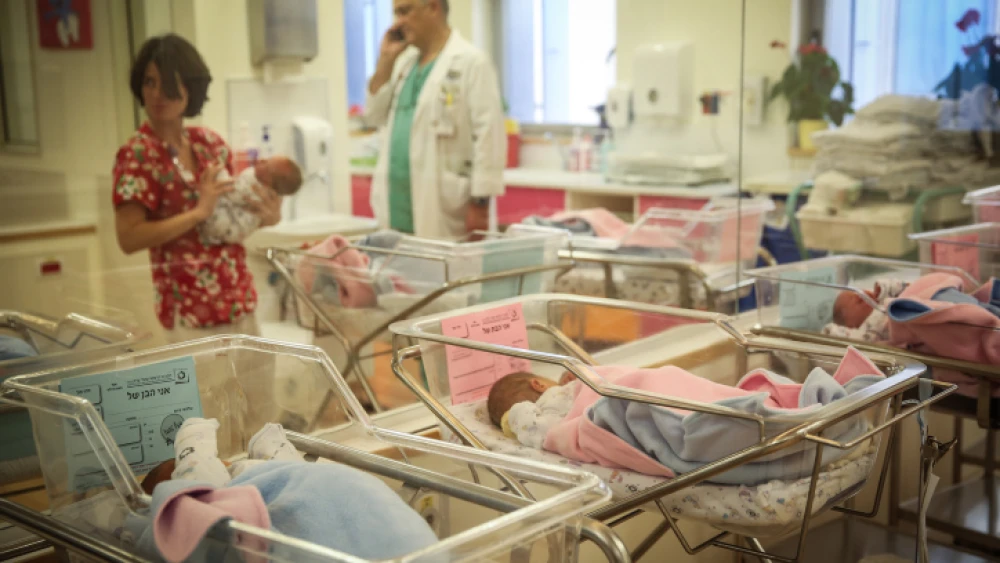
The Neonatal Intensive Care Unit at Shaare Zedek Medical Center in Jerusalem, Jan. 5, 2015. Photo by Hadas Parush/Flash90.

The Jewish fertility rate overtook the Arab rate in 2018 for the first time in the history of the State of Israel, according to data released by Israel’s Central Bureau of Statistics (CBS) on the last day of 2019.

The Jewish fertility rate hit 3.05 children per woman in 2018, compared to 3.04 for Arab women. Only Israeli citizens were included in the survey.

Israel’s overall fertility rate in 2018 was 3.08 children per woman, down from 3.11 in 2017. The OECD average in 2017 was 1.65.

The CBS also reported that Israel began 2020 with 9,136,000 citizens, of which Jews accounted for 6,772,000 people (74.1 percent) and Arabs 1,916,000 million (21 percent).

In the past decade, Israel’s population has grown by 17.8 percent, and is expected to top 10 million by the end of 2024.

In 2019, 177,000 babies were born in Israel, 34,000 people immigrated to the country and 45,000 people died.

“In this political environment, he may be as reliable a supporter as possible that the Democratic caucus would sign off on for the position,” political science scholar Dan Schnur told JNS.
“Anyone who attempts to pose a threat or attack Israel will face devastating consequences,” said Danny Danon, Israeli ambassador to the global body.
“I think they’re much more susceptible to being targeted if a public official wants to target them, if a community wants to target them,” Rep. Josh Gottheimer told JNS.
Israel is building a barrier as part of efforts to bolster border defenses.