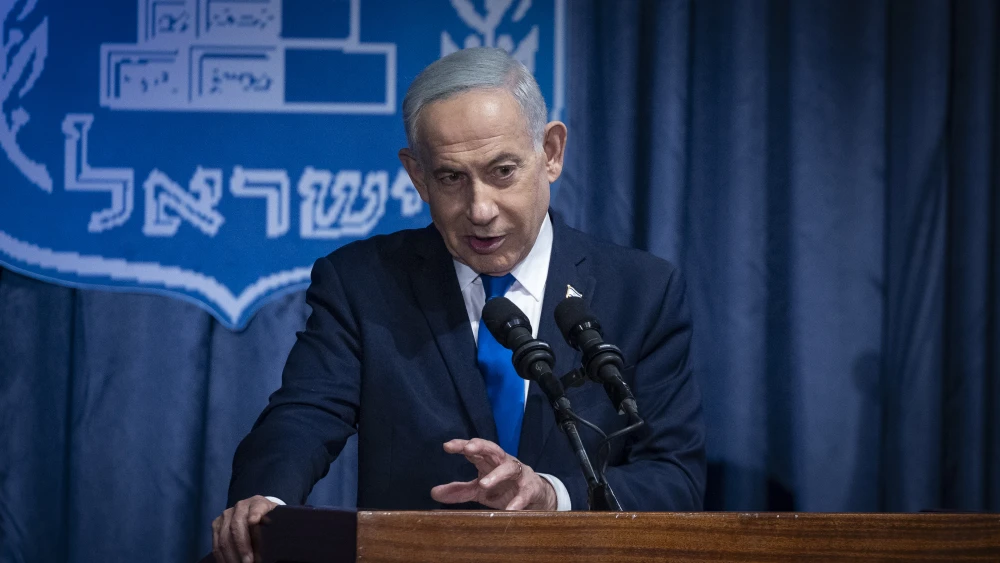
Israeli Prime Minister Benjamin Netanyahu visited the site of a new barrier along Israel’s eastern border on Thursday, saying the project would bolster defenses against potential incursions.
Speaking near Kibbutz Masada in the Jordan Valley, Netanyahu said that the massive barrier was being built “from the Yarmouk to Eilat” and will be an “additional layer of security” to complement security zones in Lebanon, Syria and the Gaza Strip.
Accompanied by Defense Minister Israel Katz and senior military officers, Netanyahu received a briefing on efforts to strengthen border security.
ראש הממשלה בנימין נתניהו ביקר היום (ה׳) במרחב המכשול החדש שמוקם בגבול המזרחי יחד עם שר הביטחון ישראל כ״ץ, ראש מנהלת גבולות ותפר, אלוף ערן אופיר, מפקד אוגדה 96, תא״ל אורן שמחה ומפקדים נוספים.
— ראש ממשלת ישראל (@IsraeliPM_heb) October 15, 2026
במהלך הביקור ראש הממשלה קיבל סקירה על המאמצים שנעשו ונעשים לעיבוי ההגנה בגבול ולחיזוק… pic.twitter.com/vv8CBAw6KO
“We are surrounding the State of Israel with a massive barrier, but it does not stand alone. There are forces here, there is an operational plan, there are plans to counter drones—I will not elaborate. Simply put, maximum protection so that we can defend Israel’s citizens and prevent anyone from even thinking about invading the State of Israel,” the premier said.
“A tremendous amount of work is being done here—enormous engineering work, enormous logistical work. The Israel Defense Forces are mobilized, and the reserves are mobilized. All this strength is meant to tell Israel’s enemies: Do not test us.”
Katz said the defensive measures are part of a proactive policy aimed at destroying enemies and removing threats, including those posed by Iran.
“What the prime minister showed here is an important component of the security plan, the defense plan—the security zones, the fence, the forces. But this only supplements the main element: a proactive offensive policy led by the prime minister, pursued by the State of Israel and the IDF, against distant Iran and nearby threats,” Katz said.
“First and foremost, going on the offensive, destroying the enemy, removing threats and, alongside that, providing strong protection for Israel’s citizens,” he added.
On Tuesday, Netanyahu said that Jerusalem is prepared for any scenario, including what he called a “turning of barrels” by the Palestinian Authority.
“Our enemies are thinking of testing us these days ahead of the elections,” Netanyahu said during a visit to the seam line area of the Samaria security barrier, referring to the Oct. 27 Knesset vote.
“I do not advise our enemies to test us,” the premier said. “You will encounter a force here that you never dreamed of.”
The same day, Netanyahu warned his Cabinet that Hamas would try to challenge Israel ahead of the Oct. 27 national election.
“Precisely because Hamas is so weak, it will try to challenge us with the remainder of its forces ahead of the elections,” the prime minister said. “We are ready for this. First of all, we will thwart such attempts. And, in any case, we will respond to them with tremendous force if they make this mistake. I say to all our enemies: ‘Look at what we did to you on seven fronts in the War of Revival. Don’t tangle with us.”