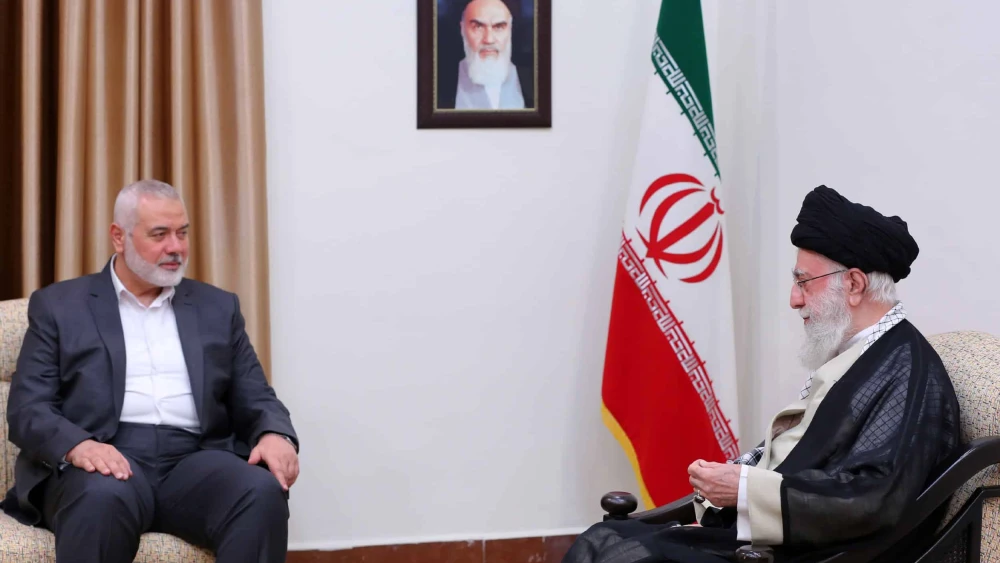
Iranian Supreme Leader Ali Khamenei recently met with Hamas chairman Ismail Haniyeh in Tehran, Khamenei confirmed on Sunday.
Haniyeh updated Khamenei on “the latest developments in the Gaza Strip and the crimes of the Zionist regime in Gaza, as well as the developments in the West Bank,” Khamenei said on X (formerly Twitter).
According to Iran’s semi-official Tasnim News Agency, “Ayatollah Khamenei praised the steadfastness and resilience of the people of Gaza and expressed strong regret over the crimes of the Zionist regime, supported directly by Washington and some Western countries.”
The Iranian supreme leader also “emphasized Tehran’s consistent policy of supporting the Palestinian resistance forces against the Zionist occupiers,” per Tasnim.
The report did not say when the meeting took place.
آقای اسماعیل هنیه رئیس دفتر سیاسی حماس و هیات همراه با حضرت آیتالله خامنهای رهبر معظم انقلاب اسلامی دیدار و گفتوگو کردند. pic.twitter.com/D9dBMXDFmi
— KHAMENEI.IR | فارسی (@Khamenei_fa) November 5, 2023
Israel has underscored Iranian support for Hamas since the terrorist group conducted its Oct. 7 cross-border invasion of the western Negev, resulting in the deaths of more than 1,400 people, with thousands wounded and recovering in hospitals throughout the Jewish state.
Late last month, Israel Defense Forces Spokesman Rear Adm. Daniel Hagari said that Iran assisted Hamas by supplying it with funding, intelligence, weapons and technological knowledge.
As many as 500 men affiliated with Hamas and Palestinian Islamic Jihad trained in the Islamic Republic leading up to Oct. 7, The Wall Street Journal reported on Oct. 25. Iranian-sponsored exercises took place in September, at which time terrorists received specialized combat training.
Senior Hamas operatives have publicly thanked the Islamic Republic for its support. “Hezbollah and Iran supported us with weapons, expertise and technology,” Khaled Mashaal, the former head of Hamas, told Al Arabiya television.
Last week, Haniyeh met with Iranian Foreign Minister Hossein Amir-Abdollahian in Qatar. The Hamas leader resides in Doha, where he has an office under the protection of the Gulf country’s government.
In an Oct. 26 address, Haniyeh called for “the blood of the [Palestinian] women, children and elderly. … We are the ones who need this blood, so it awakens within us the revolutionary spirit, so it awakens with us resolve.”
Over the weekend, an IDF drone struck a house in Gaza belonging to Haniyeh, Arabic-language media reported. According to the reports, a missile targeted Haniyeh’s home in the Shati area of Gaza City.
Earlier in the war, Palestinian media reported that an IAF strike in Gaza City’s Sheikh Radwan neighborhood killed 14 relatives of Haniyeh. The terrorist leader’s brother and nephew were killed in the alleged strike, reports said.