
Almost two weeks after the British Labour-led government announced a boycott of Israeli products from Judea and Samaria, another U.K. left-wing movement, the Green Party, on Sunday passed a resolution calling Zionism a form of racism.
To some political analysts, this suggests a downward spiral that risks painting a target on the backs of ordinary British Jews.
“Basically, they’re competing for Islamist votes,” Lance Foreman, a Jewish business owner from London who had served as a European Parliament member for the Brexit Party, told JNS of the Green Party and Labour.
“The Greens had allied with Islamists over the last couple of years and Labour realizes that it’s sort of taken a lot of votes away from them, so they’ve been showing how they can lecture Israel,” he said.
Financial Times columnist Stephen Bush observed a similar dynamic, arguing in an op-ed on Monday that Labour shifted its Gaza policy partly because of electoral losses to the Greens, while the Greens have now adopted a position “whose full implications are much more radical.”
The resolution, passed by 1,022 votes to 813 at the party conference in Brighton on Sunday, says that Zionism “will be treated as any other form of racism, and this motion will be implemented by the anti-racism policy working group as appropriate and in accordance with its ordinary practice.”
The party, which is headed by Zack Polanski, a British Jew, now backs “the establishment of a single democratic Palestinian state in all of historic Palestine.”
At the Green Party conference, members submitted a draft amendment to the anti-Israel resolution, specifying that Jewish institutions should not be targeted. It was defeated by 1,026 votes to 684 on a card vote. Dave Rich, director of policy at CST, warned that this would be interpreted as license for Greens activists to beset “Zionist synagogues.”
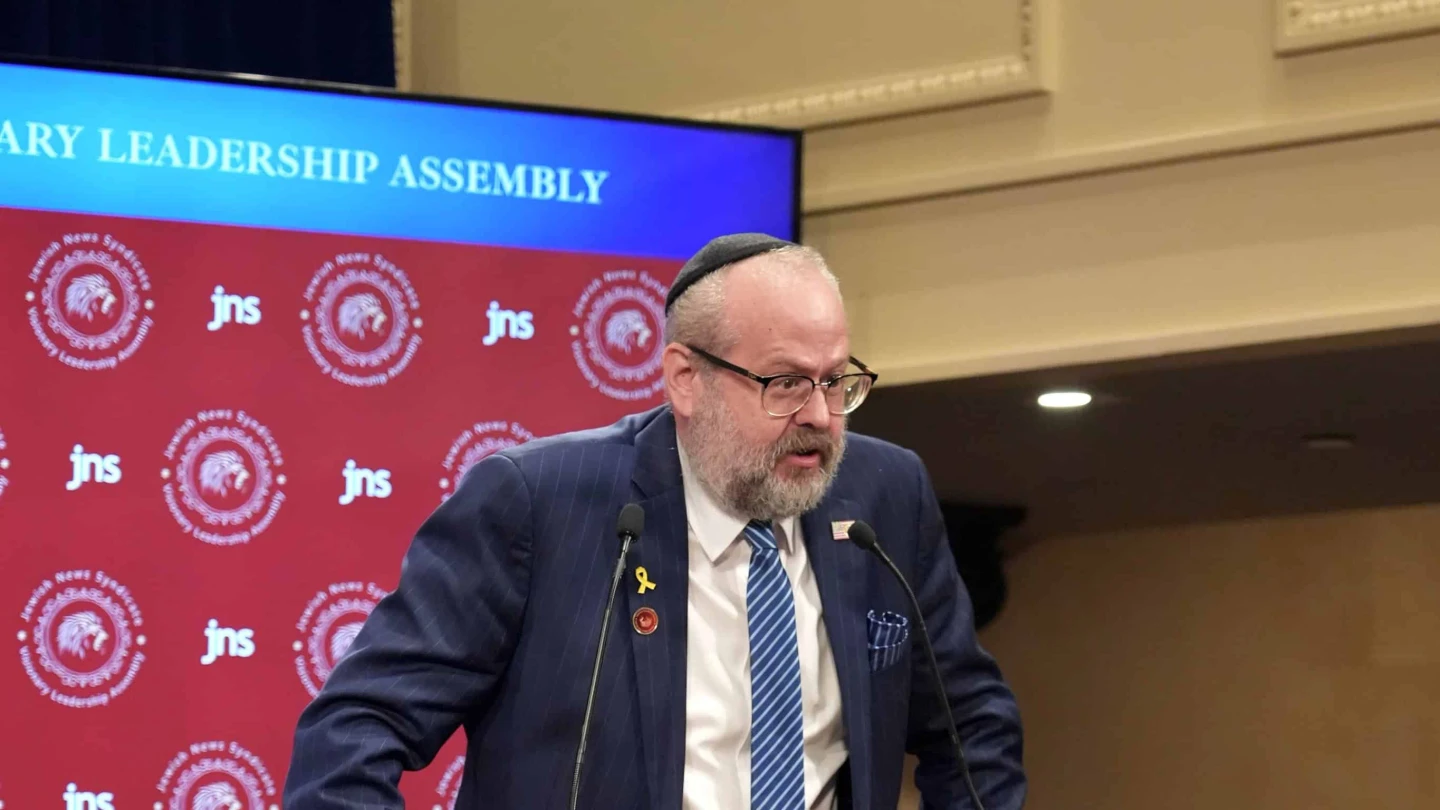
This “really will bring the Green Party into accusations of downright racism,” Jonathan Arkush, a former president of the Board of Deputies, told JNS.
Protesters have already targeted synagogues, citing “Zionist” activity there, including at a June 14 Israeli property fair at Edgware United Synagogue, northwest London, where police arrested 14 people. In November, anti-Israel activists gathered outside St. John’s Wood United Synagogue and projected “Stolen Lands Sold Here” onto the synagogue’s exterior.
The Board of Deputies of British Jews and the Jewish Leadership Council called the resolution “an attack on the Jewish community” and “an antisemitic platform, based on a grossly offensive distortion and erasure of Jewish experience and identity.” Noting condemnations by Labour and the Conservative Party for the Greens’ resolution, the two Jewish groups said the Green Party “has become an extremist party with a platform of anti-Jewish racism.”
Israel’s Foreign Ministry said that with the resolution, “the Green Party in Britain ceased to act as a political party and became a body that gives legitimacy to terrorism.”
The Green Party holds five of the 650 seats of the House of Commons, the lower chamber of the British Parliament. Four of its MPs said they opposed the resolution on Israel. Several Jewish Green Party members also opposed the resolution. Polanski did not condemn it.
Despite its low representation in parliament, the Green Party is a rising political force: In the May 2026 local elections in England, the Greens won 587 council seats, a gain of 441 compared with the previous elections for those seats. They flipped many of those seats from Labour. That party’s former leader, Keir Starmer, distanced it from the more radical left-wing policies of his predecessor, Jeremy Corbyn, whom critics said encouraged antisemitism.
“The two-party system in the U.K. is broken, and the Green Party’s rise is evidence of this,” Geoffrey Alderman, a British Jewish historian and former Board of Deputies member, told JNS.
Under Starmer’s successor, British Prime Minister Andy Burnham, Labour hardened its attitudes toward Israel. On Sept. 23, the British government announced a ban on the introduction into the United Kingdom of products from Israeli communities in Judea and Samaria.
These changes coincided with an explosion of antisemitic incidents in the United Kingdom. Britain’s Community Security Trust (CST), British Jewry’s watchdog on antisemitism, recorded 3,700 antisemitic incidents in 2025, the second-highest annual total on record—up 4% from 2024 and 123% from 2022, the last full year before Hamas’s Oct. 7 attack. Of the 2025 incidents, almost half showed explicitly anti-Zionist motivation.
Unlike Foreman, who spoke of the Green Party and Labour’s anti-Israel policies as feeding off each other, Arkush said the trends coincide independently as politicians in both parties use Gaza “to appeal to Muslim voters, and, sadly, in effect, to antisemitic elements and people who have an irrational hatred of Israel.” The Greens’ refusal to amend the resolution to protect Jewish institutions shows “the majority of the Green Party members didn’t want to water down the anti-Israel policy,” he said.
Arkush predicted that the Green Party’s anti-Zionist shift will backfire, costing it constituencies where the Greens owe their success to environmentalism.
The Greens are also popular in some areas with substantial Jewish communities, including Hackney, where the Greens won control of the council from Labour in May.
Rather than clinch a net gain in votes, “I think it’s more likely that the anti-Israel shift will actually just emphasize the fact that the Greens are irresponsible, extremist and not to be trusted. And I think that most British voters will see that, and reject it,” he said.
However, Foreman, the former European Parliament lawmaker, argued that the Green Party’s veering toward radicalism had already paid off electorally. The new anti-Israel policy aims to preserve those gains against Labour’s competing appeal to Muslim voters, he said.
“The Greens are now competing and they’ve gone one stage further to try and hold on to those votes,” Foreman said. “It sort of worked for them because they were a tiny party. They had very, very little support until they started aligning themselves with the Islamists.”