Growing up, Carrie Rieger Brownlie spent most holidays with her maternal grandmother. “Even when she was diminished in old age,” her grandmother “found a way to complain to me about being unsatisfied with stamp art,” the deputy counsel general at the U.S. Postal Service said.
“She would say, ‘Why aren’t there any pretty stamps?’” Rieger Brownlie told JNS days before attending the first-day-of-issues ceremony for the new Chanukah stamp on Tuesday at Touro Synagogue, a Reform congregation in New Orleans.
“The idea that this is a Chanukah stamp and that it is connected not only to our traditions but also that it is beautiful, it’s a nice touch,” the Postal Service official told JNS before the event.
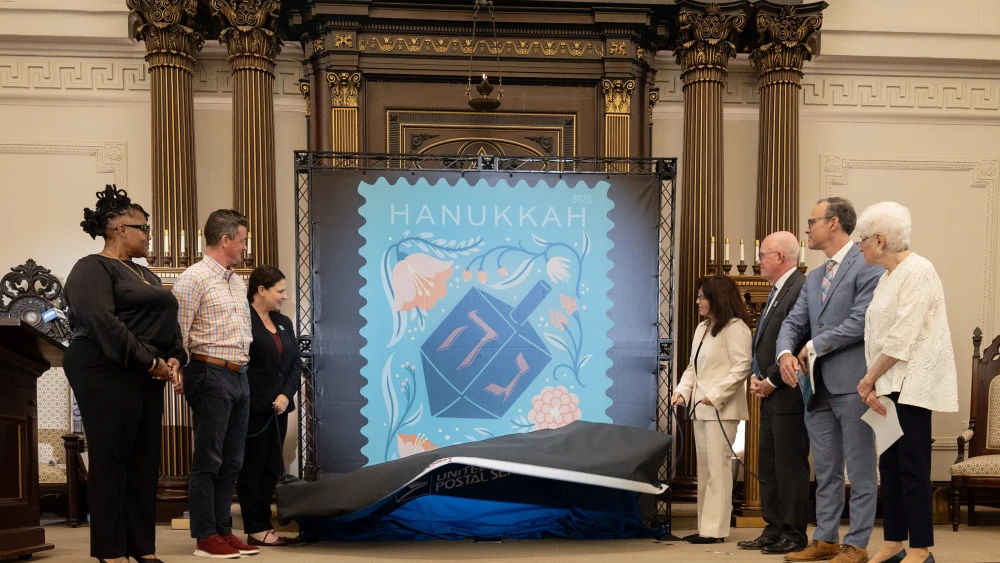
This Chanukah, which begins this year on Nov. 4 at night, Rieger Brownlie plans to send out letters using the independent federal agency’s newly released stamp, which depicts a dreidel surrounded by flowers on a turquoise background.

The illustration, by Lisa Perrin, shows two sides of the holiday-associated top, displaying the Hebrew letters gimmel and hay. In the traditional way of playing the Chanukah game, landing a gimmel earns the spinner the whole pot of coins or candy, and hay yields half of the ante.
The two letters that don’t appear in the drawing, nun and shin, are less advantageous spins. The former yields no winnings, and the latter requires the spinner to put extra ante in the pot.
The Postal Service plans to make 10 million of the Chanukah stamps, it told JNS.
“It’s my first stamp dedication, so that’s exciting, and that it happens to be a Chanukah stamp is great,” Rieger Brownlie told JNS, speaking over video from her home, with a menorah, vases and wine goblets on shelves over her shoulder.
“There is a menorah up there,” she told JNS. “It was not intentional. This is actually my normal workspace.” (The menorah, she said, comes from her parents’ home and would require too much wax cleaning to use on the upcoming holiday.)
“The color combination. The dreidel. All of it feels very joyous and festive,” she said of the new dreidel stamp. “I think in particular the color combination is not necessarily something that would have jumped out at me before.”

“The combination of the oranges and the peaches and the blues is really beautiful,” she told JNS.
The stamp is the Postal Service’s ninth Chanukah stamp, the agency said.
Antonio Alcalaì, a USPS art director, designed the stamp with Perrin’s art, according to the agency.
“I’m excited to be in New Orleans, which I haven’t been to,” Rieger Brownlie told JNS. She said that she was looking forward to visiting the historic synagogue.
According to the synagogue’s website, Touro is “one of the oldest continuously operating synagogues in the country” and the “one of the first Jewish temples outside the 13 original colonies.”
Rieger Brownlie, who is in her 15th year at the Postal Service, told JNS that she has worked on many different things at the USPS, all within the law department. She started her current role at the beginning of the year.
“I do a lot of election mail work, which I don’t really want to talk about necessarily,” she said.
“Litigation, mostly. I was on the team that supported the postal reform legislation,” the Postal Service Reform Act that passed in 2024, “which was a significant help for us financially,” she told JNS. “That was a big win.”
Her team also supports the stamp program, “so any intellectual property or trademark issues, we help support, which is fun, because we get early access to figure out what the designs are going to be,” she said.
The past week, she saw her first next-generation USPS delivery vehicle “out in the wild.”

“My team helped support both the procurement, supply management and the environmental regulatory piece of that, so that was exciting,” she told JNS. “It’s nice to work on things that are so tangible. It’s public service. It’s government work, but it’s also in everybody’s lives every day—the stamps, the vehicles, the mail.”
After law school at George Washington University, in the District, Rieger Brownlie worked in private practice for a few years and realized “that that was probably enough.”
“I was looking to make a move to government,” she told JNS. “I had studied policy before and wanted to be doing more administrative law and government-related work. The Postal Service just sort of happened—it was a federal government job that happened to work out.”
“It was actually through a Jewish geography thing,” she said.
A family friend was at a barbecue for a reunion from a trip to Israel. “Somebody said, ‘Oh. We are hiring for these vacancies. Does anybody know any good, young lawyers that are interested?’” she said.

“The family friend called my mom and said, ‘Tell Carrie,’” she told JNS. “In some ways, it was just sort of coincidence, but it’s been fantastic. As far as government legal work goes, it’s unique in that we are a mission-driven, operations-based organization.”
“We generate revenue through stamps,” she said. “The ability to support a client that is producing something, doing something and that is still such an operations- and mission-driven organization that touches everyone in the country but is still public service, not political.”
The job is “a really special, unique opportunity for a government lawyer,” Rieger Brownlie told JNS.
Since joining the Postal Service, she collects stamps and thinks about which to use for which envelopes, including when she sends mail to her children in camp. She instructs her children about how to properly address a letter and chooses which stamps to give them to use to send mail back to her from camp.
It’s nice to have themed stamps, which are specific to occasions, she said.
“I didn’t give a ton of thought to the Post Office before I started working at the Postal Service,” she told JNS. “Now, my family laughs at me, because I’m very postal, in terms of stamps, doing a plant tour—walking through and seeing how our machines work and all of the engineering that goes into it.”
“I definitely geek out on all of the areas,” she said.


So does the legal department at the Postal Service select stamps deliberately on the materials it sends out for work in its legal cases, JNS asked.
“We probably would use Priority Mail instead of First Class Mail, so I don’t know that there would be a stamp on it,” Rieger Brownlie told JNS, with a laugh.
For her younger son’s bar mitzvah in November, she is thinking of using the new Chanukah stamps for the thank-you notes.
JNS asked if Rieger Brownlie had a thought about the new Chanukah stamp unveiling amid rising antisemitism worldwide.
“I’m very excited to be able to participate in a stamp dedication that is something that is representative of a joyous, celebratory Jewish tradition,” she said.
Some people get “seriously into it” around the holidays at U.S. Postal Service headquarters. “The law department is probably the least creative,” Rieger Brownlie said. “Unfortunately, the law department is probably on the less festive side of things.”
At her home, each person has his or her own menorah for Chanukah, so family members “definitely take the festival of lights piece of it seriously.”
“They’re a little older now, so there’s less dreidel in the house,” she said, of her children. “But they do take their homemade latkes and apple sauce very seriously.”