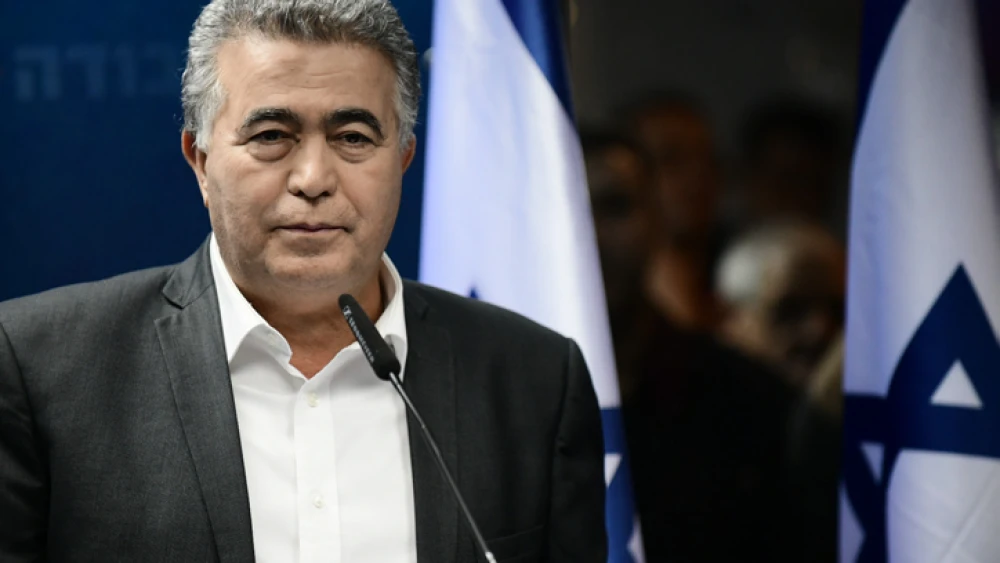
Israel’s left-wing Labor-Gesher and Meretz parties announced on Monday that they will merge ahead of the country’s March 2 elections.
The decision followed what insiders in both parties described as marathon talks between Labor leader Amir Peretz and Meretz head Nitzan Horowitz. Both parties fear one of them could fail to clear the 3.25 percent electoral threshold (roughly four Knesset seats) required to enter the Knesset.
“This is a significant move for the 2020 election, which will ensure the ability to form a government of change and hope,” Peretz and Horowitz said in a joint statement, adding that the new political alliance will serve as “the social heart and diplomatic compass for the next government after the end of the Netanyahu era.”
Talks between the parties ahead of Israel’s April 9 and Sept. 17 elections about a possible joint run were unsuccessful. Ahead of the September elections, Labor instead merged with Gesher, headed by Orly Levy-Abekasis, a former Yisrael Beiteinu lawmaker, while Meretz partnered with former Labor politicians to form the Democratic Union.
According to the deal struck between the two parties, Labor-Gesher will have six of the first 11 spots in the new slate, while Meretz will have five. Peretz will lead the new faction, with Levy-Abekasis at the No. 2 slot and Horowitz at No. 3.
They will be followed by Meretz MK Tamar Zandberg, and Labor MKs Itzik Shmuli and Merav Michaeli.
Former Israel Defense Forces Deputy Chief of Staff Yair Golan will take the seventh slot, followed by Labor MKs Omer Barlev and Revital Swid, and Meretz’s Issawi Frej at the 11th spot.
Former Labor MK Stav Shaffir, who ahead of September’s elections was placed second on the Democratic Union’s slate, was not included in the new union, though officials in both parties did not rule out a future alliance with Shaffir, who currently heads the Green Party.
Briefing his party on the merger, Peretz reportedly said, “We have no choice but to unite.”
Senior Labor MK Itzik Shmuli said on Sunday morning that he supported a merger, but only as a “technical bloc” that could potentially separate soon after the elections.
This article first appeared in Israel Hayom.