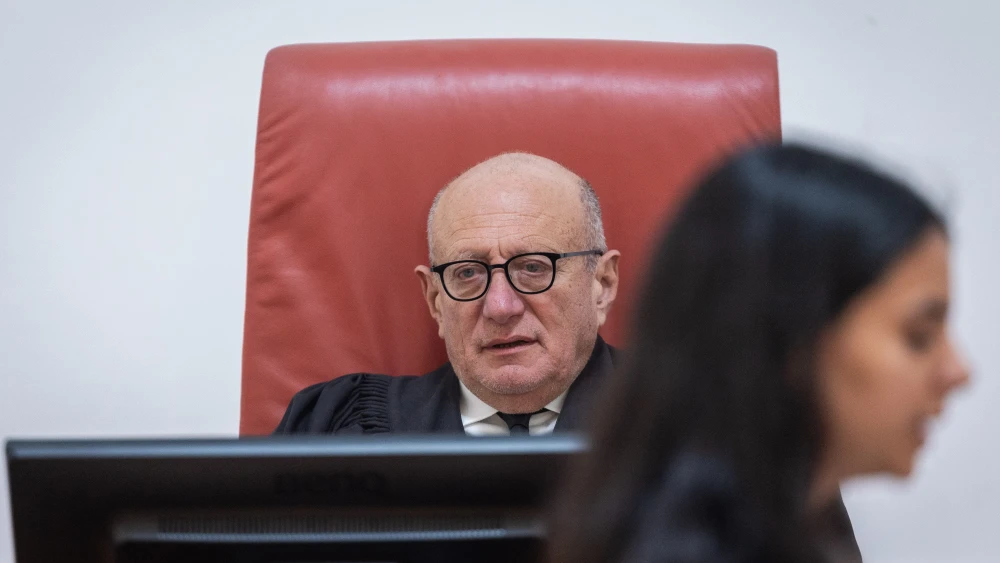
Israel’s Supreme Court, sitting as the High Court of Justice, issued a temporary injunction this week against the convening of the government regulatory body responsible for commercial TV and radio in response to petitions brought against recent changes to the council’s makeup.
In explaining its May 4 action, Supreme Court Justice Alex Stein sided with petitioners, largely left-wing groups, against the government’s March 24 appointment of Yifat Ben-Hay Segev as director of the Second Authority for Television and Radio.
The Second Authority for Television and Radio is led by a 15-member council entrusted with protecting the public interest and encouraging competition.
Although Ben-Hay Segev is qualified for the position, having formerly served as CEO of the Israeli Council for Cable and Satellite TV, petitioners claimed her appointment was illegitimate, designed to serve the interests of Israeli Prime Minister Benjamin Netanyahu, and would undermine the Second Authority’s independence and the public’s trust.
One of the petitioners, Channel 12, said that Ben-Hai Segev had displayed “long-standing personal hostility” for years against the channel’s News Company (Hevrat HaHadashot). Ben-Hai Segev had sued Channel 12 and two of its reporters for a half-million shekels in 2024 after they insinuated that she had received a senior position from the government as a reward for testifying on behalf of Netanyahu in his corruption trial.
A second petitioner, the Union of Journalists in Israel, asserted that Ben-Hai Segev’s appointment was an attempt to block the purchase of Channel 13 by a group of high-tech investors led by Wiz Inc. CEO Assaf Rappaport, who is known for his far-left politics.
The Movement for Quality Government in Israel, another NGO, also joined the petitioners. “This petition is concerned with a hasty hijacking carried out by the Israeli government—in time of war—and an unexplained move that could have fateful consequences for the free media in the State of Israel,” according to its petition filed on March 30.
The Israel Democracy Institute also criticized the appointment, claiming it would create “functional chaos” due to a cooling-off period in which Ben-Hay Segev could not deal with broadcast television issues for the first six months of her tenure due to her having served on the advisory board of Channel 13.
‘All kinds of neutral names’
Hanan Amiur, author of the Hebrew-language book Guide to Manipulating Public Opinion: Six Ways the Israeli Media Tells You What to Think, told JNS, “The left in Israel has a system. They establish their own organizations whose goal is to work for the left, but they give them all kinds of neutral names in order to confuse things: the Israel Democracy Institute, the Movement for Quality Government, the Union of Journalists—all sorts of very beautiful and innocent names. But the truth is they’re left-wing organizations.”
Amiur said he couldn’t speak to the petitioners’ motivation, whether it was fear that the Second Authority under its new leadership would interfere with the purchase of Channel 13 or not. “Truth be told, I don’t have a clear idea,” he said.
Attorney General Gali Baharav-Miara also came out against the government and called on the High Court to freeze the appointment of Ben-Hay Segev in a legal opinion she submitted on May 4.
She said that Netanyahu was involved in the appointment, a conflict of interest as Ben-Hay Segev was a witness at this trial. She also asserted that there were other flaws with the appointment process.
Knesset member Simcha Rothman, who chairs the parliament’s Constitution, Law and Justice Committee, said the main issue is not the High Court’s ruling.
“The main event here is the attorney general’s announcement to the government at the last minute that she won’t represent its position but will present something else in its place,” he told JNS. He said she has once more justified the government’s decision to oust her.
On Aug. 4, 2025, the Cabinet voted unanimously to fire Baharav-Miara. She appealed and the Supreme Court overruled the government’s decision on Dec. 14, 2025.
Israel’s governing coalition has been at odds with the attorney general since its formation in 2022. The adversarial relationship sharpened after the government’s attempt to reform the judicial system in 2023, which would have curtailed the attorney general’s powers.
“I like to say that Baharav-Miara is the ‘anti-attorney general.’ She is not apolitical. She has seven automatic supporters in court,” Haran Feinstein, a retired Israeli judge who teaches at Bar-Ilan University’s Department of Criminology, told JNS.