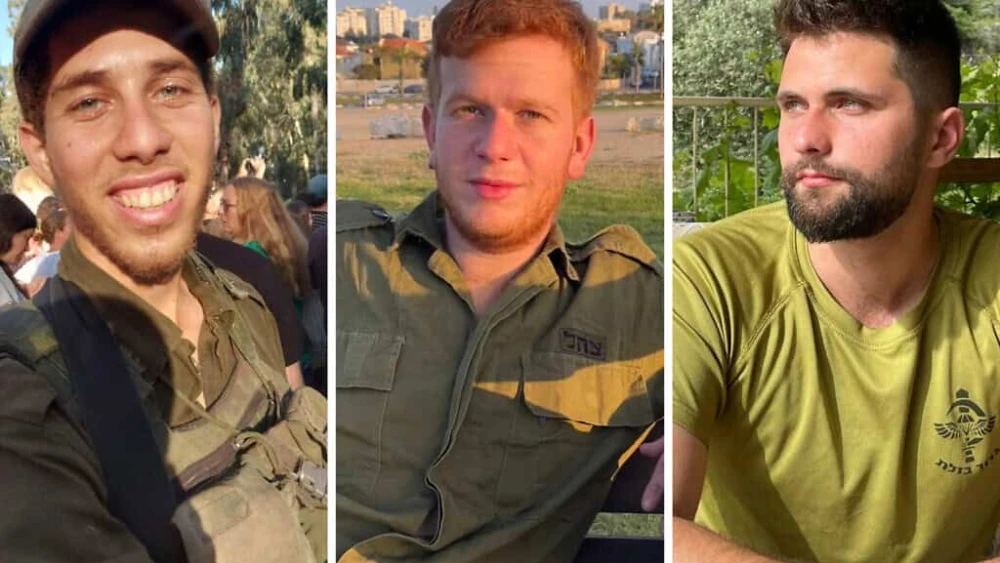
The Israel Defense Forces on Wednesday published the names of three soldiers killed in action in Rafah in the southern Gaza Strip the previous day.
They were named as Staff Sgt. Amir Galilove, 20, from Shimshit, near Nazareth; Staff Sgt. Uri Bar Or, 21, from Midreshet Ben-Gurion, located adjacent to Kibbutz Sde Boker in the Negev; and Staff Sgt. Ido Appel, 21, from Moshav Tzofar in the central Arava.
IDF just announced: 3 soldiers were killed yesterday in booby-trapped building in Rafah.
— Arsen Ostrovsky (@Ostrov_A) May 29, 2024
The troops, all from Nahal Brigade 50th Battalion, have been named as:
🕯️ Staff Sgt. Amir Galilove, 20
🕯️ Staff Sgt. Uri Bar Or, 21
🕯️ Staff Sgt. Ido Appel, 21
May the memories be blessed! pic.twitter.com/tOfQTxyPI8
The soldiers all served in the Nahal Infantry Brigade’s 50th Battalion.
According to an initial investigation, they were killed by a blast in a booby-trapped building. An officer and two other soldiers were seriously wounded in the explosion and another officer was moderately hurt, the army said.
Their deaths bring the IDF death toll to 290 since the start of the Gaza ground incursion on Oct. 27 and to 639 on all fronts since the war began on Oct. 7.
Israel launched a ground offensive in the last Hamas bastion over three weeks ago, which began in eastern Rafah but has since expanded to other areas.
Israeli tanks rolled into the center of Rafah on Tuesday, according to Palestinian reports.
According to the reports, IDF infantry was also advancing in the Tel Sultan neighborhood of northwestern Rafah, with tanks positioned there, marking the first ground operation in that part of the city.
Tel Sultan is where one of the four Hamas battalions in Rafah is located, with the others being in Yabna (south), Shaboura (north) and east Rafah, all areas where the IDF has been active in recent weeks.
The IDF spokesperson said on Tuesday that the Bislamach Brigade (in peacetime the School for Infantry Corps Professions and Squad Commanders) joined the Armored Corps’ 162nd “Steel Formation” Division in fighting in Rafah. Three other brigades are already active in the area, with troops operating along the Philadelphi Corridor, an Israeli codename for a 8.7-mile long border area between Gaza and Egypt. The soldiers are conducting targeted operations against terrorist elements and infrastructure there.
According to the IDF, troops from the Nahal Brigade’s combat team located tunnel shafts, seized weapons and killed many terror operatives in the Rafah area in recent days.
Last week, Nahal Brigade soldiers found a large weapons cache and a lathe for the production of rockets and grenades, as well as explosive vests, a rocket-launch complex, platforms for making rockets and more.
Troops are also active elsewhere in Gaza, according to the IDF, including in Jabalia in the north, where dozens of terror sites were destroyed, including observation posts, weapons depots and a building used by Hamas.
Several terrorists were also killed by IDF troops over the past day in Jabalia, including a mortar-launching cell that was hit by a fighter jet.
In central Gaza, the IDF said that it expanded operations in the Netzarim Corridor, killing terrorists and conducting targeted raids.