


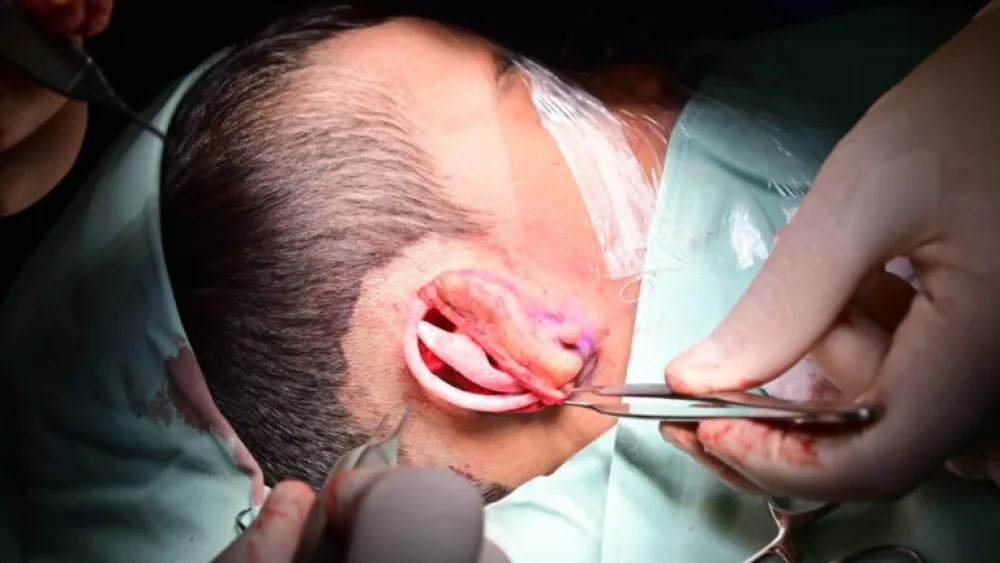
Israeli doctors 3D-printed an ear and attached it to a 6-year-old boy born with microtia, a deformity that stops the development of a baby’s ear in the womb, usually during the first trimester of pregnancy.
Using a 3D printer, staff from the plastic surgery department at Galilee Medical Center in Nahariya created a synthetic prosthesis resembling cartilage and then covered it with skin.
Reconstructing an ear using cartilage and prosthetics is not unusual, but 3D printing that cartilage was a breakthrough.
The entire procedure took three hours, and the boy was released from the hospital several days later. His grateful parents were moved to tears.
Unfortunately, the ear is not functional, because microtia causes blockage of the ear canal, a complication that is not fixable through surgery.
Still, the synthetic prosthesis “reduces pain and complications that could be caused in the area from which the cartilage is extracted,” Dr. Amin Abu-Jabal, who led the surgical team, told Ynet. It offers “maximal accuracy and aesthetic in the highest level.”
While microtia affects babies before they’re born, corrective surgery cannot be performed until a child is 6 years old, at which point the ear reaches about 85 percent of its full size.
Microtia is usually not hereditary and, in most cases, affects only one ear. Approximately one in 6,000 to 8,000 babies are born with the condition and the cause is not known. People with microtia may have only a small ear or no ear at all.
Researchers at the Technion-Israel Institute of Technology and Sheba Medical Center previously developed a way to 3D print the “scaffolding” required for ear reconstruction. This development was not connected to the reconstruction in Nahariya.
This article was first published by Israel21c.



