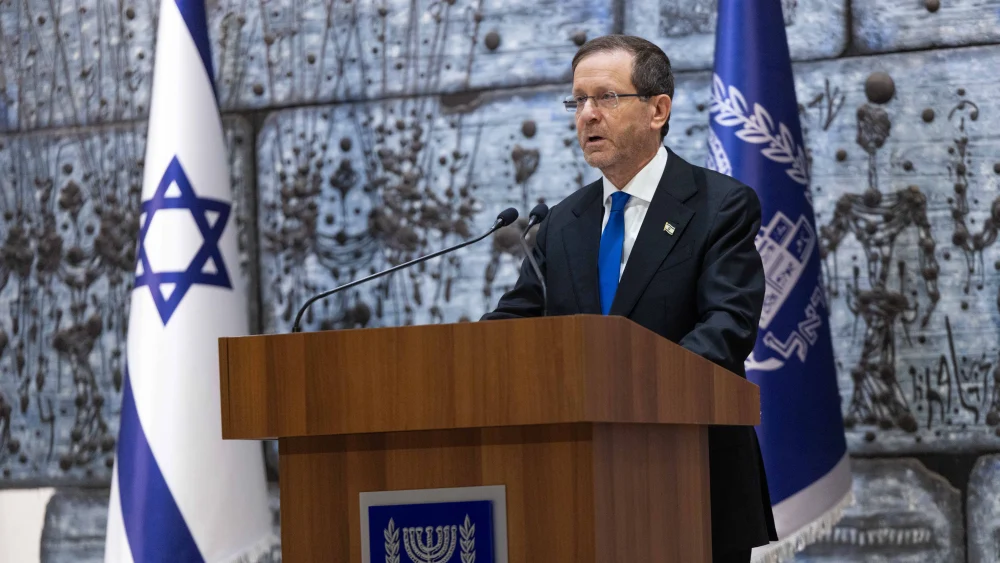
Israeli President Isaac Herzog announced on Saturday night that he will task Yashar leader Gadi Eisenkot with forming the next government.
The ceremony is set for 5 p.m. on Sunday at the President’s Residence in Jerusalem and will be broadcast live, Herzog’s office said.
Factions totaling 67 Knesset members recommended Eisenkot during consultations that ended on Thursday. They included the Arab-majority Joint List and Ra’am (United Arab List) parties.
Factions totaling 46 lawmakers backed Israeli Prime Minister Benjamin Netanyahu. The seven-seat United Torah Judaism party recommended no one.
Herzog met with both Eisenkot and Netanyahu in recent days before making his decision, according to the statement.
Under Basic Law: The Government, Eisenkot will have 28 days to form a coalition. Herzog can extend that by up to 14 days.
Following Herzog’s announcement, Eisenkot posted on X a photo of the two shaking hands at the President’s Residence in Jerusalem. “Now is the time to form a national emergency government,” he tweeted in Hebrew. “I will do everything to ensure we are worthy.”
זו העת להקמת ממשלת חירום לאומית.
— Gadi Eisenkot - גדי איזנקוט (@gadi_eisenkot) November 7, 2026
אעשה הכל כדי שנהיה ראויים 🇮🇱 pic.twitter.com/18Q3eIE6g0
Before the president’s decision, Netanyahu on Saturday issued a recorded message to the press, calling for a unity government.
He warned that a coalition backed by “Islamists” will risk Israel’s survival, apparently referring to the 19 seats won by the Arab parties.
“As early as next week, there are those who intend to hastily swear in a government with supporters of terrorism,” Netanyahu said.
Such a government would “dismantle the State of Israel from within, as is happening in European countries—and much worse,” he said.
The premier said that the Jewish state would experience worse riots than those recently seen in Paris and Brussels, adding, “These are not scare tactics. This is the reality we will face, and that is why we must stop it, because our very existence is at stake.”
He further stated that a national unity government, which includes “all the parties in the national camp and all the Zionist parties,” would permanently remove the nuclear threat from Iran and preserve Israel as a Jewish state, unlike a government dependent on Arab parties that would prevent it from fighting against Hamas and radical Islam.
“And so there is only one choice: not national suicide, but national unity,” he said.
אחדות לאומית 🇮🇱 pic.twitter.com/YuTxqwAdCZ
— Benjamin Netanyahu - בנימין נתניהו (@netanyahu) November 7, 2026
Gadi Eisenkot’s Yashar party later described Netanyahu’s speech as “hysterical.”
“The man who divided, tore apart and sowed discord in Israeli society is heard saying the word ‘unity’ only when he realizes his days in office are numbered,” the party said.
While unity is important, Netanyahu has “systematically” undermined it, the statement continued.
If Netanyahu and his allies distance themselves from the “extremists,” it continued, presumably referring to the Otzma Yehudit and Religious Zionist parties, they are welcome to join a unity government under Eisenkot’s premiership.
Yashar added that it will form a government only with those who accept Eisenkot’s four principles, including the commitment to destroying Hamas’s military and governing power.
‘Not looking to punish the ultra-Orthodox’
The leader of the far-left The Democrats party, Yair Golan, tweeted on Saturday night that “Netanyahu’s government must be replaced.”
In a move to possibly soften opposition to a coalition with the haredi parties, Golan said that “we are not looking to punish the ultra-Orthodox.” He said that he seeks partnership with the ultra-Orthodox community that entails “mutual responsibility.”
He urged drafting haredi men into the military and expanding the integration of the haredi community into the workforce.
“Just as we respect the ultra-Orthodox way of life, we expect our way of life to be respected too. In our communities, it should be possible to go out for a night on the town on Shabbat, have a coffee, and, God forbid, even get there by public transport,” Golan said.
‘No stone unturned’ for a good government
After concluding his consultations on Thursday, Herzog said he had asked the representatives of the factions “difficult questions in an effort to help the parties and the public to break free from set ways of thinking and open their minds to other paths.”
While the results of the recommendations may appear clear, the ability to form a government in the current conditions is “not entirely clear, given the mutual vetoes between the blocs and within the blocs themselves,” he added.
Herzog said he would leave “no stone unturned” in an effort to build a “stable and good government for the people of Israel.”