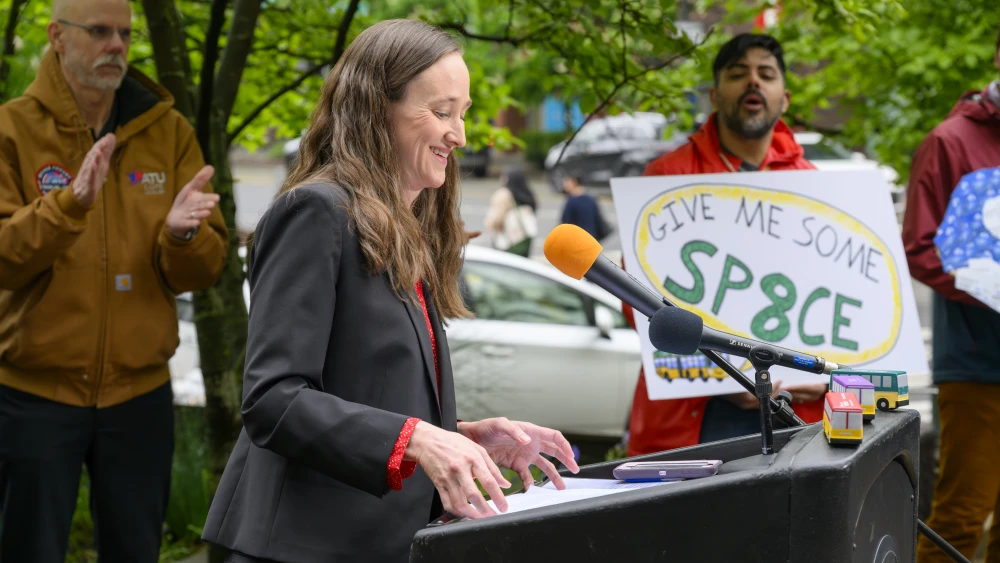
A spokesman for Katie Wilson, Seattle’s socialist mayor, told JNS in August that she would consult with Jewish groups as part of the process of hiring the next police chief of the 18th largest U.S. city. Jonah Spangenthal-Lee, then a spokesman for Wilson, said that “we have discussed scheduling conflicts on Saturdays.”
But Spangenthal-Lee stopped being a City Hall employee in September, according to his LinkedIn page, and Jewish organizations in Seattle told JNS that Wilson’s office did not contact or consult them about the search for the next police chief, even as City Hall spoke with other minority communities.
Wilson’s office told JNS over the summer that it was still building the search committee in response to a question about whether Jews would be part of the panel. (JNS sought comment from City Hall.)
City Hall released a 57-page community engagement report, which is dated Oct. 19, last week. “Seattle’s next police chief must be visible, accountable and present in our neighborhoods, listening to residents, workers and businesses across our city,” Wilson states in the report.
The report says that it draws on “a public survey, small roundtable discussions with community leaders and public listening sessions across south, central and north Seattle,” a total of “1,322 survey respondents and more than 400 participants across roundtables and listening sessions contributed their perspectives.”
Of the roundtables, which were invite-only, listed in the report, two were with “indigenous leaders” and there was one each with “youth,” “immigrant and refugee leaders,” “LGBTQIA+ leaders,” “African American leaders,” “Asian American, Native Hawaiian and Pacific Islander leaders,” “business leaders” and “Latinx leaders.”
The city also held “listening” sessions, which were open to the public, in the north, south and central parts of Seattle and one with “Asian communities” in the South-End. The latter, which occurred on Oct. 16, was close to Seattle’s main Jewish neighborhood, Seward Park. But that meeting took place from 6:00 to 8:00 p.m on a Friday. Shabbat started at 6:00 p.m. that day, according to a local Chabad page listing candle lighting times.
There was also a Sept. 26 “listening” session near the Jewish community, but that took place from 12:00 to 2:00 p.m. on a Saturday. That meeting prompted JNS to ask City Hall if it would hold another meeting for Jews, that wouldn’t coincide with Shabbat, and that is it when the mayoral spokesman told JNS that the city was aware of the conflict for many Jews.
Many Jews don’t use electronics or travel further from home than they can walk on Shabbat.
As of Oct. 20, the city now considers “community engagement” to be “complete,” according to the new 57-page report, which doesn’t include the words “Jew,” “Jewish,” “Judaism” or “antisemitism.”
JNS reported in August that Jews, who make up an estimated 1% of of those who live in the Seattle metro area, were the targets of 9.1% of hate crimes in the city from Jan. 1, 2023 until Jan. 31, 2026 and that in the first seven months of 2026, Jews were the targets of 19.7% of the city’s hate crimes.
Solly Kane, president and CEO of the Seattle Federation, told JNS at the time that “the rise in hate crimes and bias incidents targeting Jews is alarming but not surprising,” and Ariel Novick, Pacific Northwest regional director at the Anti-Defamation League, told JNS that “the disproportionate targeting of Jews in Seattle reflects a national crisis.”
A page on the Seattle Police Department website includes instructions for reporting hate crimes in Amharic, Arabic, Farsi, Korean, Oromo, Somali, Spanish, Tigrinya, Chinese (traditional) and Vietnamese, but not Hebrew or Yiddish.
The Seattle Neighborhood Group, a community safety organization, facilitated four public listening sessions on behalf of the mayor’s office, according to the 57-page City Hall report. (JNS sought comment from Seattle Neighborhood Group.)
A police source with knowledge of the police chief search told JNS that the mayor’s office was responsible for scheduling the listening sessions, not the police department.
A local Jewish organization, that asked not to be named, told JNS that for the Jewish community, “access also means timing.”
“A South Seattle session on Shabbat shuts out the Orthodox families who live there,” a spokesman for the Jewish group told JNS.
The lone mention of hate crimes in the report, despite Jews facing almost a fifth of such crimes so far this year in Seattle, is to Asian communal leaders telling City Hall that there was a “need for experience in addressing hate crimes targeting the Asian community,” the report says.
The Jewish organization told JNS that consulting community stakeholders should continue and include the Jewish community as the search process moves forward.
“Listening sessions are a good first step, but they only gather input on what the community wants in a chief. Where the rubber meets the road is the hiring process itself,” the Jewish organizational spokesman told JNS.
“Targeted and marginalized communities, the people who rely on law enforcement for their safety, should help interview and evaluate the candidates, whether that’s a place on interview panels or a chance to meet and question the finalists,” the spokesman said.
According to the mayor’s office, there are more than 40 qualified applicants, whom an advisory committee is reviewing. Final interviews with the mayor are planned for December. Her nominee will require Seattle City Council confirmation.
Wilson has accused Israel of “genocide” and hosted a book talk, in which she and other speakers accused Christian Zionists and technology leaders of partnering with Israel to bomb the Gaza Strip, so investors could make money selling condos.
The Seattle mayor previously pledged to make sure that the Seattle Police Department does not train with Israeli law enforcement partners.